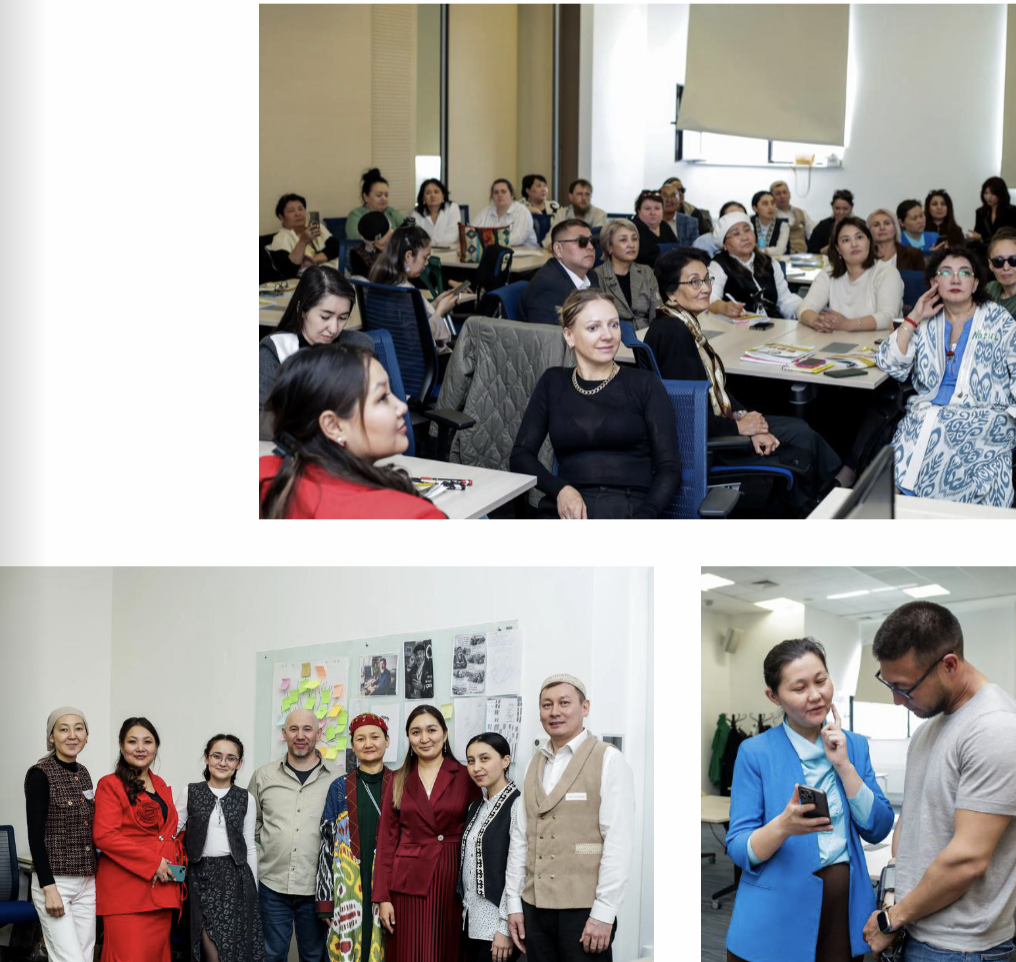
The Tolyq Adam entrepreneurship training programme, developed by the Nazarbayev University Research Centre for Entrepreneurship (NURCE) in partnership with the Association of Business Trainers of Kazakhstan, completed a landmark year in 2025, delivering six cohorts across five major cities and reaching more than 140 trained graduates, including 19 entrepreneurs with disabilities.
The programme, which takes its name from the Kazakh concept of the "complete human being" drawn from the philosophy of Abai Qunanbaiuly, represents a significant departure from conventional entrepreneurship training. Rather than following generic international business frameworks, it is built around Abai's foundational triad of mind (ақыл), heart (жүрек), and will (қайрат) — and uses this structure to help entrepreneurs examine the relationship between their business decisions and their deeper personal values, responsibilities, and sense of identity.
The origins of the programme trace back to an early challenge the NURCE team encountered in its initial training sessions. Participants listened carefully, took notes, and asked questions — but many appeared to search for themselves in the material without quite finding a connection. The concepts were correct, but the context felt distant. When the team redesigned the programme to incorporate Abai's philosophical framework as its organising principle, the effect on participants was immediate and lasting.
By the second day of the four-day intensive, participants began speaking less about growth alone and more about responsibility. Conversations turned to the tension between ambition and conscience, and between profit and integrity. By the third day, discussions became more deliberate. Participants began reflecting on the values that shaped their decisions as entrepreneurs — values they had long held, but rarely named.
Months after completing the training, participants from across different regions continued to send messages. One participant from Semey wrote: "I thought Abai was only for school textbooks. I did not realise he was speaking to my business decisions." A participant from Astana reflected: "The training offered a fresh perspective on my business. I saw how values, mindset, and responsibility directly shape sustainability and growth. The link between ESG and Abai's philosophy was especially powerful — it felt both personal and profound." Another wrote simply: "For the first time, I connected profit with conscience. I had never placed them in the same sentence."
Aigerim Tarbagatayeva, Head of the Association of Business Trainers of Kazakhstan and a Tolyq Adam trainer, described the programme's philosophy in these terms: "We demonstrate that sustainability is not a constraint, but a driver of growth. When business is grounded in integrity and care, it earns not only profit, but trust."
In 2025, cohorts were delivered in Almaty, Astana, Aktobe, Semey, and Karaganda. The programme brought together entrepreneurs from diverse regions and backgrounds, including participants from rural communities and urban centres, and gave particular attention to creating an inclusive environment for entrepreneurs with disabilities.
In 2026, the programme will expand significantly, with cohorts planned across additional cities and regions. The current schedule is as follows:
Participants are encouraged to follow NURCE's social media channels for updates, as some dates may be subject to change. The programme is delivered as part of two active research grants: "Equitable and Sustainable Horizons: Advancing ESG Training and Implementation in Kazakhstan through Abai's Philosophical Insights" (Grant No. 111024CRP2001, 2025–2027) and "Empowering Abilities: Integrating Abai's Holistic Human Philosophy in Entrepreneurial Training for Disabled Entrepreneurs in Kazakhstan" (Grant No. 040225FD4720, 2025–2027).
The programme, which takes its name from the Kazakh concept of the "complete human being" drawn from the philosophy of Abai Qunanbaiuly, represents a significant departure from conventional entrepreneurship training. Rather than following generic international business frameworks, it is built around Abai's foundational triad of mind (ақыл), heart (жүрек), and will (қайрат) — and uses this structure to help entrepreneurs examine the relationship between their business decisions and their deeper personal values, responsibilities, and sense of identity.
The origins of the programme trace back to an early challenge the NURCE team encountered in its initial training sessions. Participants listened carefully, took notes, and asked questions — but many appeared to search for themselves in the material without quite finding a connection. The concepts were correct, but the context felt distant. When the team redesigned the programme to incorporate Abai's philosophical framework as its organising principle, the effect on participants was immediate and lasting.
By the second day of the four-day intensive, participants began speaking less about growth alone and more about responsibility. Conversations turned to the tension between ambition and conscience, and between profit and integrity. By the third day, discussions became more deliberate. Participants began reflecting on the values that shaped their decisions as entrepreneurs — values they had long held, but rarely named.
Months after completing the training, participants from across different regions continued to send messages. One participant from Semey wrote: "I thought Abai was only for school textbooks. I did not realise he was speaking to my business decisions." A participant from Astana reflected: "The training offered a fresh perspective on my business. I saw how values, mindset, and responsibility directly shape sustainability and growth. The link between ESG and Abai's philosophy was especially powerful — it felt both personal and profound." Another wrote simply: "For the first time, I connected profit with conscience. I had never placed them in the same sentence."
Aigerim Tarbagatayeva, Head of the Association of Business Trainers of Kazakhstan and a Tolyq Adam trainer, described the programme's philosophy in these terms: "We demonstrate that sustainability is not a constraint, but a driver of growth. When business is grounded in integrity and care, it earns not only profit, but trust."
In 2025, cohorts were delivered in Almaty, Astana, Aktobe, Semey, and Karaganda. The programme brought together entrepreneurs from diverse regions and backgrounds, including participants from rural communities and urban centres, and gave particular attention to creating an inclusive environment for entrepreneurs with disabilities.
In 2026, the programme will expand significantly, with cohorts planned across additional cities and regions. The current schedule is as follows:
- 25–28 March — Astana
- 1–4 May — Shymkent / Turkestan
- 21–25 June — Qaton Qaragai
- 3–6 July — Retreat at Kolsai
- 9–12 July — Almaty
- 3–7 August — Astana
- 13–16 August — Qostanai / Aktau
Participants are encouraged to follow NURCE's social media channels for updates, as some dates may be subject to change. The programme is delivered as part of two active research grants: "Equitable and Sustainable Horizons: Advancing ESG Training and Implementation in Kazakhstan through Abai's Philosophical Insights" (Grant No. 111024CRP2001, 2025–2027) and "Empowering Abilities: Integrating Abai's Holistic Human Philosophy in Entrepreneurial Training for Disabled Entrepreneurs in Kazakhstan" (Grant No. 040225FD4720, 2025–2027).