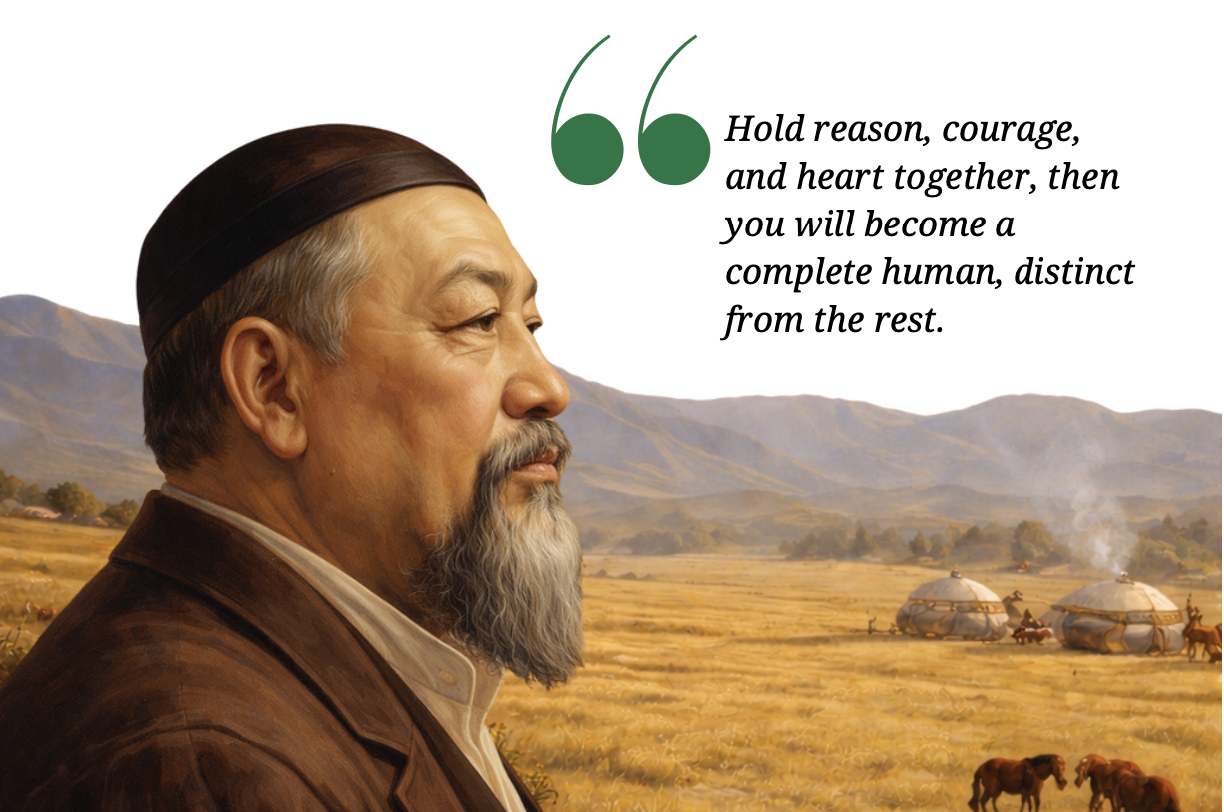
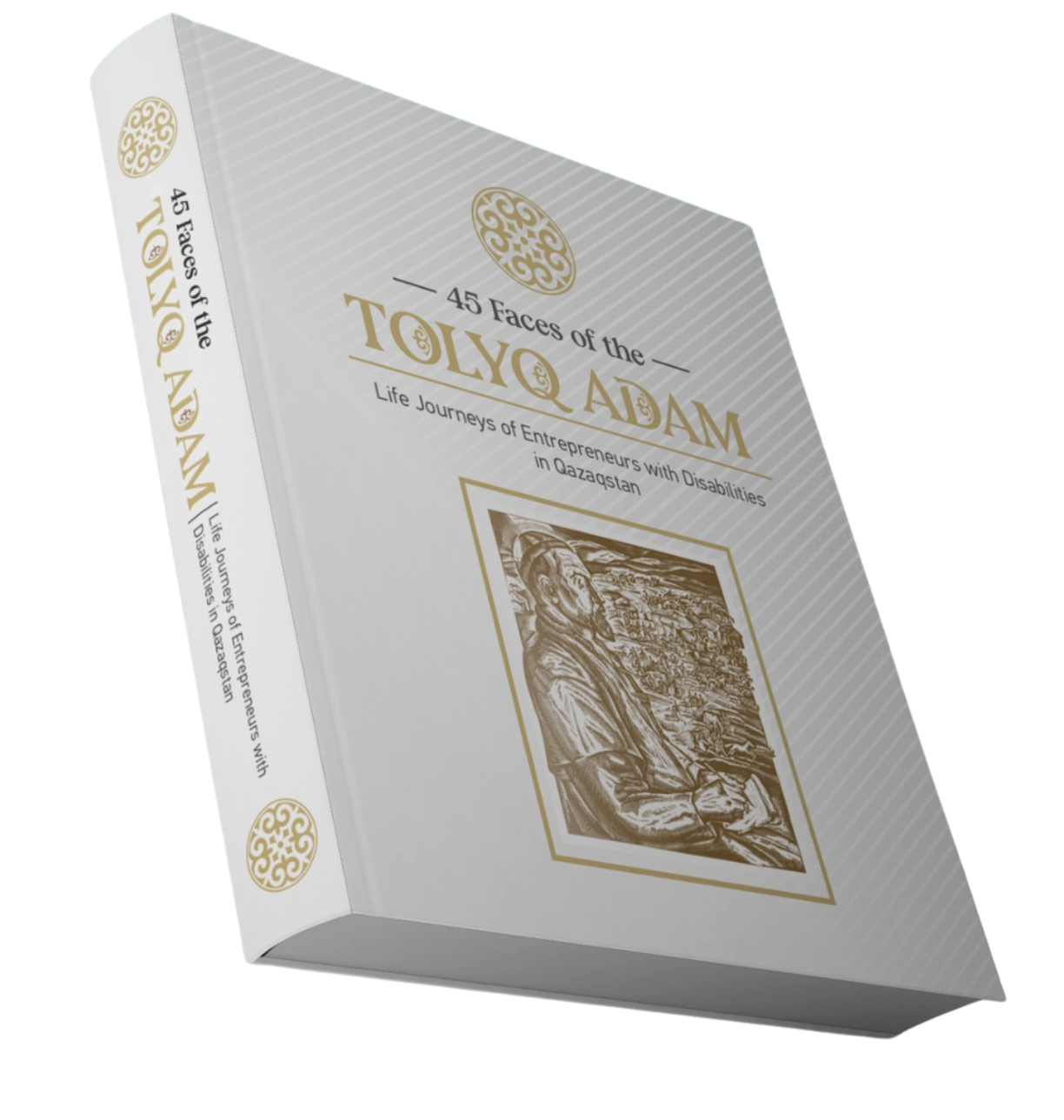
The NURCE is preparing an upcoming book titled 45 Faces of the Tolyq Adam: Life Journeys of Entrepreneurs with Disabilities in Qazaqstan. The project, currently in progress, documents the experiences of entrepreneurs with disabilities and will be released in 2025.
The project began with a simple but unsettling question: where are people with disabilities in public life? Despite global estimates suggesting that up to 16% of any population lives with a disability, visibility in Qazaqstan remains strikingly low — shaped by inaccessible environments, limited data, and inherited social silence.
Rather than framing disability through deficit or pity, the book draws on Abai’s concept of the Tolyq Adam — the complete human being. Abai’s philosophy places wholeness in ethical life, thought, and responsibility, not in physical ability. This insight became the book’s anchor: each life story is paired with a Word not to label, but to illuminate.
The entrepreneurs featured come from across the country — urban and rural, established and emerging. Some had to build their own ramps. Others fought for basic access. None described themselves as victims. They spoke as builders of businesses, families, and futures.
The book also forms a visual archive, with portraits accompanying each story and a central image of Abai painted by the late artist Taymas Teleushev. Together, these voices and images create not just a publication, but a national record — one that insists on visibility, dignity, and belonging.
The project began with a simple but unsettling question: where are people with disabilities in public life? Despite global estimates suggesting that up to 16% of any population lives with a disability, visibility in Qazaqstan remains strikingly low — shaped by inaccessible environments, limited data, and inherited social silence.
Rather than framing disability through deficit or pity, the book draws on Abai’s concept of the Tolyq Adam — the complete human being. Abai’s philosophy places wholeness in ethical life, thought, and responsibility, not in physical ability. This insight became the book’s anchor: each life story is paired with a Word not to label, but to illuminate.
The entrepreneurs featured come from across the country — urban and rural, established and emerging. Some had to build their own ramps. Others fought for basic access. None described themselves as victims. They spoke as builders of businesses, families, and futures.
The book also forms a visual archive, with portraits accompanying each story and a central image of Abai painted by the late artist Taymas Teleushev. Together, these voices and images create not just a publication, but a national record — one that insists on visibility, dignity, and belonging.
Narrative 7: Abai’s Word Seven — On the life of the mind and the awakening of the soul
“Without seeking to understand the world, one can never be what one should be — a human being.”
When Lyudmila Luchnikova lost her sight, she feared her world had ended.
“I had put a cross on myself,” she said. But what began as darkness became the start of a different kind of vision — one not of the eyes, but of the soul.
“I had to adapt and find a way to work for myself.”
With fierce determination, she built a business from scratch, expanded it with intuition, and channeled her pain into leadership — heading a volunteer organization with over 35 members. When betrayal struck and her team fractured, she refused to be broken.
“Life throws something new at me, something that pushes me forward.”
She turned to philosophy and numerology to deepen her self-understanding, sharpening her insight rather than growing bitter.
“We learned,” she said, “not to give such people access to important information anymore.”
Yet through it all, she never hardened.
“Sometimes I want to step away… but I get bored. I love having purpose.”
Her story is a living echo of Abai’s wisdom — that the soul must be nurtured through learning, labor, and moral clarity.
“Don’t waste time waiting,” she tells her younger self.
“Just go for it.”
Lyudmila’s journey is not one of overcoming disability, but of cultivating the light within. She reminds us that the awakened soul sees farther than sight ever could.
“Without seeking to understand the world, one can never be what one should be — a human being.”
When Lyudmila Luchnikova lost her sight, she feared her world had ended.
“I had put a cross on myself,” she said. But what began as darkness became the start of a different kind of vision — one not of the eyes, but of the soul.
“I had to adapt and find a way to work for myself.”
With fierce determination, she built a business from scratch, expanded it with intuition, and channeled her pain into leadership — heading a volunteer organization with over 35 members. When betrayal struck and her team fractured, she refused to be broken.
“Life throws something new at me, something that pushes me forward.”
She turned to philosophy and numerology to deepen her self-understanding, sharpening her insight rather than growing bitter.
“We learned,” she said, “not to give such people access to important information anymore.”
Yet through it all, she never hardened.
“Sometimes I want to step away… but I get bored. I love having purpose.”
Her story is a living echo of Abai’s wisdom — that the soul must be nurtured through learning, labor, and moral clarity.
“Don’t waste time waiting,” she tells her younger self.
“Just go for it.”
Lyudmila’s journey is not one of overcoming disability, but of cultivating the light within. She reminds us that the awakened soul sees farther than sight ever could.
Artistic tribute: The linocuts of Taymas Teleushev
It started with an image. A linocut of Abai, shared casually in a group chat. Stark, textured, and attentive, it immediately slowed the conversation. The portrait didn’t just represent Abai — it seemed to listen to him. There was restraint in the lines, and a depth that invited looking twice.
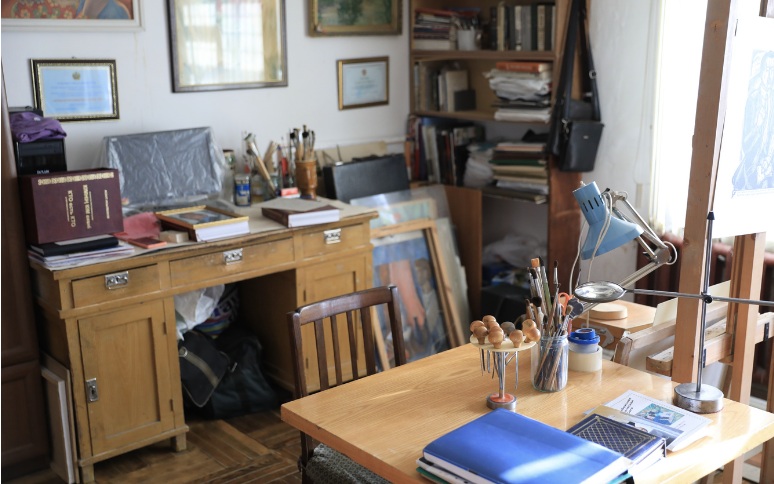
His life extended far beyond the studio. Taymas taught art to deaf children, coached chess teams, wrote poetry, and built spaces where expression did not depend on speech. His work was quiet, but it was never passive.
At the time, all we knew was a name: Taymas Teleushev. An artist whose work had found its way into the Abai Museum. Drawn by the quiet force of the image, we began searching for him, hoping to invite his work into our book project on Abai and the lives of entrepreneurs with disabilities.
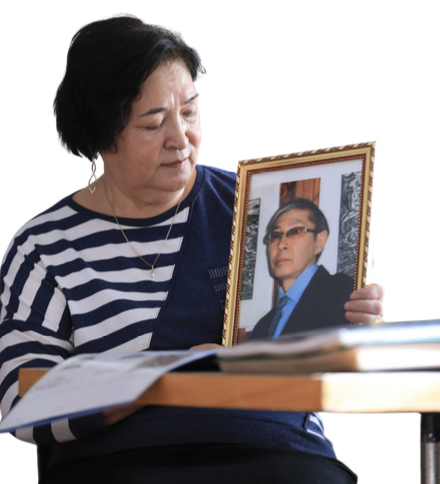
The search led somewhere else. Taymas had passed away only months earlier. What we thought would be a collaboration became something different — a responsibility to understand, and to honour.
Taymas was born near the Aral Sea and lost his hearing as a child. What he lost in sound, he translated into line. His linocuts — among the earliest and most distinctive in Kazakhstan — are precise, deliberate, and deeply attentive. Abai’s words appear again and again in his work, not as illustration, but as conversation. The philosophy is there in the pauses, the tension, the discipline of each cut.
With the support of his wife, Zinaida, we are now digitizing Taymas’s Abai-inspired linocuts. They will appear throughout the forthcoming book, framing the stories of entrepreneurs who, like him, move through the world with their own rhythms, resilience, and resolve.
Including his work is not about decoration. It is about continuity.
It started with an image. A linocut of Abai, shared casually in a group chat. Stark, textured, and attentive, it immediately slowed the conversation. The portrait didn’t just represent Abai — it seemed to listen to him. There was restraint in the lines, and a depth that invited looking twice.
His life extended far beyond the studio. Taymas taught art to deaf children, coached chess teams, wrote poetry, and built spaces where expression did not depend on speech. His work was quiet, but it was never passive.
At the time, all we knew was a name: Taymas Teleushev. An artist whose work had found its way into the Abai Museum. Drawn by the quiet force of the image, we began searching for him, hoping to invite his work into our book project on Abai and the lives of entrepreneurs with disabilities.
The search led somewhere else. Taymas had passed away only months earlier. What we thought would be a collaboration became something different — a responsibility to understand, and to honour.
Taymas was born near the Aral Sea and lost his hearing as a child. What he lost in sound, he translated into line. His linocuts — among the earliest and most distinctive in Kazakhstan — are precise, deliberate, and deeply attentive. Abai’s words appear again and again in his work, not as illustration, but as conversation. The philosophy is there in the pauses, the tension, the discipline of each cut.
With the support of his wife, Zinaida, we are now digitizing Taymas’s Abai-inspired linocuts. They will appear throughout the forthcoming book, framing the stories of entrepreneurs who, like him, move through the world with their own rhythms, resilience, and resolve.
Including his work is not about decoration. It is about continuity.
Cultivating entrepreneurial integrity: Tolyq Adam trainings expand across Kazakhstan
As 2025 draws to a close, the Tolyq Adam entrepreneurship trainings developed at Nazarbayev University have expanded across Kazakhstan, reaching new regions and growing communities of entrepreneurs. Designed as a homegrown alternative to imported business models, the program positions entrepreneurship as an ethical and social practice rooted in the philosophy of Abai Qunanbaiuly.
During the year, the fifth and sixth cohorts were delivered in Astana and Karaganda, bringing together entrepreneurs from micro, small, and medium-sized enterprises, including participants from socially vulnerable groups. Over 3.5 days of immersive training, participants engaged in a structured learning journey that combines Abai’s Words of Edification with contemporary entrepreneurial challenges. This design reflects the program’s core assumption: that entrepreneurial capacity is shaped not only by skills, but by values, reflection, and responsibility.
Rather than focusing narrowly on growth strategies or technical tools, Tolyq Adam begins with a different concern — the moral orientation of the entrepreneur. Drawing on Abai’s concept of the Tolyq Adam, the holistic and ethically grounded human being, the training invites participants to examine purpose, integrity, and the broader consequences of business decisions. This reframing matters in contexts where entrepreneurship is often driven by necessity and structural constraint.
Abai’s philosophical ideas are translated into practice through facilitated discussions, business simulations, reflective exercises, and group work. Participants explore how principles such as justice, patience, dignity, and care operate within everyday entrepreneurial dilemmas. ESG practices and sustainability are introduced not as abstract frameworks, but as lived choices embedded in relations with employees, families, communities, and the environment.
Participant feedback consistently points to the depth of reflection enabled by the training. Many describe the experience as transformative — not because it provides ready-made solutions, but because it reshapes how success itself is understood. Several participants noted that the program restored a sense of dignity and agency, particularly for those whose entrepreneurial paths had been shaped by precarity rather than opportunity.
During the year, the fifth and sixth cohorts were delivered in Astana and Karaganda, bringing together entrepreneurs from micro, small, and medium-sized enterprises, including participants from socially vulnerable groups. Over 3.5 days of immersive training, participants engaged in a structured learning journey that combines Abai’s Words of Edification with contemporary entrepreneurial challenges. This design reflects the program’s core assumption: that entrepreneurial capacity is shaped not only by skills, but by values, reflection, and responsibility.
Rather than focusing narrowly on growth strategies or technical tools, Tolyq Adam begins with a different concern — the moral orientation of the entrepreneur. Drawing on Abai’s concept of the Tolyq Adam, the holistic and ethically grounded human being, the training invites participants to examine purpose, integrity, and the broader consequences of business decisions. This reframing matters in contexts where entrepreneurship is often driven by necessity and structural constraint.
Abai’s philosophical ideas are translated into practice through facilitated discussions, business simulations, reflective exercises, and group work. Participants explore how principles such as justice, patience, dignity, and care operate within everyday entrepreneurial dilemmas. ESG practices and sustainability are introduced not as abstract frameworks, but as lived choices embedded in relations with employees, families, communities, and the environment.
Participant feedback consistently points to the depth of reflection enabled by the training. Many describe the experience as transformative — not because it provides ready-made solutions, but because it reshapes how success itself is understood. Several participants noted that the program restored a sense of dignity and agency, particularly for those whose entrepreneurial paths had been shaped by precarity rather than opportunity.