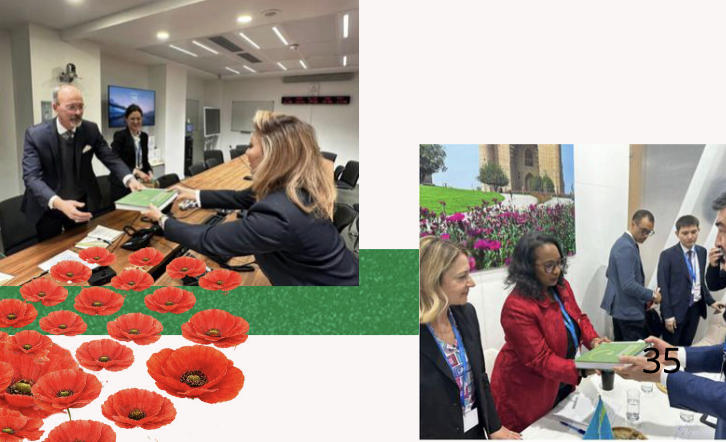
A NURCE publication documenting sustainable entrepreneurship practices in Kazakhstan has reached international policy audiences, travelling from the research field to the highest levels of global climate and economic governance. The book Green Innovators of the Steppe: 51 Narratives of Leading Sustainable Pioneers was presented at the Kazakhstan pavilion at the COP29 climate conference in Baku, and was subsequently shared during policy discussions associated with the Organisation for Economic Co-operation and Development (OECD) in Paris.
The publication was originally conceived as a qualitative research project, documenting how ecological responsibility is embedded in everyday economic activity across Kazakhstan. During fieldwork, NURCE researchers encountered entrepreneurs whose practices reflected principles often described in policy circles as sustainability or the circular economy — but who themselves rarely used such terminology. Instead, they spoke about repairing materials, avoiding waste, and working within the limits of seasonal resources. For them, environmental responsibility was not a strategic positioning tool. It was an inherited practice, passed down through family and community as a way of living in right relationship with land and place.
These observations led to the collection of 51 narratives documenting this embedded ecological ethos. The resulting publication initially functioned as qualitative research, illustrating how environmental values operate within local livelihoods in ways that formal sustainability frameworks often fail to capture.
What happened next was unexpected. After publication, the narratives began to circulate in ways the research team had not anticipated. The book was requested for official use at COP29, where it served not primarily as academic analysis but as a representation of Kazakhstan's environmental identity and cultural relationship with nature. It was then shared at OECD-associated policy discussions in Paris, where policymakers and practitioners engaged directly with the entrepreneurs' stories — without them being mediated through academic interpretation.
This trajectory placed the research in an unfamiliar but significant position. Academic work typically travels horizontally through scholarly channels: articles cite other articles, arguments develop across publications, and knowledge circulates within disciplinary communities. In this instance, the narratives moved vertically — from the lived experience of entrepreneurs in Kazakhstan's steppe regions directly into international climate policy conversations.
The publication did not replace scholarly research. Rather, it created an additional route through which knowledge could travel — allowing the voices and practices of Kazakhstani entrepreneurs to be present in spaces where decisions about global sustainability are made. Dissemination, the NURCE team reflected, had acquired a broader meaning: not only expanding audiences, but allowing research to circulate beyond the academic voice that first documented it.
Green Innovators of the Steppe is available through NURCE and was produced as part of the Centre's broader programme of research into entrepreneurship, sustainability, and community-based economic practice in Central Asia.
The publication was originally conceived as a qualitative research project, documenting how ecological responsibility is embedded in everyday economic activity across Kazakhstan. During fieldwork, NURCE researchers encountered entrepreneurs whose practices reflected principles often described in policy circles as sustainability or the circular economy — but who themselves rarely used such terminology. Instead, they spoke about repairing materials, avoiding waste, and working within the limits of seasonal resources. For them, environmental responsibility was not a strategic positioning tool. It was an inherited practice, passed down through family and community as a way of living in right relationship with land and place.
These observations led to the collection of 51 narratives documenting this embedded ecological ethos. The resulting publication initially functioned as qualitative research, illustrating how environmental values operate within local livelihoods in ways that formal sustainability frameworks often fail to capture.
What happened next was unexpected. After publication, the narratives began to circulate in ways the research team had not anticipated. The book was requested for official use at COP29, where it served not primarily as academic analysis but as a representation of Kazakhstan's environmental identity and cultural relationship with nature. It was then shared at OECD-associated policy discussions in Paris, where policymakers and practitioners engaged directly with the entrepreneurs' stories — without them being mediated through academic interpretation.
This trajectory placed the research in an unfamiliar but significant position. Academic work typically travels horizontally through scholarly channels: articles cite other articles, arguments develop across publications, and knowledge circulates within disciplinary communities. In this instance, the narratives moved vertically — from the lived experience of entrepreneurs in Kazakhstan's steppe regions directly into international climate policy conversations.
The publication did not replace scholarly research. Rather, it created an additional route through which knowledge could travel — allowing the voices and practices of Kazakhstani entrepreneurs to be present in spaces where decisions about global sustainability are made. Dissemination, the NURCE team reflected, had acquired a broader meaning: not only expanding audiences, but allowing research to circulate beyond the academic voice that first documented it.
Green Innovators of the Steppe is available through NURCE and was produced as part of the Centre's broader programme of research into entrepreneurship, sustainability, and community-based economic practice in Central Asia.