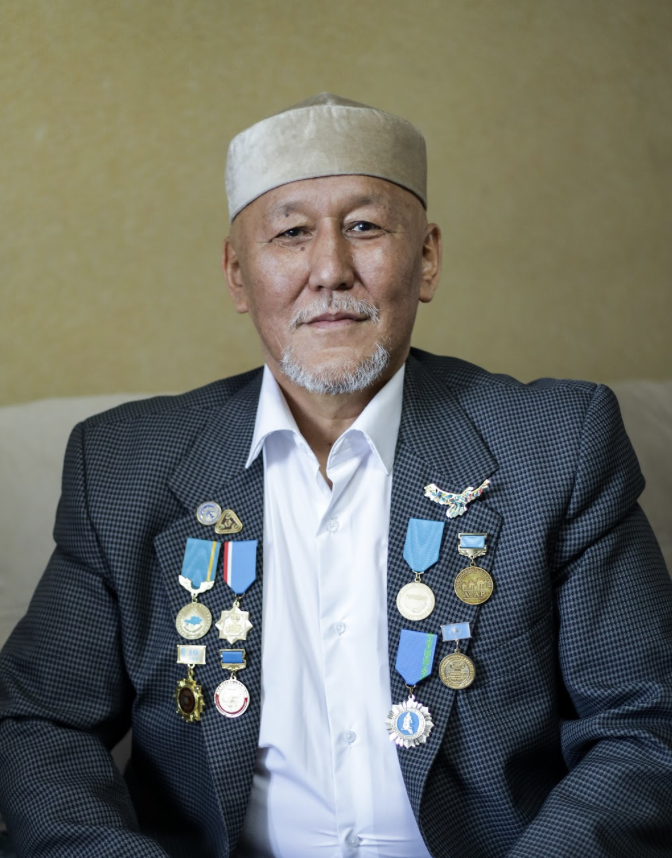
When Abylaikhan Assylbai was a child in the Zaysan district of East Qazaqstan, he grew up with the rhythm of metal and stories carried through generations. His father was a master craftsman; his grandfather on his mother’s side was a jeweler. Craft, beauty, the shaping of raw material into cultural memory, these were woven into the bones of his family. But his father died in the WWII when he was only five years old, leaving a silence in their home and a sense of unfinished apprenticeship in the boy who would one day carry the craft forward. He remembers himself sitting in the first desk at school, calm, quiet, observant. Books of the greatest Qazaq philosophers and writers became his early companions. He studied agronomy at a technical college in Talgar, hoping perhaps that working with the earth could bring something steady to his life. He worked in gardening for a time, but his hands always reached for creation. Even before disability entered his life, he would braid qamshy and build wooden sandyq with patience and pride. “Since childhood I was drawn to art, although no one taught me this, it was in my blood. I was following the call of my Father” he says. In the mid of 80s Abylaikhan could not but join Qazaq youth in Zheltoksan riots against Moscow’s decision on a new ruler of Qazaqstan. Youth was oppressed heavily by the Soviet regime but they didn’t give up.
Then came 1997. He climbed high for a day’s work, up a crane, and fell. A fracture tore through his thoracic spine, severing sensation below the waist. He lay in bed for three long years. Days stretched into nights without movement, without certainty, without the guarantee of standing again. The world narrowed to the dimensions of a hospital room. His athletic body was now a cage. “I was bedridden,” he recalls. “Since then, 28 years have passed.” What kept him alive was not just medicine, it was imagination. One day, while lying there fighting loneliness and fear, he saw a master craftsman on television: Darkembai Shokparuly, a legendary figure in traditional Qazaq armor, handcraft and artistry. Something inside Abylaikhan stirred. A seed. A promise. A reminder of the hands he inherited from ancestors who had shaped beauty for the nation. Three years later, when he was finally able to move a little, he traveled to Almaty, a difficult journey with a broken body but an unbroken spirit, and became Darkembai’s student. “I lived with him and learned from his experience,” he says. For six years they worked side by side. In that workshop, he re-learned life. He re-learned his place in the world. He re-learned that creation was not just craft: it was dignity. He learnt that it was a commitment of every craftsman to develop Qazaq craftsmanship and art and teach at least 10 more apprentices. Only then the Qazaq art would strive. He walked then with a cane, knowing that each step cost him more than others could see. A wheelchair felt “inconvenient,” he says politely, but really, it symbolized the boundaries he refused to accept. He chose movement, even if it was painful, because choosing movement meant choosing life.
Eventually, he went to Semey, Abai’s homeland, where he has lived since 1996. He built a small private workshop, only large enough for one body to move slowly between tools. In winter, the living room becomes his workspace. On the walls and tables: bes qaru shields, shokpar clubs, axes, chain mail glinting like the armor of ancestors rising into the future. He specializes in kireuke sauyt, chain mail armor. Each requires 35,000 tiny steel rings, woven one into another like the interlocking resilience of a nation. Patience, precision, devotion, that is the currency of his days. “Other masters say, ‘No, there will not be enough patience.’” But he has enough for a lifetime. His teacher once told him: “If you want to have fewer rivals in art … choose the most difficult path.” So he did. And he continues. Now 62, he works from nine in the morning until ten at night. He performs namaz throughout the day. He exercises from a chair because he cannot feel his legs, squats, stretches, gymnastics for the body that refuses to quit. “I just want to work,” he says. “I don’t need rest.” He keeps a cane beside him like a loyal companion. Behind it, three heart attacks survived with sheer will. “Death comes suddenly,” he reflects, “so I want to leave a mark, a legacy.” That word, legacy, is what drives him. He dreams that his children will inherit not only his blood, but his craft and his pride.
His achievements are many: Grand Prix awards from Samgau, Zhanshuak, Souvenir of the East. The gold award from Keruen of Kindness, where they honored his generosity, gifting armor to his teacher and even to his hometown museum. In 2017, he was invited to Astana to meet the President. Appreciating his talent, virtue and contribution to the development of the Qazaq craftsmanship the local community elected him as a Chair of Alqa Biiler (a council of sages).
“I received many letters of appreciation,” he says with a small shrug, “but most often it’s limited to paper praise … there’s never any financial support.”
This is the reality he lives in, a system where acknowledgement comes cheaply, but accessibility and inclusion cost more than authorities are willing to pay. He once received a space from the akimat for a workshop, but it was far away and unreachable by his cane. He received a grant from Damu, 500,000 tenge,and bought large tools that now gather dust because his workspace cannot fit them. “For about ten years now, they’ve just been standing there unused,” he says, quietly exposing a policy failure without bitterness. He won 1 million tenge recently for being the only person in Qazaqstan to have woven the greatest number of chain mails. Yet still, there is no adequate workshop where students can sit beside him and learn. He asks, leaders nod, leaders change, and nothing happens. His workshop waits. His tools wait. His dream waits. And still, he creates. He has faced humiliation too, especially in early days.
“Even some relatives, when they drink, can say something hurtful like, ‘You’re disabled.’” He does not flinch telling it. Then he smiles slightly: “Let them call me disabled as much as they want … I don’t consider myself spiritually incomplete.”
Abai would call this jurek (heart), a heart that refuses to shrink. His spirituality deepened after the accident. He constantly read Abai during those years of bedridden stillness. He quotes Abai easily:
“Love all people as your brothers.” “Enbek bärin zhenbek” — Labor conquers all.
He doesn’t stop reading Qara Sozder (Abai’s Book of Words), Auezov, Muqagali, Alikhan Bokeikhan, Magzhan Zhumabayev, Shakarim. “Abai’s path is the path to perfection,” he says. “There are no incorrigible people.” He continues, “My master cited to me Al Farabi that knowledge without upbringing could become evil. A man has to have 70 virtues in order to find their place in society. This requires studying and learning constantly and hard”. Abylikhan stresses that thanks to his parents upbringing he became what he is today - resilient, honest, industrious and talented. His legacy was woven into armours of warriors once donated and now displayed in various museums including in Zaisan, his fatherland. He carries Abai’s philosophy not as literature, but as a compass. He disciplines his morning, trains his will, refuses selfpity. He believes in aqyl (mind), thinking critically, learning constantly. He believes in qairat (will), the force that lifts a man back into life. He believes in jurek (heart), choosing honor even when society looks down. When he fell, his sister Karima stood beside him like a guardian sent from God. She turned her garage into a workshop and continues supporting him. His wife, too, stood through every frightening night. She worked as a massage therapist and prayed with him for hope, and their daughter was born. “A good deed is the fruit of your purity,” he says. Family held him together until he learned to hold himself.
He has no pension savings, a consequence of bureaucracy forgetting his existence at the exact moment he needed protection. The enterprise never recorded his accident properly; therefore, he cannot access certain medicines or rehabilitation centers even now. “They say there is attention to art,” he adds softly, “but the allocated funds often do not reach the masters.” Still, he keeps dreaming. “I want to sew armor for films,” he says with a spark in his voice. “And for my children, so they can earn and continue my work.” He wants to train ten students as his teacher once demanded of him. He wants his art to continue in hands that have not yet learned patience or pride. He wants to teach to craft with high spirits, as pieces of any craftsman would continue to live for decades after leaving the workshop. Sometimes he visits a school for children with disabilities. He sees fear in them, fear that society will not accept them. So he speaks truth into their insecurity:
“With your talent, you can reach the greatest heights.”
He says it with conviction, because he lived it. He refuses regret. “Everyone should do what they do best,” he says. He once refused even a two-room apartment offered in exchange for opening a shop, he did not want wealth he didn’t earn by his own labor. His craft is his integrity, thread by thread, ring by ring
“I prove myself through action,” he says. “Let it be that on paper I’m disabled, but morally and spiritually I am a strong person.”
His aqyl (mind) continues learning. His zhurek (heart) continues believing. His qairat (will) continues working. Every ring of chain mail he connects is an act of rewriting the narrative Qazaqstan once imposed on disability. Every weapon he crafts tells the narrative of a people who endure. Every hour he spends shaping metal is a testament to the truth he lives: A person does not break unless they choose to. Following the words of Magzhan Zhumabayev “Men zhastarga senemin” (I believe in youth) he sees great importance in mentoring young generations to be more resilient, educated, to love its people and the Qazaq language, promote and speak in the Qazaq language. He dreams to pour his experience and wisdom on pages of a book that would guide young generations of craftsmen. He has climbed back onto life’s heights, not with legs that failed him, but with hands that never did. And now, as he moves forward with breath measured by heart that has stopped three times yet continues beating. He took his challenge and goes on every day He knows that legacy is not counted in money or buildings: It is counted in persistence. It is counted in culture and art kept alive. It is counted in the students who will follow. It is counted in the armor of the spirit he wears daily. Abylaikhan Assylbai has already woven more than chain mail. He has woven himself whole.