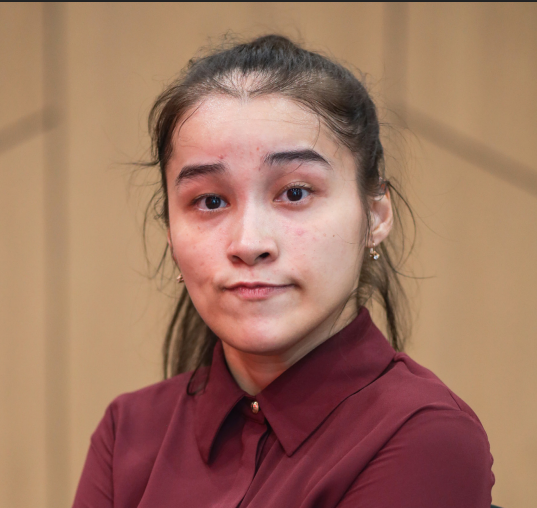
Zhansaya Namaz’s life is a heart-first act of leadership. She does not pursue dominance, power, or the spotlight. Instead, she brings joy, dignity, and visibility to people who are too often ignored. She stands up,kindly but firmly, when shop employees dismiss a person with disabilities, when sponsors refuse, when officials overlook inclusion. Every forum she creates, every psychology game she runs, and every social event she organizes says: “We deserve to be seen, valued, and included.” Her courage is not loud, but unwavering. She keeps going even when transportation barriers trap her at home, even when her parents fear for her, even when the city is not built for bodies like hers.
Abai writes that the one who follows the commands of the heart, mercy, generosity, truth, is the true batyr. Zhansaya’s activism is exactly that. She demonstrates jurek (heart) that is brave enough to reject shame culture (Uyat ) and instead speak openly about rights, dignity, and dreams, not only for herself, but for a whole community.
Her work embodies the kind of humanity Abai urged the Qazaq people to embrace: compassion with courage, love with leadership.
From the outside, Shymkent looks like any other fast-growing Qazaq city: wide avenues, new malls, bright billboards. But for Zhansaya Namaz , the city has always been mapped a little differently. Every outing requires planning. Which ramp actually works? Will the “Invalid” (person with disabilities) Taxi come on time? Will there be someone to walk beside her? and yet, this same city has become the stage where she is slowly reshaping what “special” means.
Zhansaya is 28. She introduces herself simply: she lives in Shymkent, works in social projects, charity, and social entrepreneurship. Behind that modest sentence is a life defined by both constraint and quiet rebellion. From childhood she has lived with a condition that affects her coordination and mobility; she needs an accompanying person to attend most events and often depends on her younger brother or parents to move around the city. “I’m an intelligent person,” she says softly, “I just have a problem with coordination.” That distinction matters deeply to her. It is the line she draws again and again, between the body’s limits and the mind’s and heart’s vastness.
Her parents, like many in their generation, responded to disability with fear and overprotection. When she first spoke about wanting to run projects, they told her, “You won’t manage, why do you need that?” Their fear was love, but it wrapped her in cotton wool. As a girl she heard the phrase that still haunts many young Qazaqs: “Uyat bolady – “It will be shameful.” Shame for speaking too loudly, for wanting too much, for stepping out of line when your body already marks you as different. Those words, she says,
“cut off wings, squeeze the heart and make you afraid to take a step forward.”
Yet even as a teenager, she felt another voice inside her, quieter but firmer. She sensed that Allah had not created her just to sit at home and accept other people’s fears as destiny.
“Each of us has a mission in this world … If a dream burns in my heart, it means I am destined to make it come true.”
That conviction, half faith and half stubbornness, was the beginning of her entrepreneurial path. After finishing school, she studied accounting by correspondence. It was a practical choice, a profession her family could accept. But the work that really drew her in was not in ledgers and numbers; it was in people. She opened a small social media account on Instagram where parents of special children began to message her, asking about their children’s future. What would happen to them when their parents grew old? How would they study, work, love, live? Their questions echoed her own unspoken fears, and something in her shifted. At first she simply imagined holding a single event for these children, a day of joy where they could forget hospitals and diagnoses. But the response was overwhelming. “Everyone started asking us to continue,” she recalls, “not just for children, but for everyone.”
That was the seed of her first social project.
At twenty-seven, together with a classmate, also a person with first-group disability who walks with crutches, she launched a forum for parents of special children. They invited well-known speakers and producers like Bakhytzhan Pozilov and Edil Akhmetov, people with real authority and charisma. The goal was simple but radical: to show that children with disabilities and their families deserved the same access to knowledge, inspiration, and high-profile events as anyone else.
“We wanted people like us to go to concerts of famous artists and coaches…For people with disabilities, this is a great pleasure.”
The forum was a success. There were many orphans among the participants, many anxious parents, and many tears. The energy in the room convinced her and her co-founder that this could not remain a one-off event. They decided to continue, gradually shifting their attention not only to children but also to adults with disabilities, teenagers, young people, parents, siblings.
Her biggest project so far was a summer social forum. About a hundred people came, including participants from other cities. The program brought together highly qualified professionals, authors, coaches, experts, who shared practical life hacks and knowledge. Gifts and books were distributed. “So that disabled people could develop and keep up with society,” she explains. What gave her the greatest joy was not the number of people or the famous names, but the look in the eyes of parents and children:
“The joy in the eyes of special people, especially parents… It’s a very great joy. I don’t get tired; on the contrary, I draw energy from my work.”
That joy, that exchange of energy, is where Abai’s Tolyq Adam quietly appears in her life. Her aqyl (mind) is always learning, she attends forums, psychological trainings, AI camps, basic psychology courses. Her jurek (heart) is wide open to the pain and hopes of special families. And her qairat (will) shows in the way she keeps moving forward despite refusals, logistical nightmares, and the constant need for accompaniment. The harmony is not perfect, she still struggles, still doubts, but the three are slowly learning to walk together.
The systemic barriers she faces are many and familiar. In Shymkent, InvaTaxi 9services are “very underdeveloped,” with too few cars and long waiting times.
“To go into the city, you have to submit a request about two weeks in advance, even just for a walk.”
Ramps and elevators are often missing or unusable. Public spaces are not built with wheelchairs or crutches in mind. Then there is the attitude: the way shop assistants ignore a girl with a disability who asks the price of something, as if she cannot possibly be a real customer. “It really irritates me,” Zhansaya admits. She tries to intervene gently but firmly:
“I explain to the staff that this is a special person, not mentally retarded, he understands everything … and we try to change their worldview so that they don’t do this again.”
On top of physical and social barriers come the structural ones around funding. Sponsors often refuse to take her seriously. To organize a new course or forum, she has to write to entrepreneurs again and again, explaining, persuading, proving that people with disabilities are worth investing in. The most painful moments are when someone who had previously agreed suddenly backs out.
“It was very painful when one entrepreneur, with whom I had already agreed, refused to help … I didn’t know what to do at that moment.”
But even then, she refused to give up. “Thank God,” she says, “I found a very good person, an acquaintance, who supports me in everything. He helped me organize the New Year for special people.”
From the state, she has received almost no direct support. “To be honest, no government resources have helped us,” she says. Officials tell her to write to private entrepreneurs; her feelings and complaints are not taken seriously. “We are intelligent people, just with the problem of coordination,” she insists. “We understand everything, but so far the government hasn’t provided us with any assistance.” In a postSoviet mindset where disability is still often seen as deficit or charity case rather than as potential, she is pushing for a different logic, one of inclusion, partnership, and respect
Her own family’s journey mirrors this shift. At first her parents opposed her projects, afraid to let their special daughter move independently in the world. But Zhansaya is, in her own words, “a persistent girl.” She persevered, applied for opportunities, and eventually won a grant from an IT fund where she studied for three months. The program took her to a summer camp in Almaty, then to Astana to receive a certificate and letter of thanks from the youth of Shymkent. Those months of study changed her deeply. She learned AI basics, communication skills,
and, more importantly, saw other people, disabled and non-disabled, navigating their own fears and stereotypes. “Seeing other people motivated me more,” she says. As someone passionate about psychology, she absorbed everything and later began using these tools in her own training and games with children, helping them become more open, more confident, more ready to stand in front of society and speak. When stress hits, she leans on a simple but powerful philosophy: “I know that this is a real situation in which there are always choices and decisions. You just need to find that path.” That is pure qairat (will), the will that refuses to sink into victimhood. She advises other people with disabilities who want to start projects:
“Don’t listen to anyone. Listen to your heart, your inner world of voices, just as Allah lives inside each of us. Follow your dreams and goals, no matter what the difficulties.”
Culturally, she holds a complex position. She deeply respects the traditions of all peoples, seeing each culture as “its own universe.” At the same time, she openly challenges the oppressive side of “uyat bolady.” For her, those words have been used to silence dreams, especially for disabled people and girls. “We are not born to be afraid,” she insists. “When someone tells you, ‘You’ll be ashamed!’ it prevents you from fulfilling your destiny.” Her stance is not rebellious for its own sake; it is grounded in faith. “If an idea came to me, it was sent by Allah,” she says. “Don’t be shy about taking steps toward your dreams, especially if Allah himself sends you these ideas.”
Her current projects “Qadam” stretch across several horizons. In the short term, she dreams of opening her own premises where people with disabilities can work as defectologists, speech therapists, and programmers, fields where their intellect and sensitivity can shine. “For special people this is very difficult,” she admits, referring to the financial and logistical barriers, “but I think we will cope with it someday.” In the long term, she wants to help special people acquire real estate. “I know very few people with disabilities who own property,” she says. Many try, but fail. For her, supporting independent living is a core part of true inclusion.
Alongside all this, she is writing a book with a co-author, oncologist and psychotherapist Akram Avdametov, a sought-after public speaking coach in Shymkent. Their meeting, like many turning points in her life, felt to her like a sign. She had been searching for a coach, drawn to him partly because cancer had taken people she loved. During his lessons she learned that public speaking is not magic but a skill, and that her main barrier was not intelligence but coordination and fear. He believed in her, invited her to intensives, and agreed to be co-author when she confessed her dream of writing. The book, tentatively titled “ Status Special,” is autobiographical, blending memoir, essay, and motivational reflection. It tackles inclusion, stereotypes, and society’s treatment of disability. “If at least one person, after reading it, believes in themselves and takes the first step towards their dream,” she says, “then everything was not in vain.” The proceeds, she has already decided, will go to charity.
In everyday life, she continues to learn, to meet new people, to run games and trainings that develop children’s intellectual abilities and help them express themselves. She sees herself not as a savior but as a fellow traveler, someone who knows from inside what it means to be stared at, pitied, underestimated, and who has chosen a different response: to create spaces where special people are seen, heard, and taken seriously.
When asked what success means to her beyond money, her answer is disarming in its simplicity: “Waking up every day is already a success in this life.” It is the answer of someone who has looked closely at fragility, at the possibility of being stuck at home because no one can accompany her, at the weight of “uyat” (shame) and yet has chosen life, movement, and service.
Her motto is clear: “Together we are strong.” In her forums, in her future centre, in the pages of the book she is writing, that line becomes an invitation, to parents, to teenagers, to sponsors, to officials, to other entrepreneurs with disabilities. She is building, slowly and persistently, a Shymkent where people with different bodies and minds do not have to beg for a seat at the table, but sit there as partners, creators, and carriers of their own missions.
In that work of stitching together her aqyl,zhurek, and qairat, of refusing both despair and arrogance, Zhansaya Namaz is quietly becoming what Abai once imagined: a Tolyq Adam, a whole person, whose very existence widens the space of possibility for others.