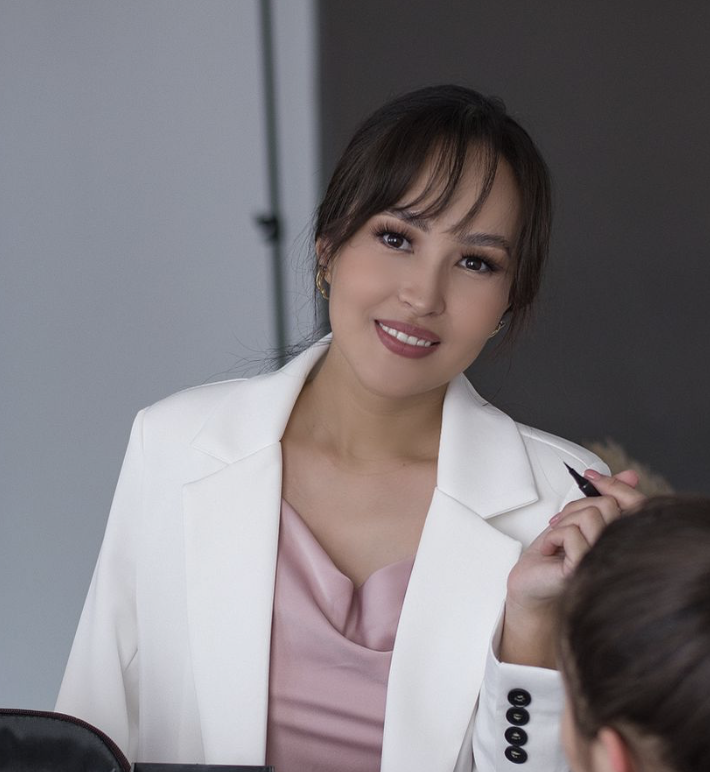
When Abai asks whether a quarrelsome, envious person can truly be called human, Mensulu’s life offers the answer. She does not chase status or dwell on unfairness, even when denied grants. She continues with her own labor, her own qairat (will), and a steadiness shaped by hardship met with dignity. Her quiet resilience shows what it means to be a worthy guest: to pass through the world without harming others and to leave behind a trace of beauty.
Her journey becomes a living interpretation of Word Thirty Four. She reminds us that our time is borrowed, our bodies temporary, and our true legacy the sincerity and tenderness we offer others. In moving from shame to self-acceptance and from insecurity to purpose, she reveals that being a guest is not insignificance — it is an invitation to live gently, with humility and compassion, knowing we all share the same fragile road.
Mensulu Satzhan was born into a world that had already decided what she would not be able to do. From the first moment, her body told a different story: she entered life without her right arm, and for years nobody knew she had only one kidney as well. Her parents, loving but protective, learned to navigate the silences of doctors and the loudness of society. In Aktobe, where she grew up, children stared, adults whispered, and strangers tugged at their own children’s hands, telling them not to play with her. “I used to wear long sleeves even in summer,” she remembers. “I wanted to hide the arm that wouldn’t grow.” At school she had no friends at first. She walked the hallways of fifth grade feeling like an outsider in her own childhood, her body a constant reminder of difference. Her parents told her to study well, and she clung to those words as if they were a rope thrown across a shrinking world. Slowly, her brilliance drew people in. She became a straight-A student, the one classmates sought for help, the one teachers praised. She missed Altyn belgi by a single math point, but she graduated with a red diploma37, her academic excellence a shield she built with her own aqyl when society tried to reduce her worth.
At seventeen, searching for work and repeatedly rejected, she entered a women’s association that opened her eyes to something she had never seen before: people like her not hiding, but leading. “Some had no arm, some no leg, but they were beautiful and working,” she recalls. “I wanted to be like them.” She became an assistant, helping run events for children with disabilities, learning from women who refused to collapse under the weight of society’s expectations. It was the first glimpse of a world in which her body did not need to be apologized for. She chose philology because literature had always been her companion. She loved poetry, reciting it alone on walks, recording videos of herself speaking lines that captured feelings she had no other language for. At the university she excelled again, graduating with honors and taking up a teaching position in a Russianlanguage school, where she taught Qazaq language and literature. Teaching children felt natural; she believed for a long time that it was the only thing she could ever do.
Marriage brought warmth but also revelations, an ultrasound after the wedding revealed she had been born with only one kidney. Doctors warned her against pregnancy. “They advised abortion,” she says quietly. “They were worried because of the one kidney and the one arm.” But she wanted her baby, and her OB/GYN assured her that the kidney was functioning well. She carried the pregnancy bravely, only to face an emergency C-section at 36 weeks.
Breastfeeding with one arm was agonizing. “I’d never faced problems like that,” she recalls. Crying spells flooded into nights; the fatigue of stitches, sleeplessness, and the weight of a newborn she longed to care for herself pushed her into postpartum depression. She questioned her very right to motherhood. “I blamed myself. Why did I give birth if I can’t take care of her?” The arguments with her husband were small, irrational, but heavy with shame and exhaustion. Her spirit dimmed until her husband handed her something unexpected: a certificate for a makeup course. At first, she couldn’t imagine it. “How could I do makeup on people … with one arm?” Lashes terrified her; brows came out uneven. But the salon owner, Malika Rakhimova, sent her a single message that changed everything: “If you have the will, you can find a way.” That line planted itself in her chest like a seed of qaýrat (will). On the first day, she was scared; on the second, her curiosity began to outweigh the fear. By the end of the week-long training, something in her had awakened, a feeling she had forgotten since her poetry days: inspiration.
Her daughter was just three months old when she began. Money was tight. She bought her first basic makeup kit for 35,000 tenge through Kaspi paying in installments. Blush, a pencil, a small eyeshadow palette, that was her beginning. She worked through house calls, carrying everything herself. Some clients hesitated when she arrived. “When a makeup artist with one arm shows up, people automatically feel fear, distrust,” she says. She would smile, explain calmly that she had been doing everything this way for twenty-five years. Slowly, people relaxed. Little by little, she was building not just a client base, but a bridge of trust between her life and theirs.
Her parents disapproved when she resigned from teaching right after maternity leave. “Where will you go? Who will come to you?” they asked. She doubted too, but something inside her had shifted. Postpartum depression had pushed her to a breaking point, and makeup became her way back to life. Every time a client looked in the mirror and straightened their shoulders, she felt her own strength return. “Their self-esteem rose,” she says. “And I realized I could do something for people.” Motherhood complicated everything but clarified her purpose. Her children became her motivation, the center around which her schedule rotated. She worked on weekends, spent weekdays with them, and learned to balance exhaustion with tender moments, cooking together, talking, watching their small joys unfold. “Success for a mother is healthy children,” she says. “And for an entrepreneur, it’s being able to thank yourself for bringing your ideas to life.” Her second pregnancy slowed her physically; her legs swelled, and she was told to rest. A friend suggested teaching makeup. So she began in her bedroom, lights taped to furniture, students sitting on the couch, her body heavy with pregnancy but her mind alive. She charged 5,000 tenge at first. Word spread. After giving birth, she rented a chair again, then moved clients to her home, and finally gathered enough experience and courage to open her first studio.
There were setbacks, renovation costs, staff salaries, rising prices for consumables, clients who wanted low prices but high professionalism. Yet she kept moving forward. “My children are my motivation,” she says. “Looking at them, I know what I’m striving for.” Eventually she opened her second studio, adding manicures, lashes, and other services. Growth slowed because the children are still small, but her vision remains wide: study cosmetology, maybe expand into other countries, build something for her children to inherit. Society still throws its glances. She remembers being pointed at on the street, even as a child, and those memories have not faded. But she has changed. “Over the last year and a half, I consciously accepted myself,” she says. She now writes on her Instagram bio: “One-armed makeup artist in Aktobe.” Writing those words publicly was liberation. “Clients know where they’re going,” she says. “And it makes me feel lighter.” She carries within her a quiet strength, the kind that forms not in the absence of hardship, but through it. When women come to her shaking with insecurity, she steadies them through jurek (heart). She teaches them makeup, but more than that, she teaches them to stand in their lives without apologizing. One student, trembling on the first day, now works in Astana with her own clients. “She changed completely,” Mensulu says, glowing with pride.
Her business rests on values of quality and trust. Her life rests on simple practices, movement, home-cooked food, rest when needed, gratitude to God. Government grants never came through; she applied twice and was rejected. But she has learned to rely on herself, her faith, and her craft. When she visits people with disabilities, sometimes climbing stairwells to bring beauty to those who cannot reach her, she understands the full circle of her journey. She was once the child whom adults didn’t let their children play with. Now she is the woman other young girls look at and whisper, “I want to be like her.” She is the one showing them that mind, heart and will are not theories, they are choices made daily in the small acts of work, courage, and care
Her mission, she says, is simple: “To inspire people and bring them joy.” It is the mission of someone who grew up searching for acceptance and decided, instead, to build a world where others might find it more easily. Through her makeup brush, her teaching, her laughter with clients, and the soft wisdom she passes to her children, she embodies more than a profession. She embodies a way of being, a quieter form of the Tolyq Adam, built not through perfection but through perseverance, tenderness, and the will to keep expanding her own life beyond what the world once believed it could be. Mensulu walks through her days with the knowledge that she began with less, but grew into more, not in spite of her body, but through it, because of it. In her story, beauty is not a product; it is a practice. And through that practice, she is reshaping what inclusion means in Qazaqstan, one face, one student, one quiet act of courage at a time.