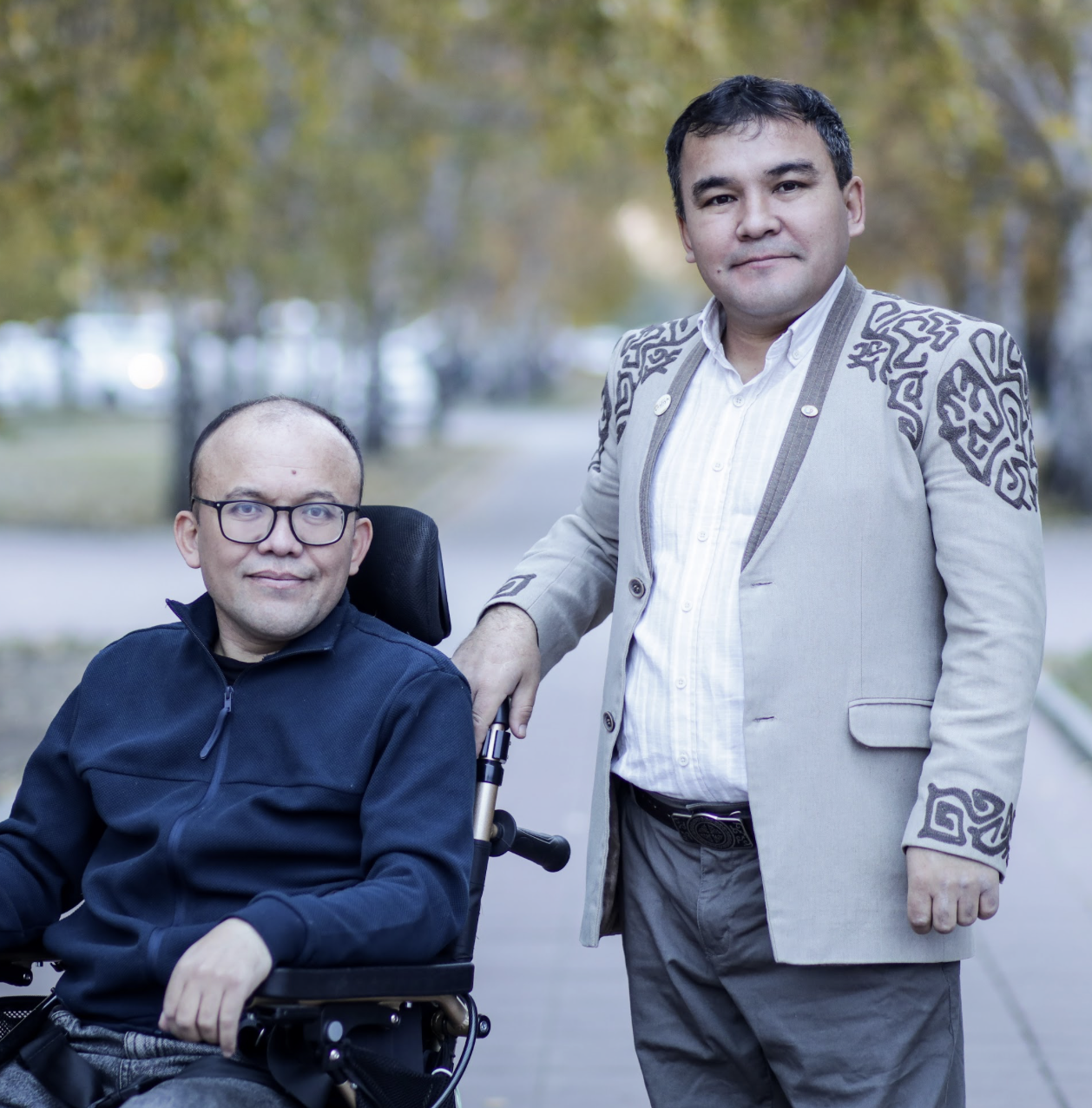
Their resilience, their refusal to fall into ignorance, laziness, or bitterness, the three vices Abai warns against, shows their commitment to living truthfully and purposefully. They strive, as Abai instructs, to act with purity of intention, using the gifts given to them not for personal glory but to uplift others. Their artistry becomes a form of gratitude; their perseverance, a form of worship; their brotherhood, a manifestation of the compassionate humanity Abai sees as the path closest to the Most High. In this way, the brothers’ lives stand as a quiet but powerful embodiment of Word Thirty Eight’s central message: that true elevation comes from aligning one’s inner world with reason, justice, and heartfelt love; that work done with sincerity becomes prayer; and that gratitude expressed through creative action becomes a form of faith that dignifies both the individual and the community.
In the northern city of Kostanay, where winters bite deeply and summers arrive with a soft warmth, four brothers grew up learning that life would never be simple, but that simplicity is not what makes a life meaningful. The Ankauov brothers — Sarsen, Dauren, Arlan, and Baglan — were born into a family where creativity flowed as naturally as breath, and where the values of Qazaq culture shaped every corner of their childhood. Their disability, Duchenne muscular dystrophy (DMD), came slowly, like a long shadow, weakening muscles year by year. But in their home, weakness was never the main story. What defined them instead was upbringing, layered with love, responsibility, and the quiet, steady expectation that each child holds a gift meant for the world. Their father, a shepherd, musician, craftsman, and philosopher in his own quiet way, was the first to see the artistic flame in his children. He taught through example: rising before dawn, planning work with precision, preparing for winter, repairing what needed repair, and never tolerating laziness. “Creativity is within you,” he often told them, noticing Arlan’s early passion for drawing, Baglan’s thirst for knowledge, Sarsen’s natural leadership, and Dauren’s silent, meticulous mastery of leatherwork. He guided each child according to their nature—mind, heart, and will—woven into the fabric of everyday life long before the brothers ever encountered Abai’s philosophy in books.
Their mother, raised by her grandmother, carried the ancestral art of carpet weaving in her hands. As a little girl, she watched the loom rhythmically rise and fall, absorbing every gesture without realizing she was storing a map of memory. Many years later, in 2016, after her sons had built their studio, those memories returned to her “as if awakened from the past,” she said. She took out the loom inherited from her mother-in-law and began weaving again, joining the work alongside her sons, a living example of how tradition never truly disappears, just sleeps until someone is ready to revive it. Childhood for the brothers was not easy. Their diagnosis came gradually, weak muscles, tired legs, falling more than other children. Sarsen remembers the day he first realized something was changing: “One day I could run with my friends, and the next, I couldn’t keep up. My legs didn’t listen to me the same way.” There were moments of staring at classmates’ curious or mocking faces, moments of falling in the schoolyard and children misunderstanding, thinking they were drunk or clumsy. “In childhood, kids can be cruel,” Arlan said. “But our father raised us to stand up for ourselves. Spirit doesn’t fall, even if the body does.” Despite these hardships, the boys grew in a home filled with respect, discipline, and unconditional support. When the father passed away, the eldest brother, Sarsen, stepped into his place almost naturally. He had been the closest to their father’s discipline, understanding, and strategic mind. “When father taught me to plan the winter, I did not know then that he was teaching me about life,” he says. Later, these lessons became the backbone of their entrepreneurial work.
Their entrepreneurial path did not begin with a grand plan, but with a simple realization: they could not depend on anyone else. Their health required flexibility, some days they could stand longer, some days they couldn’t; some days the pain in their back or legs demanded rest. Regular employment had no room for such unpredictability. “When you work for someone,” Baglan explained, “you must be there from nine to evening, sick or not. For us, that wasn’t possible. When you work for yourself, you can adjust, but more importantly, you can maintain your dignity.” The idea began like a spark. Arlan experimented with leftover wool from carpets at home, playing with textures, combining colors, searching for something unseen before. He had studied interior design, but his technique, appliqué from sheep’s wool, was entirely self-invented. “I tried everything,” he said. “I experimented until I found the highest-quality method.” He created a painting whose surface looked like it was painted, yet was made entirely of wool, soft to the eye, firm to the touch. The brothers immediately recognized its potential.
From this spark, they built a collective vision. Their eldest brother pushed them gently but firmly: “We must create something of our own, something Qazaq. A brand.” Together, they refined the technique until it became a fully patented, worldrecognized method, received first in 2012, then confirmed again in 2016. “There is no analogue,” Arlan says. “Words can’t explain it—you must see it.” Their trademark soon attracted attention. Locals and foreigners alike were drawn to the paintings, each one carrying Qazaq motifs, ornaments, and textures that could be both touched and felt emotionally. People bought them for homes, for gifts, for cultural exhibitions. Foreign visitors saw in them a rare glimpse into Qazaq spirit, modesty, dignity, beauty, and the lingering presence of nomadic memory. But the business grew not only from creativity; it grew from necessity, unity, and shared resilience. “We helped each other,” Arlan said. “One alone could not do it. But together, we had abilities and strengths.” Each brother found his place. Arlan led artistic production, Dauren crafted leatherworks with unmatched precision, Sarsen handled planning and economic strategy, and Baglan wrote texts, prepared documents, did research, organized exhibitions, and studied SMM and technology to support their public presence.
resence. Their disability shaped the path but did not limit the destination. They learned to balance health with work: carrying paintings through rain and snow, driving long distances from the village to the city for exhibitions, sometimes falling, sometimes hurting, yet never giving up. “People look at me and say, ‘You look healthy,’” Arlan shared once. “But they don’t know. Still, I try not to judge them. People can’t see what you carry inside.” Their efforts were eventually recognized at national and international levels. A breakthrough came in 2018 at a major forum in Petropavlovsk attended by President Nazarbayev and President Putin. Despite being told he wasn’t allowed to stand next to the official displays, Sarsen insisted on staying. His quiet determination caught the attention of high-level officials, including representatives from the Prime Minister’s Office. This recognition led to exhibitions at the National Museum in Astana, sponsorship from philanthropist Nurlan Smagulov, and, after eight long years of waiting, the brothers finally received two apartments in the city. “Support like that changes everything,” they say. “It allows you to breathe.” Their work reached beyond Qazaqstan as well. Arlan was selected to participate in a month-long festival in Abu Dhabi, presenting his paintings to sheikhs and artists from across the Muslim world. He still remembers the warmth, the cultural exchange, and the feeling of representing Qazaq artistry on an international stage.
Throughout all these achievements, the brothers remained deeply grounded in Qazaq values: mutual assistance, humility, respect for elders, and the belief that craft is not simply work but a form of spiritual continuity. Their mother’s revival of carpet weaving inspired them to teach children traditional arts. Today, they provide free masterclasses for children aged 7 to 18, explaining ornaments, history, and cultural meaning. “Art is a language,” Arlan says. “A painting can speak without words.” Through teaching, they preserve what might otherwise be lost. The brothers are now building a franchise model for children’s studios across Qazaqstan. They dream that their technology, their style, and their philosophy will spread to other cities. “We have 14 years of experience,” Baglan says. “Everything is prepared. Now we just need a push.”
Barriers still remain, banks hesitate to loan to disabled entrepreneurs; infrastructure is inadequate for people using canes; support programs have disappeared. “But Qazaq people are becoming more tolerant,” Baglan says. “Society is changing, slowly.” Reflecting on Abai’s philosophy, the brothers find deep resonance. They are especially drawn to Abai’s 33rd Word about craft, how craft may disappear from the world, but never from the soul. They see themselves in that description: masters who live not for vanity, but for the work itself. “A master is also a philosopher,” Baglan says. “He must remain humble and strong.” When asked what advice they would give others with disabilities, their words come softly but with strength. “Believe in your ability,” Arlan says. “Everyone has inner potential.” Baglan adds, “Support is the most important thing. One cannot fight alone.” Sarsen’s message carries the weight of a father-like voice: “Move step by step. Don’t fear difficulties. Work with what you have. Everything grows gradually.” Looking back, they say they would not change anything. “Everything happened naturally,” Arlan reflects. “Slowly, together.” Their dream is simple yet profound: that their art lives beyond them, that their patented technique continues in future generations, that the children they teach today will become tomorrow’s masters. “We are guests in this life,” they say, echoing Abai. “What we leave behind — that is what remains."
Their disability shaped their bodies, but not their spirit. Their unity shaped their identity. Their work shaped their purpose. And their hearts shaped the path they continue to walk, four brothers, bound not by weakness, but by strength, creativity, and the quiet, enduring dignity of the Tolyq Adam.