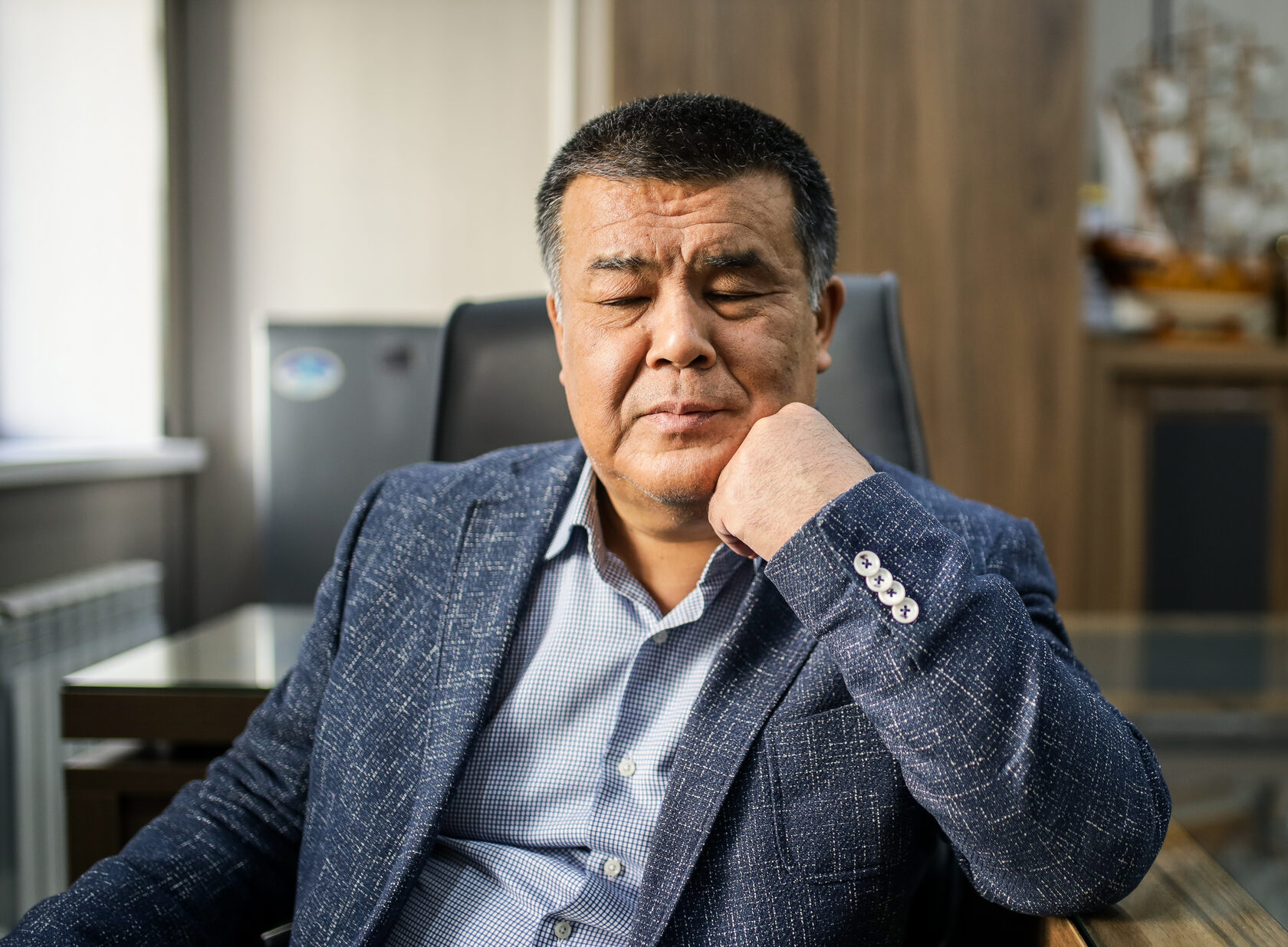
Abai reminds us that reason must not be suffocated by fear: “If freedom is not bestowed upon reason, then what about the truth?” Almat lives this freedom of mind every day. He questions complacency, challenges outdated policies, and refuses to treat dependency as an identity. His cause, the dignity and economic integration of people with disabilities, is a just cause. And as Abai teaches, such a cause fears no scrutiny. It gains strength from truth, from transparency, and from the perseverance to continue even when success seems improbable. Almat’s journey shows what happens when someone believes that good is not merely received, it is built. It shows how a person becomes whole not through what they lack or possess, but through what they stand for. Through his actions, Almat expresses Abai’s vision of humanity, one that refuses to attribute all outcomes to fate, but instead believes in the power of aqyl (mind), jurek (heart), and qairat (will) to change what is unjust. His leadership insists that inclusion and equality are not miracles granted from above; they are the results of ordinary people choosing to act extraordinarily for the benefit of others.
Almat Nauryzbayev was born in a Qazaqstan that was still Soviet, a place where life paths were mostly decided before a child even understood they were walking them. He grew up surrounded by the rhythms of a system in transition, where people believed stability came from the state and ambition was something kept quietly inside one’s chest. His earliest memories are filled with running freely, sunlight on his face, and the confidence of a boy who did not yet know what challenge meant. That changed in the fifth grade. An accident damaged his eyesight permanently. At an age when children usually fear monsters under the bed, he faced a monster far more real, total blindness. Doctors classified him as a Group 1 visually impaired person. “It’s written on my forehead that I cannot see,” he says simply now, without self-pity and without hesitation. For him, blindness was not a tragedy. It was a direction. But it took time. Losing sight meant losing ease, familiarity, and the expectation of a predictable future. In Soviet Qazaqstan, disability was not merely a physical condition, it was a label, a boundary drawn around a life. Society feared disability more than it understood it, and many visually impaired children were placed in segregated schools that became insulated bubbles. He describes it plainly:
“The biggest problem is that people get too comfortable inside their own circle. When they leave, when they step beyond the school gates … they feel lost.”
Yet Almat refused to shrink. He spoke with others confidently, he challenged norms and assumptions, and he walked into rooms as though he had every right to be there, because he did. Where others adapted quietly, he moved with a certain defiant independence.
“I never cared what anyone thought or said. Why should I be shy? Being shy won’t make you see.”
His life took a dramatic turn when perestroika came. The Soviet Union began to unravel, and with it, all the economic structures that once held society together. The sudden collapse of jobs, salaries, and certainty forced people to choose: wait for salvation or act
Almat chose action. He was a student in mechanics and applied mathematics at the time, a field that already demanded precision and boldness. “I always gathered my classmates and organized things,” he recalls. “I was always the leader.” They began selling cars, any business that promised survival. As Qazaqstan stumbled into a market economy, he learned entrepreneurship the hard way: by doing it. He advanced rapidly, shifting into production, creating foil caps for vodka bottles, then tin cans and lids for preserving jars, later expanding into other packaging materials. “In Qazaqstan, I don’t think there was a larger company than mine in that line of work,” he says matter-of-factly. No competitors. No limits. Blindness did not stop him, he simply adapted. “Of course, you depend on your environment, but it never affected me.” He relied on teams he trusted, using aqyl (mind) to strategize, qairat (will) to navigate risk, and jurek (heart) to lead boldly. He took out a 2 million KZT loan, something he still marvels at. “I was a second-year blind student, and they gave me money! To this day, I still don’t understand how.” That period of expansion gave him what he now values most, a sense of dignity. Entrepreneurship became his stage for becoming fully human again, a Tolyq Adam in Abai’s sense, mind, heart, and will working in harmony
But with great risk came collapse. The 2008 global financial crisis hit Qazaqstan like an earthquake. His business, once thriving, began to crumble under debt and shrinking markets. By 2015, he had to shut it down entirely. The loan still had to be repaid. The wounds of loss were sharp, but he never allowed them to define him.
“I’m not Musk or Jobs … I’m just an ordinary entrepreneur. I survived all difficulties, and I know what it’s like.”
His wife and children walked every step of that journey with him, each moment turning family into a pillar rather than a burden. “My business became a family business,” he explains. When entrepreneurship faded, a new purpose emerged, one rooted not only in building a livelihood but in building a community. He turned his attention, and his leadership, to the Qazaq Society of the Blind, a public association established in 1937 that today unites around 12,000 visually impaired people across the country. It includes 19 production enterprises, employing almost 3,000 workers, the majority living with disabilities. Like many institutions that survived the fall of the USSR, the Society had endured corruption. Its previous chairman, totally blind and a Doctor of Economics, was sentenced to prison for embezzling 1 190 million tenge. When this leader fell, the organization needed someone with integrity and real-world resilience. Almat stepped forward.
Since becoming chairman in 2017, he has channeled every resource into modernization, upgrading machinery, reopening production lines, and rebuilding what was once lost. “We, blind people, built all this,” he says with pride that carries no arrogance. He lists their achievements as if they are ordinary: a rehabilitation center in Almaty, 2,250 square meters, built during the pandemic using their own funds; a printing house for books in Braille; multiple new leisure centers and workshops; and a newly purchased wellness complex in Astana with a swimming pool and gym.
“No one in Qazaqstan can boast such achievements. Even the government can’t do what we’ve done.”
He laughs when others ask where he finds energy. “Nowhere,” he says. “You don’t have time to think about that. A person must always stay busy … if they have too much free time, that’s when problems begin.” Yet being productive is not just a strategy. It is his philosophy, to live meaningfully and to ensure others do as well. He sees the world clearly, despite having no sight. The systemic barriers are endless: “Is it easy for a person with disabilities to do business? It’s almost impossible.” Access to capital, state bureaucracy, employment quotas, tender rules that can destroy a company over a missed signature, these are not abstract policies but lived obstacles. “The state must create conditions. That’s what we don’t have.” There is anger in his voice when he talks about ministries and officials who refuse to listen. But his anger is the kind that comes from care, from a heart committed to justice. “We need ideology,” he says. “Not privileges. A powerful idea that lifts the nation’s spirit.”
Without naming it, he embodies Abai’s warning: that a country without moral strength becomes a country without progress. He has traveled widely, China, the Emirates, always learning. “We read a lot, we study a lot. All day long,” he says. Accessible technologies allow him to consume information constantly, talking phones, talking laptops. Blindness is not a barrier to knowledge. In moments of difficulty, he does not turn inward with despair. He adapts, moves, builds again. “Suicide? That’s not an option for us.” His resilience is less about heroism and more about refusal, refusal to stop, to complain, to be pitied. When asked how entrepreneurship has shaped him, he speaks with quiet steadiness: “Through this work I’ve grown, tremendously. Now I can speak on equal terms with anyone. With anyone at all.” That equality of voice, that is aqyl (mind), the intellect of someone who earns respect not by demanding it but by proving it daily. He dreams of returning to business once a new board is elected. His children already manage parts of the enterprise; he sees the future not as retirement but as another chapter. “If my health allows, I’ll stay active. I won’t let anyone sit idle.” He teaches courage through example rather than speeches. When younger entrepreneurs with disabilities ask for advice, he offers them Confucius instead of comfort: “The wise man is not the one who never fell, but the one who fell and rose again.”
He does not romanticize disability. He does not call it a blessing. He simply refuses to let it be a boundary.
“Those who truly want something will find a way … But if they expect help, from the state, from relatives, even from God … nothing will happen. You can only rely on yourself.”
Almat Nauryzbayev’s journey is a reminder that wholeness is not about perfect circumstances, but a perfect alignment of heart, mind, and will. He stands as a Tolyq Adam not because life was easy, but because he insisted on living fully even when it wasn’t. Thousands of visually impaired Qazaq citizens now walk into workplaces he helped build. They earn salaries, develop skills, gather in leisure centers, travel to rehabilitation complexes, and experience themselves not as objects of charity but as active participants in their nation’s future. His story is not only about one man’s resilience. It is about the collective empowerment he ignited, a shared belief within the community that “we, the blind, can build.”
And they do. Through Almat’s efforts, inclusion in Qazaqstan has begun to shift from rhetoric to reality, not because the system supported them, but because they supported each other. His sight may have dimmed long ago, but his vision has only gotten sharper.