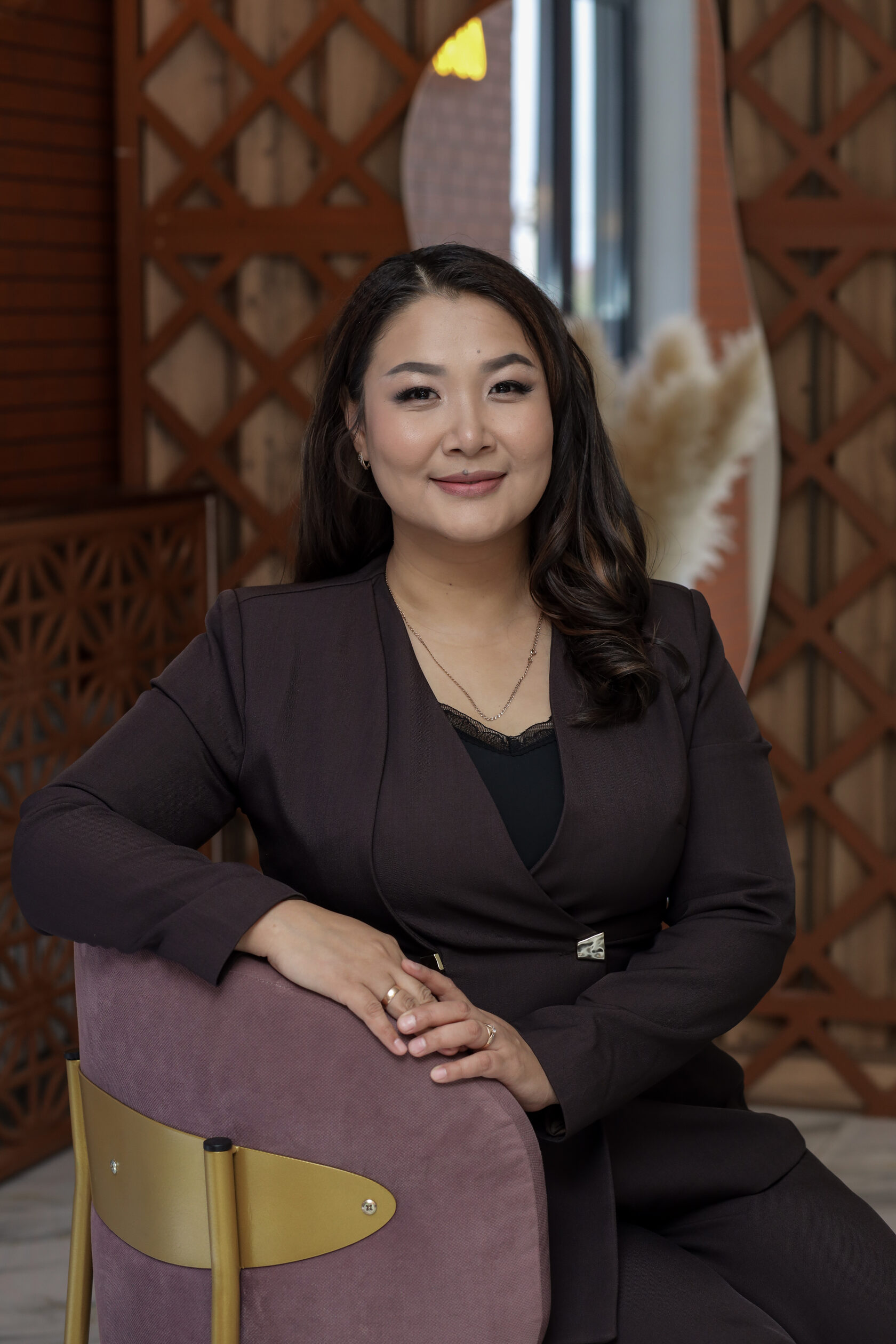
Akmaral Sidegaliyeva grew up in the wide, wind-brushed lands of Atyrau Oblast, in a village where days moved slowly and family ties shaped the rhythm of life. She remembers her childhood as one filled with warmth, noise, and tenderness, the kind of home where everyone looked after one another, where modest means were balanced by generous hearts. Her parents were steady, hardworking people, and their quiet discipline shaped her early sense of self. From a young age she learned to help where help was needed, to listen before speaking, and to move through the world with humility. She did not imagine herself as someone who would one day run a business, manage accounts, or make decisions that shaped the future of other families. Her dreams were simple then. She imagined finishing her education, finding meaningful work, and building a stable family life. As a young woman, she became a lawyer by training, a profession that suited her careful mind and patience with detail. She liked documents, numbers, the clarity of rules and procedures, the sense that things could be ordered and understood if only you took the time. She married a mathematics teacher, a gentle, thoughtful man whose steady confidence complemented her quiet pragmatism. Together they imagined a life built on learning, mutual support, and service to their community.
Nothing in her early life prepared her for the sudden violence of the accident that changed everything. It was 2021, an ordinary day that ruptured into something irreversible. She remembers fragments: the shock, the pain, the confusion, the long quiet afterward when doctors confirmed that the injury to her leg was permanent. She became a Category III disabled person, a label that felt both clinical and heavy, something that marked her not just in official documents but in her own understanding of her body. For a while she tried not to think about it, as if ignoring the change might make it less real. But the truth was that nothing would ever be the same again. Before the accident she had already stepped into the world of entrepreneurship. She and her husband had opened a small study center for children, born from a simple gap in their region: there was no tutoring center, and parents had begun asking her husband if he could offer lessons. But combining full-time school teaching with individual tutoring had become impossible. “We didn’t have a teachers’ center in our area,” she recalls. “Parents were asking, and it wasn’t possible for my husband to handle it alone.” So they opened their own center, modest at first, but built on genuine need. Akmaral’s role emerged naturally. She handled the accounting, the official registrations, the legal paperwork, the structure that held the business together. “I’m a lawyer by education,” she says. “Working with papers and computer programs is interesting to me.” There was joy in it, the joy of competence, of seeing her skills matter, of contributing something essential to the life she and her husband were building together
But after the accident, everything had to be relearned: how to move, how to pace herself, how to handle pain that arrived suddenly and stayed unpredictably. She faced the familiar post-Soviet mindset toward disability, where illness is often seen as a weakness and people with disabilities are expected to retreat from public life. Yet she refused to internalize those assumptions. When asked whether she ever felt like giving up, she answers simply, “I am a very positive person. That helped me a lot.” It was not naïve positivity but something deeper, a deliberate, quiet refusal to collapse. She found strength in faith, in her children, in the routines of work.
“Business motivated us, It gave us a reason to get back to work quickly. Thinking about the future of the kids, we decided to continue.”
This attitude shaped the next phase of her life. Even though her leg required rehabilitation, even though she fell ill more often, even though unpredictability interrupted her routines, she returned to the study center as soon as she could. She no longer took on physical tasks, but she expanded her administrative role, supporting the growing number of students and managing the paperwork that kept the center functioning. She found meaning in being useful, in staying connected to life beyond her disability. Still, the balancing act was difficult. “I can’t say I keep a balance,” she admits. “If we focus too much on work, we forget rehabilitation. If we focus on family matters, rehabilitation is forgotten again.” Her honesty reveals something universal about women’s lives, especially lives of women with disabilities, where self-care is often the first sacrifice, where family and work crowd out the very health that sustains them. Her days were rarely structured. She describes herself as someone who “goes with the flow,” someone who knows the value of discipline and planning but struggles to implement it. This selfawareness is part of her narrative, she does not pretend to be the perfect entrepreneur. She is still learning, still adjusting, still finding a rhythm that fits her new body.
Family support became essential. She and her husband live with her parents, a multigenerational household that is common across Qazaqstan but that gained new significance after her accident. “My husband’s parents and my parents help a lot,” she says. “They help with the kids and the housework.” Their support allowed her to keep working and to focus on the parts of the business she could manage from home. Entrepreneurship opened unexpected doors for her. Unlike salaried work, where taking sick leave requires paperwork and permission, running her own business gave her the autonomy to seek medical consultations abroad, schedule rehabilitation, and invest in her health. “When you work for yourself,” she says, “you can organize everything and open opportunities for treatment and knowledge.” Business became a pathway not just to income, but to dignity, control, and possibility. The accident did not fundamentally change her role in the business, but it changed her relationship with herself. She learned to recognize her resilience, to take pride in contributing despite limitations, and to value the emotional stamina that entrepreneurship demands.
“I became more confident … You become more open to people. You feel you are a significant person in the community.”
Her journey makes visible the emotional labor often hidden behind entrepreneurial success. There were moments of exhaustion, moments when she forgot to care for herself, moments when the pressures of raising children and supporting the business collided. But she persevered with a softness that reveals its own strength, the kind of strength that does not shout, but endures. She faced structural barriers too. Banks rejected her application for business loans because her pension fund contributions were paused during maternity leave. “I wanted to develop our business,” she explains, “but they refused because the pension fund wasn’t growing.” She wishes the system offered more flexibility, more trust, more tailored opportunities for entrepreneurs with disabilities. Her critique is gentle but firm: “It would be great if they didn’t look at social payments, and if there were more relief and opportunities.”
She acknowledges that Qazaqstan has made progress. Programs like Business Bastau and grants for socially vulnerable groups helped her at crucial moments. She hopes these programs will continue to expand, especially with practical training that enables people to earn immediately. “If people see that they can earn right away,” she says, “they gain motivation.” Through all of this, she never encountered direct discrimination. Her community respected her, perhaps because she did not present herself as a victim. She carried herself with calm dignity, and people responded with the same. Her definition of success reveals the quiet philosophy that guides her life. “Success,” she says, “is networking, being useful to the community, having good relations with family, reaching your goals.” It is not money, not prestige, not competition. It is harmony. This harmony echoes the spirit of the Tolyq Adam: a life where mind, heart, and will move together. Akmaral does not use these words, but her actions reveal them. Her mind shapes the business, manages the accounts, and solves the problems that arise. Her heart shows in the tenderness with which she speaks about her children, her gratitude to her parents, her desire to help her community. Her will is evident in the decision to keep working after the accident, to return to life rather than retreat from it. Her children are her motivation. She wants to leave them not just a business, but an example, a way of living that honors both responsibility and hope. She wants them to grow into strong, confident, selfsufficient people who can stand firmly in the world. Her daughter, already involved in dance and singing and modeling, gives her particular pride. “I want her to be able to support herself in any situation,” she says. Her son, still young, brings her joy with every small milestone.
Looking back, she has no regrets. She would not change the business, the choices, or the timing. She moves through life step by step, trusting that what is meant for her will unfold in time. When asked what entrepreneurship has given her, she answers without hesitation: “Freedom. You are your own boss. You can plan your life, be with your family, build relationships.” Her story is not dramatic. It is not filled with grand gestures or loud victories. It is the story of a woman who chose steadiness over surrender, dignity over despair, purpose over passivity. It is the story of a life rebuilt not through sudden transformation but through daily persistence. In a society where people with disabilities are often expected to retreat, Akmaral offers a different image, one of competence, contribution, and quiet leadership. Her work benefits her family, her community, and the children who learn in the center she helps sustain. Her life reminds us that strength does not always announce itself; sometimes it simply continues. Her final advice to others is simple, but it carries all the weight of her lived experience: “Start a business, take risks, do not give up, and remember you are equal to everyone else.” In these words, her mind, heart, and will stand together, an everyday wholeness that defines her path.