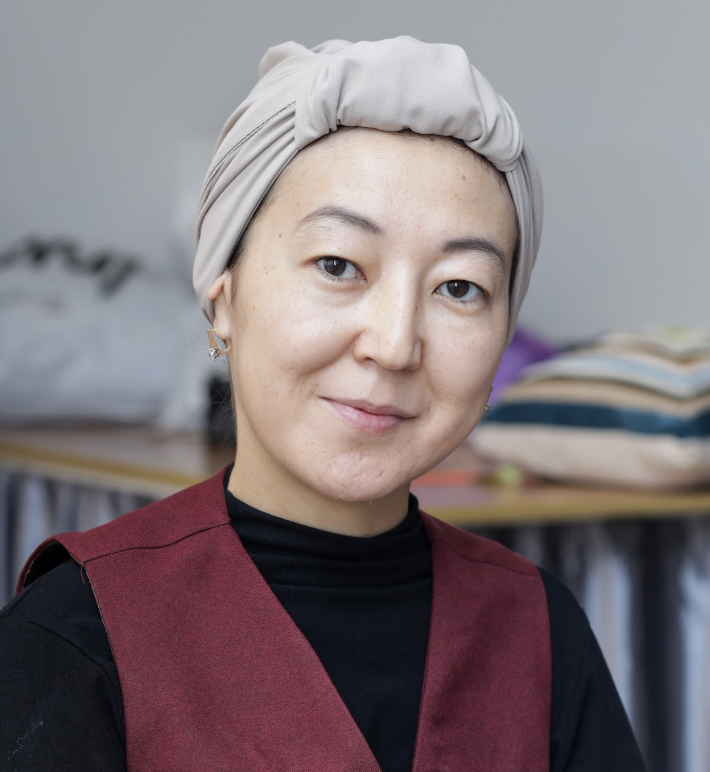
Meruyert Abylkassymova’s story begins in a small home filled with fabric scraps and the quiet imagination of a young girl. She would take socks from drawers, not to wear, but to transform. The elastic band became a doll’s skirt, a cut piece of cloth became a dress. She didn’t yet know the word “entrepreneur,” but she already understood creation. “I think, wow, I was so creative even back then,” she says with wonder, as if discovering that childhood Meruyert left behind breadcrumbs guiding her future. She grew up, studied economics, and became a teacher. Later she worked in a bank, then in a sewing factory, a place that awakened in her something deeper than employment. She fell in love with embroidery, not just sewing, but the art that gives fabric a soul. Still, life led her into different jobs, and she often felt suffocated in hierarchical workplaces. “I admired the director, he was an entrepreneur, but dealing with the middle managers felt impossible,” she admits. “I realized I wasn’t meant for a corporate job.”
After fifteen years of marriage and three children, Meruyert expected life to feel grounded. Instead, a storm came. Following the birth of her youngest daughter, her body turned against her. The pain arrived suddenly, swelling in her fingers, stiffness in her joints, exhaustion so deep she could barely move. Doctors diagnosed her with rheumatoid arthritis, a chronic condition tied to stress, trauma, and suppressed emotions. A few months later, another blow: an 8-centimeter tumor on her liver. She recalls that time quietly, the fear woven into daily tasks, the confusion of a strong woman suddenly unable to run, lift, or sew without pain. “I used to run marathons,” she whispers, and that whisper holds all the grief of lost power. There were days she needed to call a taxi just to step outside her own home. Her children were still small. Her husband did not yet understand what she carried. Then, in the midst of that darkness, the pandemic arrived.
For many, those years meant isolation and uncertainty. For Meruyert, they became the beginning of a rebirth. Bazaars were closed. Shops shuttered. Her sister was getting married, and there was nowhere to buy dowry items, Qyz jasaýy . Necessity sparked courage: “Why not sew them myself?” she thought. The first turbans she made were gifts for sisters, then friends, then customers. She stitched late into the nights, nursing a baby with one hand, guiding fabric with the other. She joined the Bastau Business course in 2018, walking home late in the evenings, holding onto new hope. “That’s when I realized I love sewing,” she says. Later, a training by Ainur Tursynbayeva opened a new world: government grants. The idea that the state could support her dream felt unbelievable. But she dared.
She wrote her own business plan, struggling through fear, through words on paper that did not yet feel real. She applied for a grant with a sample: a small quilt, körpeshe25, embroidered with qos qarlyğaş26 patterns and cultural memory. The jury loved it. “If you continue,” they told her, “you will go far.” When she received the confirmation, two million tenge, she froze. Relief and shock arrived together. “Sometimes you work so hard to get something, but when you finally have it, you don’t know what to do next,” she says. Yet she moved forward. She bought industrial equipment, her lifelong dream. “I always tell my children: dreams do come true. Write them down. Believe.” Her atelier started at home, cramped, loud, interrupted by children’s needs. Orders increased, including one from the city court. Sleepless nights became a routine. “I worked nonstop for four weeks, no weekends, nothing,” she remembers. “My back hurt so badly some mornings I couldn’t get out of bed.”
There were days she cried into her husband’s shoulder. He didn’t understand at first, he thought she was “just at home.” But eventually, he saw the truth. “I told them: I can’t do everything alone. We are a team.” Today, he cooks when needed, and the children help clean. That small shift, shared labour, became a form of love. Her health, meanwhile, remained a complex companion. She tries yoga now, and listens to motivational podcasts while sewing. She sees a psychologist. She practices jürekpen qai rattyñ tepe-teñdigi - a balance between jurek (heart) and qairat (will). Her body may tire quickly, but her aqyl (mind) and creative fire burn brightly. Entrepreneurship reshaped her identity. “Before, I was easily irritated, taking everything personally,” she says. But business forced her to grow, to delegate, to see beyond her limits. She learned that ideas expand when shared. After an entrepreneurship event hosted by the Academy of Women’s Entrepreneurship, investors admired her pillows but questioned her pricing: “You work so much… and you earn so little.” It stung. It enlightened. She now dreams not of survival but of scale, a workshop with many employees, a business where creative vision leads and hands support.
There were missteps too. She once applied, and won, two government tenders: one for deforestation services, another for electrical panel installation. Both required physical labor beyond her capacity. Others asked why a woman, especially one with health challenges, entered such fields. “They told me, ‘This is not a woman’s job.’” She laughs at that memory now, but acknowledges the burnout that followed. Even ambition needs boundaries. Yet she never stops seeking growth: new grants, new expansion routes, new ideas. She is learning to delegate, “Working alone keeps you small,” her mentors say. She now believes them. What gave her strength through every chapter? Family, especially her mother and sisters. Her mother’s disappearance years ago tore open an emotional wound she still tends to. Her sisters were the ones who helped pay for treatment when money was short. She often repeats:
“Health is the most important thing. I want to travel, I want to run again.”
Despite everything, she feels blessed. “Alhamdulillah,” she says often, with sincerity. Her faith anchors her through uncertainty. She sees illness not as a punishment but a teacher, reminding her to value life, to stop suppressing feelings, to claim joy. In her words, “Do what you love. We spend so much of our lives working. Let it be something that gives you life.” Her impact extends beyond fabric and thread. She preserves Qazaq traditional crafts, supports other seamstresses through outsourcing, and inspires women who fear their health limits their future. She is reshaping what disability, often invisible in her case, looks like in Qazaqstan. Not pity. Not limitation. Possibility
She still dreams big. Recently, she showed her collection at the AWE Central Asian Summit. Mass production or highend custom tailoring? She hasn’t decided. But she knows one thing: “I need people. A business needs a team.” This journey, marked by illness, burnout, joy, and continuous rebirth, reflects Abai’s Tolyq Adam: the unity of aqyl (mind), jurek (heart), and qairat (will). Her aqyl (mind), in strategy and planning. Her jurek (heart), in every stitch she places into someone’s celebration. Her qairat (will), when she keeps moving, even in pain. Meruyert’s life is proof that even when the body falters, the spirit can sew its way back to wholeness, one stitch of hope at a time.