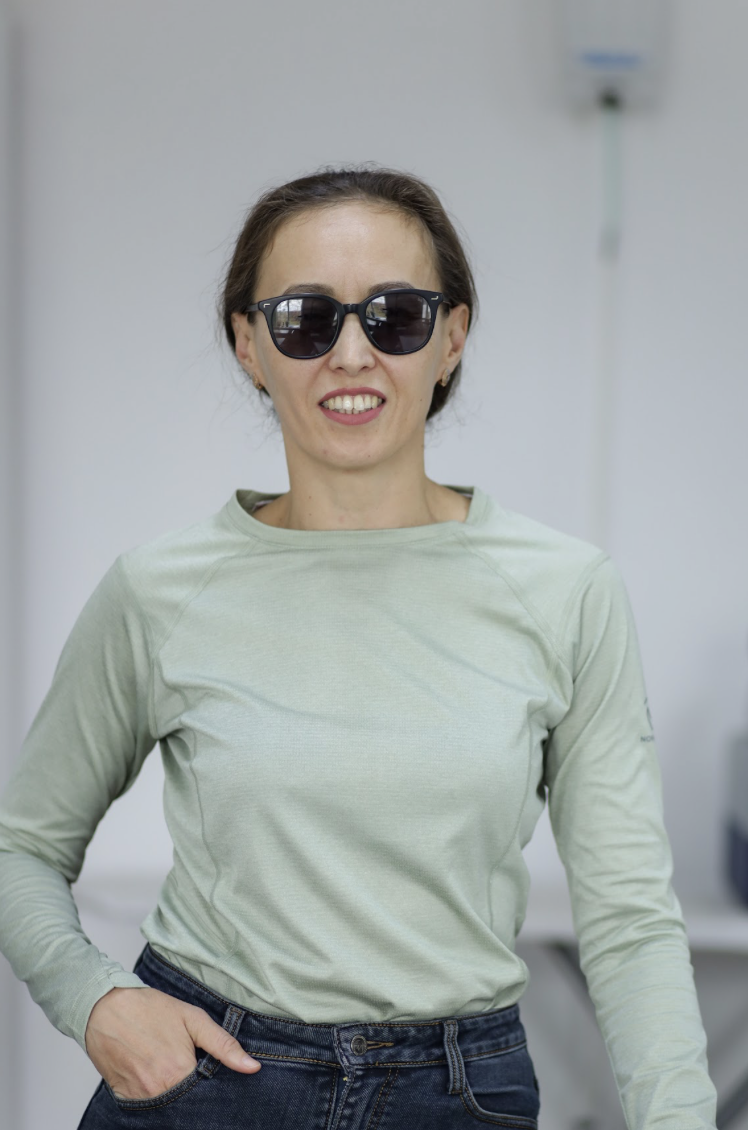
Dinara Kuzhgulova grew up with the sound of her azhe’s (grandmother) voice carrying through the house like a steady thread running through her childhood. “Gylym tappai maqtanba. Oryn tappai maktanba,” her grandmother would remind her, quoting Abai with the seriousness of someone handing down a moral inheritance.
Do not boast before gaining knowledge. Do not grow complacent before finding your true place.
Dinara did not fully grasp the depth of those words as a child, but they settled somewhere inside her, becoming a compass she would return to whenever life demanded clarity. Dinara always had a strong personality and never took “no” or “impossible” for an answer. The kind that meets difficulty with a tilted head and the question: What can I do with this? She always seeks solutions to problems, viewing them as opportunities for personal and professional growth. Today, she is a single mother raising two children, a woman living with complete blindness, and yet her life is filled with movement: entrepreneur, social advocate, athlete, mentor. She is a champion and prize-winner in several national and international judo tournaments and a passionate promoter of the rights of people with disabilities in her hometown, assisting others in landing a job. She helps others find purpose when they have nearly lost their own. Her story, however, begins long before the achievements.
As a child, Dinara knew she would one day lose her vision. An ophthalmologist warned that the world would grow dark within a decade or so. But the warning felt distant then, almost unreal. She chose to live her life fully. She graduated from a local college with a diploma in accounting and auditing and successfully worked in that field in various companies, including banks. Life moved forward. The darkness was not sudden, but its arrival left her navigating a world where every familiar object had changed shape. For nearly a year she fought for official recognition of her with a third-degree disability, a process as exhausting as it was necessary.
Dinara gratefully recalls that government support helped her survive her most difficult times. In 2017, she was left alone with two small children and no income. The local akimat (local authority) provided her with an opportunity to take courses in tailoring and design. Sewing and knitting had been her lifelong hobbies since the age of six, thanks to azhe [grandmother], and she already had a few returning customers. After completing the course, Dinara was able to open her own small, socially responsible tailoring workshop, “Qypshaq40 Style,” named after her family clan. For Dinara, her connection to Qazaq traditions and culture is deeply meaningful. Since her father had only daughters, she chose the family clan’s name for her business to honor and continue their heritage. As a social entrepreneur, Dinara helps people from vulnerable groups find employment through government subsidies and programs.
Her journey into entrepreneurship unfolded through necessity and courage. In 2017, unemployed and rejected repeatedly by employers who hesitated to hire a single mother, she turned to social support. The state covered six months of food and essential costs while she took part in “Bastau Business,” a free entrepreneurship programme. She applied for a government grant to buy professional equipment, was rejected, and applied again. By the time she completed the course, her persistence was rewarded. She received the grant. It transformed her life.
Finding a workplace was another challenge. Then kindness arrived in the form of local entrepreneur Marat Sadvakassov, who offered her a commercial space on favourable terms because he saw her situation clearly, her determination, her need, her potential. With that support, Dinara took her first real step into independence. Today, she employs seven seamstresses, all from vulnerable groups, many with disabilities of their own. The number fluctuates as workers need time for rehabilitation or medical treatment. Dinara has no interest in rigid rules or “standard hours.”
“Disabilities take many forms … Some people use wheelchairs; others can’t see, hear, or speak. Some can work only three or four hours a day. I always try to accommodate everyone’s needs. As a social entrepreneur, I go through thick and thin with my team.”
Her business grows year by year. She reinvests profits back into training, equipment, and improving conditions. People once advised her to give up entrepreneurship and return to a stable job with a small salary. She does not resent their doubts; instead, she says, “I’m grateful I heard their skepticism. It pushed me to rely on my own choices.” Deeply thankful for the help she received, from the government, from Marat, from her business manager, from relatives and her children, Dinara now feels a responsibility to pass that support forward. She teaches free tailoring courses to mothers with children with special needs and helps them find employment or open their own small ventures. “I hope I am helping people become self-sufficient and happier,” she says. Losing her eyesight in 2020 put her resilience to the test. She faced a choice, to give up and sell her business or to continue despite new challenges. Once again, she followed her heart and decided to move forward. She now believes that her blindness, while devastating, also became a source of strength that helped her achieve what she has today. At 43, Dinara entered studies for a bachelor’s degree in economics from Kostanai Regional University named after Akhmet Baitursynov. Her studies broadened her horizons and introduced her to inspiring people.
Sports have always been an important part of Dinara’s life. Her illness didn’t stop her, in fact, it opened a new chapter. Today, she is a decorated judo athlete, winning tournaments at various levels. Her entry into the sport was accidental: in 2021, her daughter found a newspaper ad from a local Paralympic sports organization recruiting visually impaired people for free judo lessons. Dinara decided to try it. Judo and daily training, she says, boosted her self-confidence and motivation to keep contributing to society. Her days are packed, so much so that she jokes about living “in her own time zone.” She emphasizes that without the help of her children and colleagues, her achievements would have taken much longer. When speaking about social barriers, Dinara notes that society often doesn’t know how to interact with people with disabilities. This leads to psychological isolation and exclusion. Beyond the lack of infrastructure, even simple tasks like riding a bus can be both physically and emotionally challenging. Society, she believes, is still learning to accept and include everyone.
She lost several friends, acquaintances, and employees due to her worsening illness but sees this as a “natural filter” for unnecessary relationships. She also notes that financial institutions often hesitate to give loans to people with disabilities, even though discrimination is officially prohibited. Dinara sincerely believes that society must care for everyone’s needs and be open to those with special requirements. “No one can be guaranteed protection from disability,” she says. “A compassionate, inclusive society is a stronger and more selfsufficient one. By ensuring inclusiveness society and every person will flourish.” Given her resilience, determination, and commitment to personal growth, Dinara has become a role model and inspiration for her colleagues, friends, and, most importantly, her children. She is respected and appreciated by local authorities and civil society for her contribution to improving the lives of people in need.
Her survival strategy, she says, is simple: set a goal, take it step by step, and treat obstacles as opportunities for growth. She shares this philosophy with her team. She advises social entrepreneurs to build flexibility into their operations, extra time for orders, adaptable schedules, clear task distribution. “A good manager must know what each employee does best and enjoys most,” she says. “Ask what they need to be happier and more productive at work.” Reflecting on Abai’s values, Dinara says the interview question about his teachings caused her to pause and reconsider her priorities. She now plans to teach her children Abai’s Words of Wisdom. Her grandmother, who completed only three grades of school but quoted Abai as if she carried his book inside her heart, is still her moral anchor. Azhe spent her days cooking, knitting, sewing quraq korpe (Qazaq quilt), reading. She handed down not only skills but a worldview: that knowledge, humility, and purpose are the pillars of a meaningful life. Dinara’s family name, Qutzhol, means “happy and successful path,” while judo translates as “the flexible way.” She believes life gives back according to the values and principles of the one walking its path. Her brand, she says, embodies usefulness, comfort, and beauty. The clothes her team makes are designed to be durable, eco-friendly, practical, and high-quality, helping customers feel confident whether they are attending a ball, running a marathon, or simply wanting to feel equal among others. “Our seamstresses sew love and positive energy into every stitch,” she adds, and she means it.
Looking ahead, Feeling fulfilled in her work, she now dreams of expanding and scaling her business internationally. Dinara dreams of expanding her brand ‘Qypshaq Style’ beyond Qazaqstan. But she says her mission as a social entrepreneur will feel complete only when society fully recognizes the value of every individual. Her guiding principle remains simple: set a goal, move toward it step by step, and treat every obstacle not as a wall, but as a doorway.