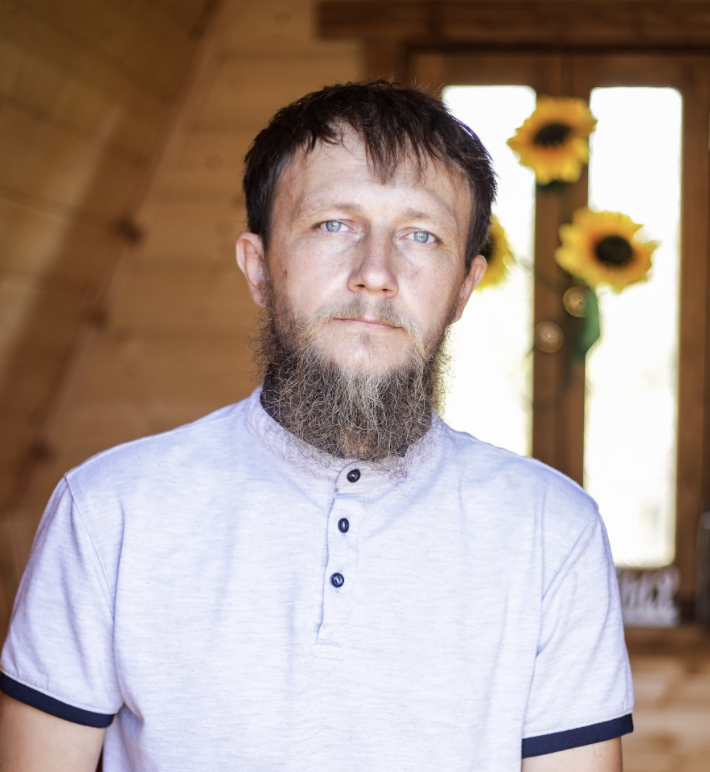
VLADIMIR LVOV’S LABOR, HEALING, AND THE WHOLENESS OF LIFE
In Akkol, a small city in the Akmola region, the hum of bees has been the soundtrack to Vladimir Lvov’s life since childhood. His grandfather Marat Asadulovich turned to beekeeping at forty-five on a brother’s advice, “Start keeping bees and your asthma will pass,” and the boy of twelve who followed him to the hives never really left.
By eighteen Vladimir had his own colonies; this season marks his twenty-first. He speaks of the craft the way some speak of prayer: a practice that orders time, deepens attention, and keeps a family’s narrative alive. His grandfather died this year at the age of 90.
“I am engaged exclusively with bees,” he says simply. “No other work interests me. I am grateful to my grandfather for such a work that I love.”
Love alone did not set his course. The decisive turn came with illness and surgery in 2016, a sudden halt that clarified what was already in his hands.
“I sat and thought, why am I searching when I already have everything? Here it is, the business that I enjoy. I just need to delve deeper.”
What had been weekend beekeeping became a vocation grounded in mind, heart, and will. He expanded the apiary, refined processes, and studied apitherapy, finding in each small improvement a way to heal body and spirit — his own and others’.
His year is written by the seasons. Winter is for preparation, the patient making of five to six hundred frames, sawing, wire-stretching, laying foundation, for a summer that starts at dawn and runs until the long northern twilight.
One day while he was sitting in the yurt, a new idea came to his mind to create api-yourta. It could be the first api-yourta in the country. Many people are interested in coming with their families and staying together.
“I’m a nomad — I travel through the fields and around the districts all summer long. I need a yurt and I bought myself a yurt for my apiary. It’s not just a yurt, it’s an Api-Yurt,” said Vladimir, sharing that he plans to scale the number of Api-yourta in the future.
The apiary is mobile: acacia in Ernazar, clover in Enbek, rapeseed, sunflower — fields called waypoints on a map of nectar. Each hive is a family with a character of its own, he says, “some aggressive, some friendly, some extremely eager for honey… and others lazy, like humans.”
Watching them has made him gentler. “Previously I was more impulsive; now I react more calmly,” he reflects. Somewhere between the work and the listening, the buzzing steadies him.
He built a hut on a cart in his first year and slid two hives under the bed, discovering what old apitherapy texts described as “sleeping on bees”: the felt vibrations, the smell of wax and honey, a low electromagnetic hum that seems to nudge the body back toward balance.
“After working hard all day, I would lie down, and in an hour and a half feel a surge of energy. At first I thought it was imagination. But it works.”
There is the stern patience of craft here, and a scientist’s curiosity. He prefers evidence to folklore, quietly correcting internet myths about tinctures with formulas that have been tested. When customers asked for remedies, he hesitated until he had the proportions right; then an older woman called back, “My father feels rejuvenated,” and Vladimir tried it himself, becoming his own proof.
The apiary is family. His wife worked alongside him before maternity leave; his small children, five and seven, have learned to stand patiently with labels.
“At first I refused because I could do it faster. Now I let them. By the third jar they’re already neat.”
He hopes they will carry the work forward, not out of obligation but because they find their own place in it — creams, ointments, healing candles, the gentle products of care.
Hospitality is part of the ethic: tea is non-negotiable.
“If you visit a beekeeper and don’t have tea, it’s disrespectful.”
He says it with a grin, but he also means it. In the forest, in May, when apple and bird cherry bloom, he urges visitors to remember how life should feel.
The hardest part is time. He is producer, mover, seller — every role at once.
“I have millions of ideas,” he admits, and the to-do list outpaces the daylight. Delegation would require more hives and stable cashflow.
Industry-level beekeeping in Qazaqstan lags, he says: potential is vast, but support systems are thin. Grants exist in principle, yet property collateral puts them out of reach for those with ideas but few assets.
“Programs exist, but not for the poor,” he says plainly.
He once defended a small grant and received 300,000 tenge, but the larger eco-tourism proposal — guest houses, learning, rest — stalled in committee. Transparency would help: “Show us who received the grants and what they did.” Until then, he reinvests slowly and relies on his own.
Crisis forced invention. A season of Varroa mites, bee enemy number one, left only eleven of fifty families alive going into winter. With spring coming, colonies costing 25,000–30,000 tenge each, and no funds to replace forty, he thought laterally and launched “A Bee in Every Home.”
Teachers, doctors, retirees bought a family of bees in spring; he managed all labor and logistics and delivered honey as a dividend by September.
“Essentially, I pre-sold the harvest,” he explains.
People came to the apiary to rest, help with extraction, and watch the work. The initial problem became a new line of business; a house in the apiary followed, where families could stay overnight, and ideas seeded more ideas — kumys with honey from a Stepnogorsk horse farm, pairings with artisans who make cheese or sew traditional costumes, exchanges that tether rural craft to urban appetite.
The apiary is also a classroom. Fairs in Kokshetau, Astana, and Stepnogorsk bring questions, and he answers without hurry: diastase numbers, nectar flow, the difference between industrial and migratory practice, why some honeys crystallize and others don’t.
He doesn’t hard-sell. “If I push, they’ll think it’s a trick and stop using it,” he says. Better that interest ripen on its own; then the learning lands.
He has a brand now, “Lvov Apiary,” and the name travels ahead of him. First you work for the name, a friend told him, then the name works for you.
He knows burnout. It comes in the off-season when pace slackens and apathy creeps in, or when he plans beyond what one person can lift. Rest is the remedy — doing nothing is already something.
In summer he feels limitless; the bees’ order becomes his order, and the forest keeps him in rhythm. This is well-being not as escape but as moral clarity: an unhurried alignment of purpose and practice. He tries to hold onto it in winter by imagining what will blossom and preparing the ground.
Kumys (also spelled kumis or qymyz) is a traditional Qazaq fermented dairy drink made from mare’s milk. Naturally effervescent and slightly sour, it has been consumed for centuries by nomadic peoples across the steppe for its nutritional value and medicinal properties. Kumys is considered both a cultural symbol and a staple of Qazaq hospitality.
On paper he has disability status; in conversation he talks about health, about limits that nudged him to make a clear choice.
“When you do what you love, you don’t count the hours,” he says.
That love becomes an ethic: take responsibility for your craft, tell the truth about your products, keep hospitality alive, teach what you can, and refuse to treat customers as marks.
When public programs disappoint, he doesn’t rail; he plots alternatives, nudged by aqyl (mind). When fatigue presses, he leans on routine and rest, steadied by jurek (heart). When money is thin or pests destroy a season’s work, he refuses to fold, carried by qairat (will). The shape of Abai’s Tolyq Adam is felt rather than declared.
He is not naive about systems. He can list the missed chances — financing that favors those with expensive collateral, committees that praise then decline, secrecy that invites distrust. But he also sees doors that might yet open: international eco-tourism grants, employment subsidies that could help him hire a content maker, platforms where accurate knowledge cuts through folk remedies and fake expertise.
He resists the cynicism that says nothing changes. “Support exists,” he repeats, “but it must be directed to those who truly need it.” In the meantime he moves one hive, one frame, one fair at a time, building something slow and sturdy.
Advice, when asked, sounds like the life he’s chosen.
“First, love what you do,” he says. “If you consciously choose your path, obstacles fade, even if slowly.”
He doesn’t map five-year plans; he holds an image and walks toward it, adjusting as he learns. What matters most is not how much money a decision brings but whether it is useful — “useful to me and to those around me.”
He wants to popularize bee products for national health because he has seen them work, and because even beekeepers, he says, “don’t fully trust their own products.” He wants a stationary apiary with flowering herbs calculated by agronomists so visitors can come any day, and he toys with a grand idea — year-round honey by following blooms across borders, a traveling show of the world’s nectar with a Qazaq heart.
There is a quiet, resilient dignity in the way he keeps returning to first principles. Curiosity — Why does this tincture help? Which plants heal what? — keeps the soul awake. Work — the honest, patient labor of mending frames and tending families — keeps the will from hardening into bitterness. Hospitality — offering tea, time, a bed over humming hives — keeps the heart supple.
Vladimir does not romanticize the forest; he invites people into its reality and lets the reality do the teaching.
“Come find one day,” he says. “Escape the hustle. Remember how life should be lived.”
What began as a family craft became a livelihood, then a public good, then a modest movement that braids eco-tourism, health education, and entrepreneurship. His wife’s hands, his children’s crooked-then-straight labels, the neighbors who bring friends, the teachers who bought bees and received honey, the older woman who ordered twenty bottles because her father felt young again — all these strands tie a life to a community.
The impact is neither flashy nor small. It is exactly the size of a frame in a hive: limited, necessary, and alive with purpose.
“When you do what you love, you don’t count the hours,” he says.
That love becomes an ethic: take responsibility for your craft, tell the truth about your products, keep hospitality alive, teach what you can, and refuse to treat customers as marks.
When public programs disappoint, he doesn’t rail; he plots alternatives, nudged by aqyl (mind). When fatigue presses, he leans on routine and rest, steadied by jurek (heart). When money is thin or pests destroy a season’s work, he refuses to fold, carried by qairat (will). The shape of Abai’s Tolyq Adam is felt rather than declared.
He is not naive about systems. He can list the missed chances — financing that favors those with expensive collateral, committees that praise then decline, secrecy that invites distrust. But he also sees doors that might yet open: international eco-tourism grants, employment subsidies that could help him hire a content maker, platforms where accurate knowledge cuts through folk remedies and fake expertise.
He resists the cynicism that says nothing changes. “Support exists,” he repeats, “but it must be directed to those who truly need it.” In the meantime he moves one hive, one frame, one fair at a time, building something slow and sturdy.
Advice, when asked, sounds like the life he’s chosen.
“First, love what you do,” he says. “If you consciously choose your path, obstacles fade, even if slowly.”
He doesn’t map five-year plans; he holds an image and walks toward it, adjusting as he learns. What matters most is not how much money a decision brings but whether it is useful — “useful to me and to those around me.”
He wants to popularize bee products for national health because he has seen them work, and because even beekeepers, he says, “don’t fully trust their own products.” He wants a stationary apiary with flowering herbs calculated by agronomists so visitors can come any day, and he toys with a grand idea — year-round honey by following blooms across borders, a traveling show of the world’s nectar with a Qazaq heart.
There is a quiet, resilient dignity in the way he keeps returning to first principles. Curiosity — Why does this tincture help? Which plants heal what? — keeps the soul awake. Work — the honest, patient labor of mending frames and tending families — keeps the will from hardening into bitterness. Hospitality — offering tea, time, a bed over humming hives — keeps the heart supple.
Vladimir does not romanticize the forest; he invites people into its reality and lets the reality do the teaching.
“Come find one day,” he says. “Escape the hustle. Remember how life should be lived.”
What began as a family craft became a livelihood, then a public good, then a modest movement that braids eco-tourism, health education, and entrepreneurship. His wife’s hands, his children’s crooked-then-straight labels, the neighbors who bring friends, the teachers who bought bees and received honey, the older woman who ordered twenty bottles because her father felt young again — all these strands tie a life to a community.
The impact is neither flashy nor small. It is exactly the size of a frame in a hive: limited, necessary, and alive with purpose.