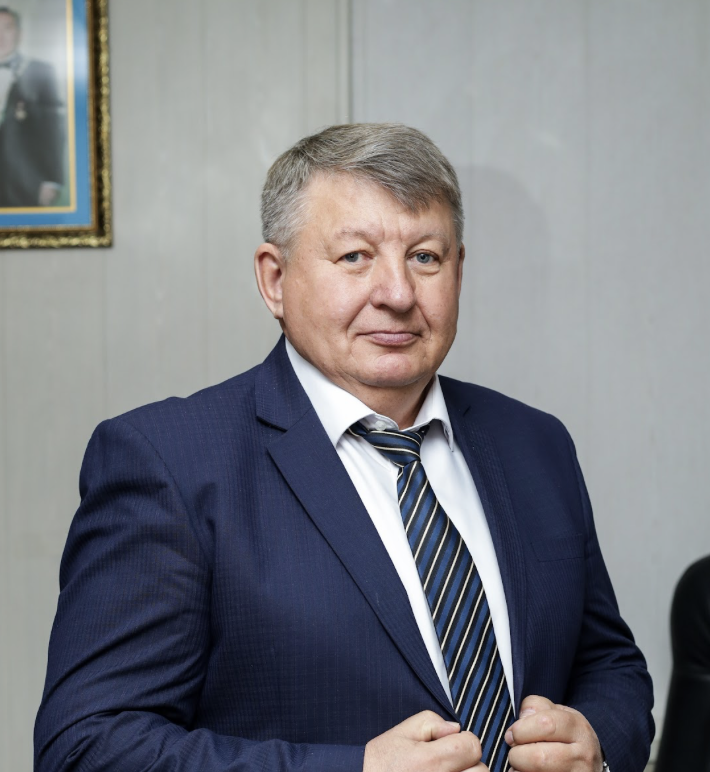
Vladimir Vladimirovich Sova’s narrative begins long before he ever thought of leading a large organization for people with disabilities. He grew up in the Soviet Union, in a world where duty to the state, collective responsibility and quiet endurance were woven into everyday life.
As a young man he followed that call of duty all the way to Chernobyl, where he served as a liquidator after the disaster. Those months left an invisible mark on his body, a slow-burning injury that would only fully reveal itself years later.
For a long time he lived as an ordinary Soviet citizen, working in public service, doing what needed to be done. He did not think of himself as “special” in any way. Then in 1990, eight years after Chernobyl, doctors officially assigned him a disability group.
“In 1990, I was officially assigned a disability group as a Chernobyl liquidator,” he recalls calmly.
The diagnosis did not come as a dramatic accident in one moment; it was more like a door quietly closing behind him. One day he was simply a civil servant; the next he was, in the state’s language, an invalid.
He did what many people did in those years: he went to the new society for people with disabilities that had just appeared in Kostanay. A small group of activists had formed it in 1988, pushing through the bureaucracy of social protection departments and the akimat to create a place where people with disabilities could at least register their existence.
“At first there were 20, 30, maybe 50 people,” he remembers. “Now there are about one and a half thousand.”
He joined quietly, still working in the government, just watching how this fragile association tried to find its place in the late Soviet and then early independent Qazaqstan.
The 1990s were harsh. Pensions and benefits were delayed; people queued not just for food but for survival. Vladimir saw how a simple food package, a bit of pasta, some rice, could bring grown men and women to tears.
“You should have seen their faces,” he says. “They thanked us with tears in their eyes just for a couple of kilos of pasta.”
It was then that something shifted inside him. The work of this small association was no longer abstract charity; it became proof that his own suffering after Chernobyl could be turned into something that mattered to others.
In 1998 the organization’s leaders invited him to join the board. By then it had a modest “material base” of its own — some rooms, basic equipment, a fragile network of trust. When the chairman passed away in 1999, Vladimir stepped in as deputy chairman. Eleven years later, in 2011, he was elected chairman of the Kostanay City Voluntary Society of People with Disabilities. What began as a way to register for benefits had become his life’s work.
By that time he carried his disability like he carried his medals, seriously, but without drama.
“I’m a second-group disabled person,” he says, “but I don’t feel like a ‘person with limited abilities’.”
He dislikes the convoluted new terminology. The phrase “persons with disabilities” sounds to him like something artificial, almost hiding the human being behind legal language.
“I prefer the simple word ‘disabled’,” he says. “Above all, we are people.”
It is a small linguistic choice, but it reveals his stubborn insistence on honesty and dignity over euphemism — mind, heart and will working together.
Under his leadership, the society grew into a complex, almost entrepreneurial organization with 56 employees and around 1,500 members, including 242 children with disabilities. It offers three key social services: taxi transport for people with disabilities, home care for older and citizens with disabilities, and rehabilitation for adults with mental disorders, run from their own leisure centre.
Around these core services, they have built an entire ecosystem of cultural and social life: sports events, creative clubs, trips in summer for wheelchair users to the central square to sit in the sun and breathe fresh air, visits to theatres and concerts, meetings with artists.
“We try to make sure each person feels attention and support and can live an active life,” he explains.
If this sounds like the work of a small municipality rather than an NGO, that is precisely the point. Vladimir describes the society almost like an enterprise: it has a building, a leisure centre, utility facilities that “support the activities of the society.” It runs on contracts, social orders, and an intricate web of cooperation with local authorities.
He knows the mechanics of the state from the inside, having served two terms as a deputy, and uses that knowledge to navigate the bureaucracy.
“I can easily get an appointment with the city akim or his deputies,” he says matter-of-factly. “Thanks to this, many issues are resolved quickly.”
Yet his work is not just administrative. It is emotional labour of the deepest kind. Every day he and his team meet people whose lives have been broken by illness, accident, or war, and who are trying to rebuild some sense of worth. He listens to their stories, their grievances, their fatigue, their hope.
“You need to take it all through yourself,” he admits. “Otherwise you won’t hear the person. And if you don’t hear, you won’t be able to help. So you must understand, listen, and even if you cannot help with action, at least support with words.”
This openness to others’ suffering comes at a cost. He speaks of evenings when he goes home with a heavy heart after a day of difficult conversations. His wife sees when he comes back quiet, carrying someone else’s pain on his shoulders. Those are the moments when his own resilience is tested, not in the dramatic heroism of Chernobyl, but in the slow, daily endurance of emotional weight.
“Sometimes, honestly, it is hard on the soul,” he says softly.
How does he recover? Paradoxically, by returning to the collective. He jokes that he doesn’t know how to rest; even in the sanatorium he lasted only three days before he and a colleague looked at each other and decided to go back to work.
Long weekends see him at the office inspecting pipes, heating, security, making sure the machine keeps running. Yet the same workplace that exhausts him also revives him.
“I come to work, meet the team, there are smiles, jokes,” he says. “You get distracted from the problems. Most often, it is the team that helps cope with this.”
He relies deeply on that team. Part of his moral code as a leader is that not everyone is cut out for this work. He remembers a driver who, after two days of transporting passengers with disabilities and hearing their stories, came to him and said, “I probably can’t work here. It’s too hard to take in.”
Vladimir did not judge him; he simply understood that this was not his path. Those who stay are the ones who can both empathize and remain steady, who combine tenderness with internal strength, an everyday embodiment of Abai’s union of mind, heart and will.
As a leader with disabilities in a post-Soviet context, Vladimir has watched the landscape shift around him. He remembers the 1990s and early 2000s when the general attitude to people with disabilities was “as long as they don’t interfere.”
Today, he sees a different picture: wheelchair users placed up front during city celebrations, special platforms in theatres, ramps and wide doorways in new buildings. He speaks with real respect about Qazaqstan signing the Convention on the Rights of Persons with Disabilities and adopting the Social Code.
“This is one of the most significant steps,” he says. “It changed the attitude of the state and society.”
At the same time, he is clear-eyed about bureaucratic failures. He describes the new licensing requirements for home care and rehabilitation services as a chaotic, half-built system that has created months of uncertainty for organizations like his. He worries about constant changes in rules that “don’t have a clear mechanism” and make it difficult to plan.
Still, his instinct is to solve problems through relationship and persistence, not public outrage. He works closely with regional social protection departments and labour offices, pushing for clarity while keeping services running. This is his way of resisting the old deficit-oriented mindset: not shouting about disability, but quietly building structures that work.
Vladimir sees people with disabilities not as passive recipients of care, but as agents who must move themselves if they want change. He loves the proverb “water does not flow under a lying stone” and repeats it when he talks about entrepreneurship.
He admires a wheelchair-using couple where the wife is a deputy and the husband a director of an NGO, both leading active, public lives.
“I hold them up as an example even for myself,” he says. “They not only live fully, they help others live.”
When asked what advice he would give to people with disabilities wanting to start a business, he answers simply: use the opportunities that exist, be persistent, don’t stop at the first failure. He knows that many people, after becoming disabled, withdraw into themselves, especially those with mobility impairments. After several attempts that don’t work, they give up.
“But there are others — persistent, tenacious,” he says. “They try ten times, and on the eleventh they succeed.”
For him, that stubbornness is the heart of success, more than any grant or program.
His own idea of success is not about money or status.
“Success is when you have authority among your colleagues,” he says. “When people say, ‘That’s our chairman.’”
It is a definition grounded in moral recognition, not in cars or titles. In that sense he is very close to Abai’s proud man who avoids humiliation and values conscience over fame. Vladimir does not want to be celebrated as a hero; he wants to be known as someone who did his job well and did not betray the people who trusted him.
After more than two decades at the organization, he reflects on his life without bitterness. Yes, he would sometimes have liked to be more lenient here, stricter there — “living life is not like crossing a river,” he smiles. But overall, he says, “I think I have lived most of my life not in vain.”
He believes he has contributed something meaningful to his family and to the thousands of people with disabilities in Kostanay whose daily lives are a little easier because the taxi arrived on time, the home-care worker came, the summer outing was organized, or simply because someone answered the phone and listened.
His motto, as he puts it, is simple: “Never give up in anything. Always move forward.”
It is not the loud optimism of a motivational poster, but a quiet, seasoned conviction born from standing in radiation-polluted soil, from watching people cry over a bag of rice in the 1990s, from sitting across the table from a mother who doesn’t know how she will manage another winter.
His entrepreneurship is not measured in profit, but in social infrastructure, in trust, in collective resilience.
In Vladimir Vladimirovich’s narrative, disability is neither erased nor romanticized. It is a fact of his body and of his social status, shaping his path from state service to civic leadership.
Yet through his work, he pushes against the old post-Soviet image of people with disabilities as passive and pitiful. Instead, he offers another figure: the experienced chairman who knows every corridor of the akimat, who refuses to let people be forgotten, who still believes in collectivism and kindness despite the noise of online negativity.
In him, the calm logic of the administrator, the compassion of the listener, and the stubborn strength of the Chernobyl liquidator come together. It is a quiet, everyday Tolyq Adam, built not in theory but in countless small acts of care that ripple through Kostanay and beyond.
As a young man he followed that call of duty all the way to Chernobyl, where he served as a liquidator after the disaster. Those months left an invisible mark on his body, a slow-burning injury that would only fully reveal itself years later.
For a long time he lived as an ordinary Soviet citizen, working in public service, doing what needed to be done. He did not think of himself as “special” in any way. Then in 1990, eight years after Chernobyl, doctors officially assigned him a disability group.
“In 1990, I was officially assigned a disability group as a Chernobyl liquidator,” he recalls calmly.
The diagnosis did not come as a dramatic accident in one moment; it was more like a door quietly closing behind him. One day he was simply a civil servant; the next he was, in the state’s language, an invalid.
He did what many people did in those years: he went to the new society for people with disabilities that had just appeared in Kostanay. A small group of activists had formed it in 1988, pushing through the bureaucracy of social protection departments and the akimat to create a place where people with disabilities could at least register their existence.
“At first there were 20, 30, maybe 50 people,” he remembers. “Now there are about one and a half thousand.”
He joined quietly, still working in the government, just watching how this fragile association tried to find its place in the late Soviet and then early independent Qazaqstan.
The 1990s were harsh. Pensions and benefits were delayed; people queued not just for food but for survival. Vladimir saw how a simple food package, a bit of pasta, some rice, could bring grown men and women to tears.
“You should have seen their faces,” he says. “They thanked us with tears in their eyes just for a couple of kilos of pasta.”
It was then that something shifted inside him. The work of this small association was no longer abstract charity; it became proof that his own suffering after Chernobyl could be turned into something that mattered to others.
In 1998 the organization’s leaders invited him to join the board. By then it had a modest “material base” of its own — some rooms, basic equipment, a fragile network of trust. When the chairman passed away in 1999, Vladimir stepped in as deputy chairman. Eleven years later, in 2011, he was elected chairman of the Kostanay City Voluntary Society of People with Disabilities. What began as a way to register for benefits had become his life’s work.
By that time he carried his disability like he carried his medals, seriously, but without drama.
“I’m a second-group disabled person,” he says, “but I don’t feel like a ‘person with limited abilities’.”
He dislikes the convoluted new terminology. The phrase “persons with disabilities” sounds to him like something artificial, almost hiding the human being behind legal language.
“I prefer the simple word ‘disabled’,” he says. “Above all, we are people.”
It is a small linguistic choice, but it reveals his stubborn insistence on honesty and dignity over euphemism — mind, heart and will working together.
Under his leadership, the society grew into a complex, almost entrepreneurial organization with 56 employees and around 1,500 members, including 242 children with disabilities. It offers three key social services: taxi transport for people with disabilities, home care for older and citizens with disabilities, and rehabilitation for adults with mental disorders, run from their own leisure centre.
Around these core services, they have built an entire ecosystem of cultural and social life: sports events, creative clubs, trips in summer for wheelchair users to the central square to sit in the sun and breathe fresh air, visits to theatres and concerts, meetings with artists.
“We try to make sure each person feels attention and support and can live an active life,” he explains.
If this sounds like the work of a small municipality rather than an NGO, that is precisely the point. Vladimir describes the society almost like an enterprise: it has a building, a leisure centre, utility facilities that “support the activities of the society.” It runs on contracts, social orders, and an intricate web of cooperation with local authorities.
He knows the mechanics of the state from the inside, having served two terms as a deputy, and uses that knowledge to navigate the bureaucracy.
“I can easily get an appointment with the city akim or his deputies,” he says matter-of-factly. “Thanks to this, many issues are resolved quickly.”
Yet his work is not just administrative. It is emotional labour of the deepest kind. Every day he and his team meet people whose lives have been broken by illness, accident, or war, and who are trying to rebuild some sense of worth. He listens to their stories, their grievances, their fatigue, their hope.
“You need to take it all through yourself,” he admits. “Otherwise you won’t hear the person. And if you don’t hear, you won’t be able to help. So you must understand, listen, and even if you cannot help with action, at least support with words.”
This openness to others’ suffering comes at a cost. He speaks of evenings when he goes home with a heavy heart after a day of difficult conversations. His wife sees when he comes back quiet, carrying someone else’s pain on his shoulders. Those are the moments when his own resilience is tested, not in the dramatic heroism of Chernobyl, but in the slow, daily endurance of emotional weight.
“Sometimes, honestly, it is hard on the soul,” he says softly.
How does he recover? Paradoxically, by returning to the collective. He jokes that he doesn’t know how to rest; even in the sanatorium he lasted only three days before he and a colleague looked at each other and decided to go back to work.
Long weekends see him at the office inspecting pipes, heating, security, making sure the machine keeps running. Yet the same workplace that exhausts him also revives him.
“I come to work, meet the team, there are smiles, jokes,” he says. “You get distracted from the problems. Most often, it is the team that helps cope with this.”
He relies deeply on that team. Part of his moral code as a leader is that not everyone is cut out for this work. He remembers a driver who, after two days of transporting passengers with disabilities and hearing their stories, came to him and said, “I probably can’t work here. It’s too hard to take in.”
Vladimir did not judge him; he simply understood that this was not his path. Those who stay are the ones who can both empathize and remain steady, who combine tenderness with internal strength, an everyday embodiment of Abai’s union of mind, heart and will.
As a leader with disabilities in a post-Soviet context, Vladimir has watched the landscape shift around him. He remembers the 1990s and early 2000s when the general attitude to people with disabilities was “as long as they don’t interfere.”
Today, he sees a different picture: wheelchair users placed up front during city celebrations, special platforms in theatres, ramps and wide doorways in new buildings. He speaks with real respect about Qazaqstan signing the Convention on the Rights of Persons with Disabilities and adopting the Social Code.
“This is one of the most significant steps,” he says. “It changed the attitude of the state and society.”
At the same time, he is clear-eyed about bureaucratic failures. He describes the new licensing requirements for home care and rehabilitation services as a chaotic, half-built system that has created months of uncertainty for organizations like his. He worries about constant changes in rules that “don’t have a clear mechanism” and make it difficult to plan.
Still, his instinct is to solve problems through relationship and persistence, not public outrage. He works closely with regional social protection departments and labour offices, pushing for clarity while keeping services running. This is his way of resisting the old deficit-oriented mindset: not shouting about disability, but quietly building structures that work.
Vladimir sees people with disabilities not as passive recipients of care, but as agents who must move themselves if they want change. He loves the proverb “water does not flow under a lying stone” and repeats it when he talks about entrepreneurship.
He admires a wheelchair-using couple where the wife is a deputy and the husband a director of an NGO, both leading active, public lives.
“I hold them up as an example even for myself,” he says. “They not only live fully, they help others live.”
When asked what advice he would give to people with disabilities wanting to start a business, he answers simply: use the opportunities that exist, be persistent, don’t stop at the first failure. He knows that many people, after becoming disabled, withdraw into themselves, especially those with mobility impairments. After several attempts that don’t work, they give up.
“But there are others — persistent, tenacious,” he says. “They try ten times, and on the eleventh they succeed.”
For him, that stubbornness is the heart of success, more than any grant or program.
His own idea of success is not about money or status.
“Success is when you have authority among your colleagues,” he says. “When people say, ‘That’s our chairman.’”
It is a definition grounded in moral recognition, not in cars or titles. In that sense he is very close to Abai’s proud man who avoids humiliation and values conscience over fame. Vladimir does not want to be celebrated as a hero; he wants to be known as someone who did his job well and did not betray the people who trusted him.
After more than two decades at the organization, he reflects on his life without bitterness. Yes, he would sometimes have liked to be more lenient here, stricter there — “living life is not like crossing a river,” he smiles. But overall, he says, “I think I have lived most of my life not in vain.”
He believes he has contributed something meaningful to his family and to the thousands of people with disabilities in Kostanay whose daily lives are a little easier because the taxi arrived on time, the home-care worker came, the summer outing was organized, or simply because someone answered the phone and listened.
His motto, as he puts it, is simple: “Never give up in anything. Always move forward.”
It is not the loud optimism of a motivational poster, but a quiet, seasoned conviction born from standing in radiation-polluted soil, from watching people cry over a bag of rice in the 1990s, from sitting across the table from a mother who doesn’t know how she will manage another winter.
His entrepreneurship is not measured in profit, but in social infrastructure, in trust, in collective resilience.
In Vladimir Vladimirovich’s narrative, disability is neither erased nor romanticized. It is a fact of his body and of his social status, shaping his path from state service to civic leadership.
Yet through his work, he pushes against the old post-Soviet image of people with disabilities as passive and pitiful. Instead, he offers another figure: the experienced chairman who knows every corridor of the akimat, who refuses to let people be forgotten, who still believes in collectivism and kindness despite the noise of online negativity.
In him, the calm logic of the administrator, the compassion of the listener, and the stubborn strength of the Chernobyl liquidator come together. It is a quiet, everyday Tolyq Adam, built not in theory but in countless small acts of care that ripple through Kostanay and beyond.