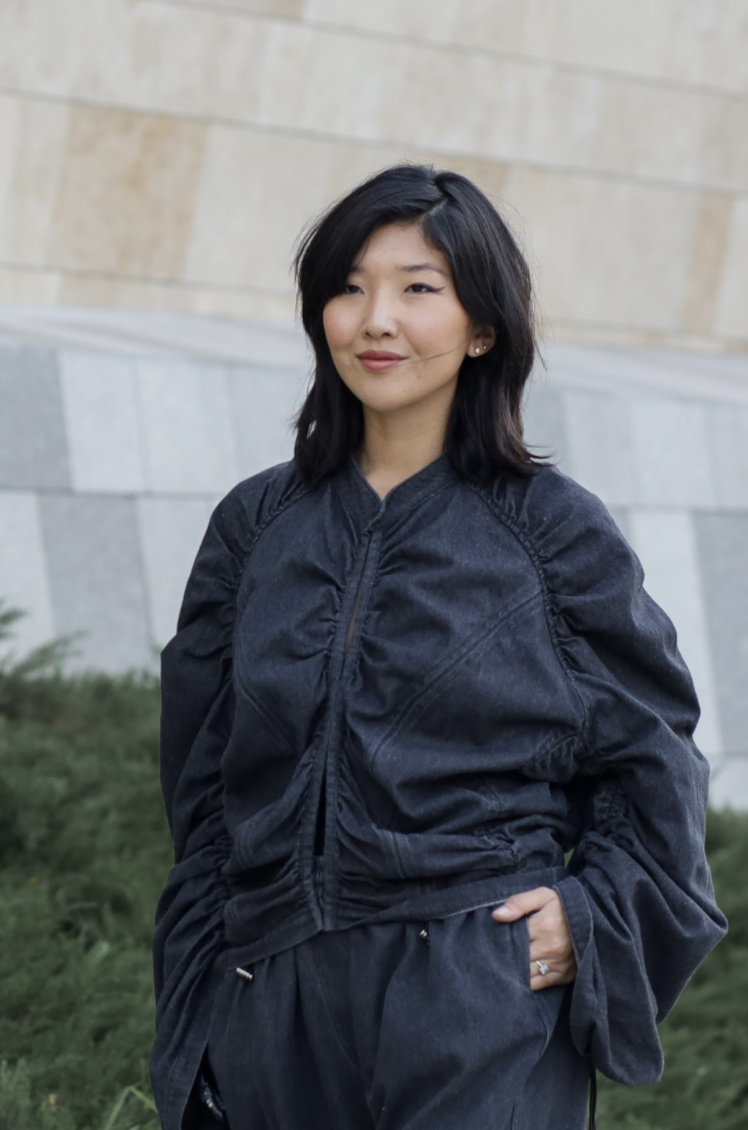
When Aymana Moldabekova talks about her childhood, she remembers two homes, two worlds. She was born into a full family in northern Qazaqstan, but life quickly took a different turn. “My grandmother took me in for what was supposed to be just a month,” she says with a soft smile. “But I ended up staying with her for life.” Her grandmother raised her in Almaty, the city that would become the birthplace of her dreams, her self-discovery, and her bold entrance into the world. She was a child who noticed everything, how people looked at her missing hand, how she felt different. “I had a prosthetic, but it was heavy, uncomfortable, and got dirty easily,” she recalls. “As a girl, this made me feel unattractive.” Children can be unfiltered, and she learned early how deeply society treats visible differences. Yet even then, something inside her persisted, a quiet ember of self-belief waiting to ignite.
Her grandmother was her anchor, the person who taught her to walk into life with grace and strength. Genetics, she often jokes, gave them both flawless skin, “People always commented about how my grandmother didn’t have a single wrinkle at 100.” But what Aymana inherited most was resilience, a soulful mix of aqyl (mind), zhurek (heart), and what would one day become her superpower: qairat (will). School could be lonely. She hid behind silence, defending herself against curious stares and questions that stung more than anyone knew. “I was very reserved,” she says. “I didn’t want to put myself out there.” But university changed everything. In university, surrounded by new people with bigger dreams, she began testing her own courage. She became a class representative, took on projects, worked jobs that pushed her into the world. She met entrepreneurs, ambitious, self-driven, and something inside her woke up. “Their work inspired me,” she says. For the first time, she saw a life beyond hiding. But the defining shift came when she stepped into modeling, first in Qazaqstan, where she was rejected. “They didn’t want me,” she admits, the memory sharp but not bitter. Then came Moscow. Then Istanbul, where everything transformed. “In Istanbul, I achieved great results,” she says, her eyes brightening. There, her difference didn’t make her lesser, it made her unforgettable. Her Asian features stood out. Her prosthetic arm made designers pause, not out of pity, but admiration. She didn’t need to fit the mold; she became the mold. She began to craft a new identity. “I embodied the image of a cyborg woman,” she says, proudly. Not a victim, not someone needing sympathy, but a futuristic figure standing defiantly against limitations. She styled herself in latex suits and sharp silhouettes. She made the metallic lines of her prosthetic part of an aesthetic, a statement. “Why be like everyone else?” she would think. “That’s boring.” She turned what society labels as “defect” into an attention-grabbing artistic edge. Confidence, once fragile, expanded until it sparkled into something powerful.
Her disability was no longer something to hide, it became her storytelling voice. When she returned to Qazaqstan in 2019, she was on fire. “I wanted to prove that I was worthy,” she says. She bought a smartphone with a good camera and began photographing women, not just their bodies, but the parts of themselves they had forgotten to love. “They would say, ‘Wow, I didn’t know I was this beautiful!’ That’s what fills me with joy,” she says. Her philosophy is simple: beauty is not something to earn, it is something to reveal. She built her business organically, through Instagram, through energy exchange, through the art of seeing others fully. She registered as a selfemployed entrepreneur. She organized posing workshops, modeling events, collaborations with global brands like Samsung. She stood on both sides of the camera, subject and creator, making the spaces she entered bend to include her.
And yet, entrepreneurship is never a straight runway. Her life is shaped by intensity, periods of nonstop hustle, followed by collapse. “I’m a creative person,” she explains. “I struggle with consistency.” The very spontaneity that fuels her creativity also exhausts her. When she burned out at 27, after political unrest, global crises, and losing her beloved grandmother, she pushed herself deeper into work instead of grieving. “My project failed, and I had to return the investment,” she says. “It was the biggest burnout I’ve ever had.” The financial pressure suffocated, but the emotional pressure nearly broke her. Only nearly. She clawed her way back through therapy, through walking, through yoga, through lying in hammocks in Istanbul under forgiving sunlight. She rebuilt herself with every breath, reconnecting mind and heart, the mind that plans and the heart that feels. “Now, I’m working on balance,” she says. “I want to grow steadily and comfortably.” She no longer needs armor to feel powerful. She no longer wears her prosthetic just to silence pity, now she wears it only when she chooses. “Sometimes, I even forget I don’t have a hand,” she laughs lightly. And when she goes into meetings bare-armed, she does it to remind herself that her worth exists without props. What used to be a wound is now a crown she can put on or take off. Her identity did not fracture because of disability, it expanded. Entrepreneurship also became a space where she could shape her own truth about inclusion.
“I’ve never felt discrimination in business … I used my disability as a resource, at certain moments, it even worked to my advantage.”
Instead of limiting her, it amplified her uniqueness. She collaborated on inclusive fashion shows, created content that made disability visible without victimhood. She reminds others, “People with disabilities who achieve success don’t fixate on their condition.” Not denial, transcendence. She is passionate about women’s spaces, storytelling, and representation. “I want a women’s community,” she says. “A place where women can come together, and no one is labeled as ‘this kind of woman’ or ‘that kind of woman.’” A two-story creative hub in her imagination, filled with women who grow together, not compete. Her business dreams are not just about income. “Money is secondary,” she says. “I’m more of a spiritual person.” Purpose matters. Transformation matters. The way a woman looks at herself afterward, that matters most. She likes competition, healthy, inspirational. She likes the feeling of watching someone succeed and thinking: I can reach that too. She sees independence not as rejection of help, but freedom from dependency. “If you want to achieve something, you have to do something for it,” she says. “Success is in your own hands, literally or not.”
There were moments when she considered traditional employment, stability, routine, but she realized she does not thrive in cages. Her creativity demands flexibility, mobility, bursts of genius followed by sacred rest. “I’m introverted,” she says. “I need time to recharge.” And she honors that now. She sees rest not as weakness but as renewal, a new form of wellness and inner well-being. Throughout her journey, friendship has been essential. “My friends supported me the most,” she says. “Emotionally, morally, even practically.” Her friend Zhulzhan became a mirror of strength during dark nights: reminding her who she is, pushing her to rise again. She learned that support is not dependency, it is community. Her grandmother’s passing remains her deepest sorrow, but even grief taught her resilience. Loss stripped away illusions and left her with clarity: life is fragile, ambitions must be lived now, not “someday.” She wants to lead women toward joy, not perfection.
Her vision for the future is not small. She wants to tell women’s stories, not only the glossy ones that land covers, but the raw ones that carry truth. Women without children at 35. Women who can’t pay employees one month. Women who are still searching. Women who exist beyond success metrics. Stories that hug, not judge. Her disability was never an obstacle, it was a frontier. A portal. An invitation into a life she created from her own brilliance. It helped her cultivate a worldview that resonates deeply with Abai’s teaching: strength is not loud; it is lived. Dignity is not ordinary; it is earned through self-respect. Knowledge comes from experience, and the fullness of a person, the Tolyq Adam, emerges when mind, heart and will are in harmony. She found her willpower in the fire of proving herself. She found her heart in lifting other women. She found her mind in learning how to rebuild after falling. Now, at 29, she is entering a new chapter, one where she no longer performs confidence just to feel it, but embodies it from within. She is building a life where work supports well-being, not consumes it. Where she is surrounded by women who challenge and inspire her. Where she rises without needing to fight shadows anymore. She has fully accepted herself, and that acceptance radiates outward, shaping how others see her too. “If you feel comfortable with yourself,” she says, “society will mirror that back to you.”
Her disability does not define her, but she defines what disability can look like in Qazaqstan: futuristic, bold, magnetic, unafraid. She is not just creating a business. She is creating belonging. She is not just photographing women. She is helping them see their own beauty. She is not just modeling difference. She is advancing what beauty itself means. She is the first cyborg model from Qazaqstan, and she owns that title proudly. She will grow, scale, and build communities. She will raise families and create safe spaces. She will travel between Almaty and Istanbul and wherever her dreams pull her. She will continue to turn what others fear into the thing that makes her unstoppable. She once wanted to prove she belonged. Now she knows she leads.