Andrey exhibits reasoned, learning faith (aqyl). He keeps studying — courses, seminars, technologies, because he knows that integrity without knowledge can drift into piety without use. His factory math (ratios, weights, lifespans) and policy critique (life-cycle cost, Environmental Code) show the aqyl Abai demands of conscious believers. Truth over expediency: Abai warns against bending truth to fit convenience. Andrey challenges the “declarative” slogans that praise inclusion and ecology while rewarding the cheapest bid. He pays taxes “here, in my country,” files patents, asks for real mentorship, practices that bind words to deeds. Unity of aqyl-jurek-qairat (mind-heart-will): He marries technical reason (designs, molds, standards), a heart oriented to usefulness (“Success is being useful — Not for yourself, but for society”), and willpower that keeps showing up. That harmony is Abai’s measure of a whole human.
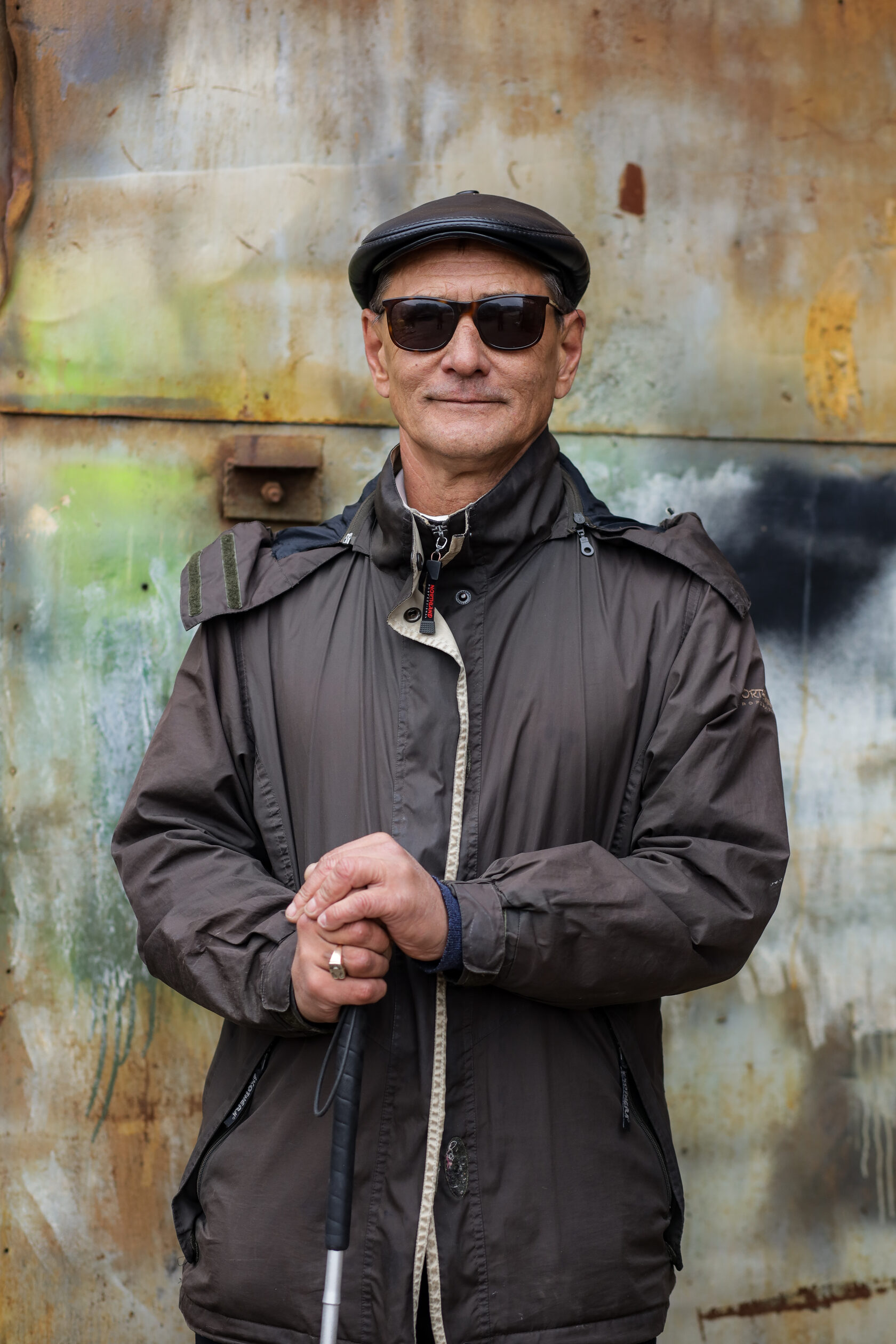
He introduces himself simply, “My name is Andrey Zelevsky, I am a social entrepreneur,” and then lets the work carry the weight of the narrative. In a district he calls one of the city’s best, the floor hums with the rhythm of recycled life: household plastic sorted by touch, ground down, measured by memory, pressed into blocks, curbs, paving tiles, and tactile indicators that guide the feet of blind and low-vision pedestrians. He is completely blind. Yet what most people step over, he has learned to hear: the shift of sacks, the scrape of pallets, the faint burr of a machine that needs adjusting. “Independence,” he says, “is when a person feels freer, when he knows what he’s doing.” He has fenced and organized the workshop so each movement is reliable. In that practiced order, aqyl (mind) finds its lane, qairat (will) keeps the pace, and jurek (heart ) remembers why the work matters. Andrey’s stubborn sense of responsibility began at home. “I cannot allow myself to throw trash around. My parents didn’t do that. My grandparents didn’t do that.” Sorting waste in the kitchen, teaching his own children to separate bottles, he carried a small ethic into a larger ambition: we are the state. If our streets are cluttered, our hands clean them. Long before this enterprise took form, he watched other entrepreneurs, “self-sufficient, confident, working 24/7,” and understood selfsufficiency as the ability to live with dignity, not just to earn. “To live with dignity … in a dignified country,” he says simply. That sentence became a compass.
His first venture started in 2007, when a wave of rhetoric promised special support for small and medium businesses, particularly for people with disabilities. He set up production of paving stones from sand and concrete because cement was cheap and near at hand. The promised scaffolding for founders with disabilities turned out to be mostly words, “declarative,” he calls it, so he paused without closing. The seed lay dormant but alive. A decade later, EXPO 2017 gave him a platform and a name for the impulse that had trailed him home from every curbside bin: Green Wave. He presented mobile shredders and a generator that could be hauled to landfills or forests to recycle at the source. People voted; he won; the shredder sold; he purchased the generator himself. When the borders tightened and logistics went strange in 2019–2020, he found local masters and used a 5.6-million-tenge regional grant to fabricate a press mold. The tile line began
The work is exacting. By touch he tracks distances, calibrates heat, counts the beat of the press. “Everything by touch, everything measured,” he says. He knows that a good 20-millimeter tile that will last requires roughly fifty kilograms of composite; that for each kilogram of plastic, he needs two kilograms of sand; that a thin PET bottle might weigh twenty grams, and he’ll need buckets of them to make one strong square. The factory math is mixed with father math, commuting to kindergarten drop-offs, then to the shop; training in the weight room; calling clients on the way home. He is a national champion and a world champion by rating in powerlifting. In bench press, squat, and deadlift, he has lifted a combined 395.5 kilograms, setting multiple records for Qazaqstan. “There’s satisfaction in producing less waste,” he smiles, and then, after a pause, adds the harder truth: “Monetization is a question. Ecology is a state task.” He knows that business coaches want to see the cash first. He also knows that every durable square he lays keeps 500 bottles’ worth of plastic out of a ditch and places a reliable texture under the cane of someone who navigates the city the way he does, by faith and fingertip.
His inventions, blocks and tiles, are patented; he holds the exclusive rights. The Environmental Code exists on paper; procurement rules once allowed recycled producers into tenders and now, he says, bar the door. Contractors choose cheaper tiles and pad margins; the cheap ones crumble in two or three years, and the city pays twice. “It all comes down to responsibility,” Andrey says, and then, more softly, to upbringing: whether one buys the leaky faucet again or saves for the one that lasts, whether a country replaces the quick fix with the long repair. There are bright spots: he completed a supplier contract under “Samruk-Kazyna,” delivered successfully to the “Welfare” fund, and placed his tactile tile at the Tolstoy Library, the district cultural center, the social protection office, and the central hospital.
Schools come for excursions; children take a small piece back as proof that yesterday’s trash can become tomorrow’s path. “When I first succeeded,” he remembers, “my daughter told everyone: ‘Dad makes gold!’” A Pakistani dye flashed under the lights; the tile looked like hammered metal. The child’s exaggeration rang true: the ordinary, turned luminous. Blindness is part of the narrative, but not the plot. He stands at a press conference when inspectors arrive and escort him out, surprised that “a disabled person” is working. He shrugs off the category. At the machine, your hands don’t show your label. He has met ministers and heads of departments who applaud his mission and then, in the chain beneath them, watched buyers tick the cheapest box. He has seen how easy it is to close a bank account and how hard to open a mind. “There’s always a way out,” he says, and you believe him because you hear how often he has chosen to look for one. He returns to courses, training, conferences, anything that sharpens skill. “When someone says they know a lot, I realize I know little.” Aqyl (mind) keeps studying; qairat (will) keeps applying; jurek (heart) keeps the work pointed toward others. Success, for Andrey, is being useful, “not for yourself, but for society.”
He is frank about the strain. Entrepreneurship compresses family time; fatigue finds everybody, working or idle. He has three employees and hopes to hire more when sales stabilize. Seasonality slows orders; websites and Instagram help, but a sales system is hard to build while you are also the inventor, operator, advocate, and father of four. Some nights, he trains; some mornings, he hauls; every day, he tries to widen the circle of use. He has two workshops now, tiles in one, paving stones in the other, and sketches a map for scaling: one or two more shops for the capital, five in Karaganda where logistics are easier. He imagines ritual products, cemetery tiles, fences, mobile constructions, so that recycled dignity accompanies people from the clinic entrance to the last, quiet lane. The barriers he names are familiar to many founders, but carry a special edge when the founder cannot simply “go here, go there” to collect forms, argue clauses, or chase signatures. “The hardest thing is getting the right information,” he admits. Digitization and AI promise clarity; the lived experience still depends on human consultants who rush the explanation. He wants a mentorship system with teeth: practical guides embedded in departments, real accompaniment after a grant lands, not just a reporting deadline and a handshake. Social entrepreneurship, he insists, should work like venture funding, initial bets, then staged support for the few that prove both useful and viable. He has applied to platforms abroad and at home, to the Nazarbayev Fund, the Ministry of Industry, the Industrial Development Fund: “so far, silence.” He has also learned to solve problems near hand, local machinists for the mold, neighborhood containers for collection, his own children bringing sacks of bottles from the kitchen to the shop
It would be easy to cast Andrey as a lone hero pushing against indifferent structures, but his narrative is braided with a quieter ecosystem — steady family, chance allies, and a cultural memory that refuses waste. “Our ancestors never left a mess behind,” he says. Iron was reused, not scattered. That ethic threads through his days, along with a practice of gratitude: when the regional contest called his idea “unprofitable,” he returned five more times until it wasn’t. When a promised order fell through, he recorded the loss and kept the line running. When someone quipped that he was “lucky” to have a pension and a business, he explained the taxes he pays and the pride of paying them “here, in my country,” so that public funds cycle back into public good. When a child at kindergarten asked what he makes, his own child answered “gold,” and he let the metaphor stand. In a moral economy, durable, accessible paths are a kind of treasure. There are plans on the table that widen the horizon beyond tiles. The problem of diapers, absorbents and fabric choking landfills, has him thinking of extraction for irrigation and reuse as insulation, the way he’s heard it done in Korea. He wants a nursery for seedlings paired with recycling, a small proof that new life can grow where we refuse decay. He talks about responsibilities, not punishments, about how rules zigzag and yet people can be taught to care for what lies underfoot. He tells young founders with disabilities to “plan carefully, learn to assess risks,” and tells those denied once not to curl inward: try again, ask for help, document better. He tells officials that recycling doesn’t mean inferior, and tells buyers that cheap means paying twice. He tells his children that trash is a resource misnamed.
If you listen long enough, the inner architecture of Tolyq Adam reveals itself without exposition. Andrey keeps learning because certainty without knowledge calcifies; he keeps showing up because knowledge without discipline dissolves; he keeps centering usefulness because discipline without compassion corrodes. He is not interested in pity or sainthood; he is interested in a city where a blind man can walk to a library on tactile tile that does not break in three winters, where a schoolchild can feel a ribbed path through a crowded courtyard, where a truck full of bottles becomes a courtyard that drains, a curb that does not crumble, a cemetery lane that does not wash away with the first thaw. He wants institutions that mentor rather than merely measure; he wants procurement that counts lifespan, not just unit price; he wants workshops in which people with and without disabilities work side by side because at the press, labels do not hold a wrench. He says success is being useful. In the register of impact, usefulness is not small. It lives in the district hospital’s entrance where a cane tip clicks and knows where to go; in the social protection office where a visitor feels the studded warning underfoot before the steps; in the cultural center where the new tiles run straight and true; in a library named for Tolstoy, where literature meets a textured line of equal access. It lives in the sacks of plastic his children carry and the patience with which he explains that 50 tons of plastic is twenty train cars if you don’t compress it, that recycling is not a gesture but an industry, that there is always enough waste to work with if only we choose not to waste people.
“Either you do something yourself,” he says, “or decisions are made behind your back.” And so he does: presses tile, files patents, trains lifts, answers schoolchildren, shows inspectors what a working body looks like when it moves by touch and reason, keeps writing letters and filling forms and asking for the mentorship that might make the next founder’s path straighter. There is nothing declarative in his shop; only the declarative memory of a culture that used everything, honored labor, and understood that dignity is not given, it is practiced, square by square, until the city learns to feel it underfoot.