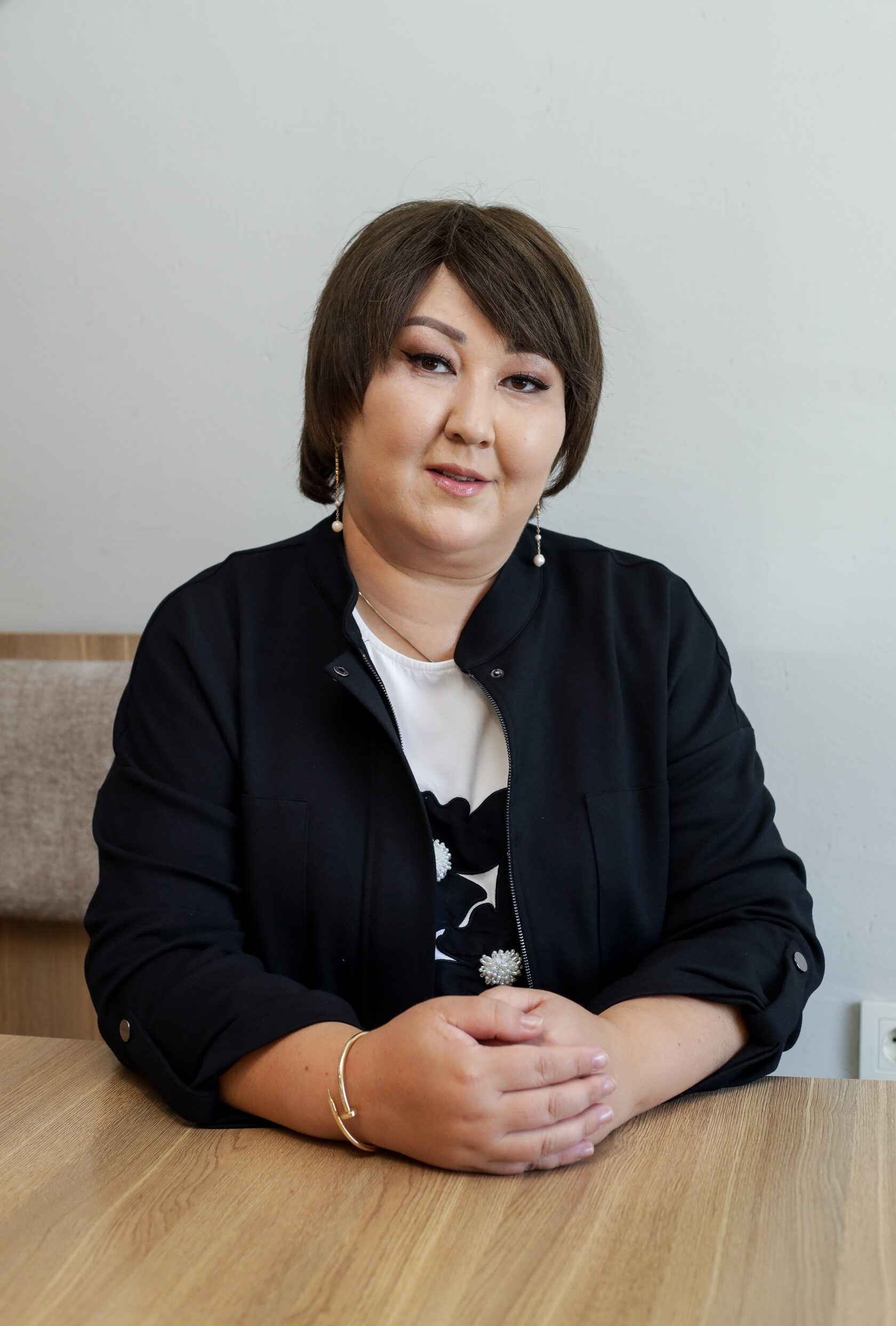
Where Abai warns that satiety can make a person indifferent, Aigul continuously reawakens gratitude, finding joy not in having more but in helping more. When her illness forced her to pause, she did not sink into despair or tire of life as Abai feared; instead, she found renewed clarity: she must recover not for vanity but “for the children, for my husband, for my mother.” The instability of worldly comforts did not embitter her; it purified her priorities. Her dreams, to teach others, to hire differently-abled youth like her son, to feed children quality food, resist the restless desire for more that Abai cautions against. She anchors herself in what endures beyond earthly excess: mind, heart and will working in harmony.
Aigul Imanserikova’s path began far from the polished counters of her presentday café. She grew up in Almaty as an only child, her mother working double shifts, one week leaving before sunrise, the next coming home long after dark. Silence filled the apartment, and a young girl learned self-reliance. Her mother would explain a recipe in a rush before running to work; Aigul would test it alone, carefully watching dough rise in a small oven, trying not to burn the cakes. At fourteen, she stood over a waffle maker, inhaling the scent of warm sugar and discovering that baking gave her a quiet sense of joy. Her academic path followed the respectable script expected of highachieving Qazaq girls, finance, a red diploma, a stable job at Halyk Bank. She married, had two healthy children, built a life that looked secure and familiar. Nothing suggested that she would one day run a business employing twelve people while navigating the daily reality of caring for a child with cerebral palsy, and later, her own cancer diagnosis.
Everything changed in 2011, when her third child was born. Something felt wrong from the beginning. “By four months, my older two were already turning over,” she says. “He couldn’t even hold his head.” Doctors dismissed her concerns, but her jurek (heart), a mother’s knowing heart, refused to be comforted by empty reassurances. He didn’t follow toys with his eyes or respond to her voice. Finally, at one year and two months, the diagnosis arrived: cerebral palsy. The identity she had built as a bank professional dissolved in an instant. Even the offer of three years’ maternity leave felt meaningless, her son would need much longer. For five years, her life became a relentless routine of physical therapy, speech therapy, and trips to hospitals. She searched nights online, looking for treatment options abroad, writing messages to strangers. When a sponsor covered their first trip to China, 15,000 dollars, she saw results. “After that first trip, he began to walk,” she recalls softly. “There were real results. How could I stop?”
During those years, money was tight. Her husband became the sole breadwinner while therapy costs multiplied. Still, her resolve stayed firm: “I told myself: my life is already lived. His is just beginning. I must do everything so that he can at least say, ‘I’m thirsty,’ when I’m not near.” When her son was finally strong enough to attend kindergarten at five, Aigul suddenly found a few hours of silence each day. Into that quiet stepped her childhood hobby, baking, now carrying an adult purpose. Her eldest daughter won a mixer in a raffle, and a classmate invited Aigul to a cupcake masterclass. “I thought I would just learn something for the kids,” she smiles. Instead, she found herself surrounded by women already running small businesses. The spark caught fire
She started with simple orders in her home kitchen, neighbors buying pies “just to support her,” she jokes. But each order nurtured her qairat (will). She woke at three in the morning to ensure cakes were ready by eight. “If I promise, I must deliver,” she says. Fear sat quietly beside her, fear of disappointing customers, fear of never earning enough, but she kept going. Her mother, shaped by Soviet expectations, worried: “You have a finance degree. Why tire yourself at night? Find a normal job.” But Aigul had glimpsed a life in which she could earn income and be present for therapy sessions, school pickups, and doctor visits. “I realized this is my thing,” she says simply. “I enjoyed it too much to go back to an office.” By 2019, her home bakery gained recognition. The Auezov district akimat offered her a free room, but on one condition: she would teach other mothers. That room became more than a workspace; it became a refuge for single mothers, large families, and parents of children with disabilities. They baked, but they also shared burdens, finding winter coats for each other’s children, making sure no one left feeling alone. “It wasn’t just about baking,” Aigul says. “We all needed human connection.” Then the pandemic forced the room to close. Instead of collapse, demand increased, people stayed home and ordered baked goods. Her father-in-law saw how she was running herself ragged and built a 40-square-meter workshop in their yard. The business became inseparable from family life. Children passed plates through the workshop door, helped measure flour, and reminded her to rest. “My business became my fifth child,” she laughs, a living thing she nurtured alongside her four children. Her next leap required aqyl (mind). In 2023, she heard about a concessional loan program for parents of children with disabilities. After careful planning, she borrowed 32 million tenge to buy professional equipment and open a café. Her mother sold an apartment to buy her a small commercial space: “It’s old and lower district,” Aigul says, “but it’s ours.” That word, ours, carries security no salary ever gave her.
The café expanded beyond desserts, offering healthy meals for busy mothers and semi-prepared food for families. Today she manages two production spaces, a café, and a team of twelve. The business is still a family ecosystem: her son with cerebral palsy now works part-time assembling boxes, practicing motor skills while earning his first wages. Her daughters help with packing and deliveries. “Everyone works,” she says. “No one just sits on a phone.” Aigul holds tight to a principle that echoes Abai’s Words: true distinction comes from conscience, reason, and goodness, not wealth or display. “Our products have always been natural. I’d rather sell less but sleep peacefully.” She refuses artificial additives and kindly redirects parents wanting neon-colored cakes: “My own children eat this. It must be good.” In February 2024, another shock arrived. A routine surgery revealed cancer. “I planned to return in three days,” she says. Instead, she received a diagnosis requiring chemotherapy and disability status, this time for herself. Her husband cried: “What will I do without you?” She answered calmly, “Don’t worry. I’m not going to die. We will fight this.” When her hair fell out, her youngest son searched the internet for cures, bringing her blankets and socks, trying to protect the mother who had always protected him. Chemotherapy forced her to release control. Her family, and team, ran the business while she was in the hospital. It survived. “For the first time I realized I can delegate,” she admits. Her mind, heart, and will, aqyl (mind), zhurek (heart), qairat (will), began to align in a healthier balance. She learned to lead without burning her own flame down to the wick.
Still, systemic barriers remain sharp. Therapy is expensive. School options for children with disabilities are limited to trades that do not suit her son. “We must grow the business so he will have work,” she insisted to her husband. After meeting a young entrepreneur in Astana who hires baristas with Down syndrome, she started dreaming of a café where her son could one day prepare coffee for regulars, inclusion not as charity, but as dignity. Support has arrived in pieces, a free room to teach mothers, two equipment grants, the concessional loan, the MAMA PRO project where she updated digital skills and wrote her first business plan. But the real safety net has been people: her husband, her mother, other mothers she once taught. Women call her daily: “How to open a company? Where to find boxes?” She answers everyone. “It’s nice when you’ve already walked this path and can help someone else avoid mistakes.” Yet she is honest: guilt is a companion. Some nights she comes home exhausted, worried she has not given enough love or attention. Her eldest daughter grew up too fast, helping feed siblings while Aigul baked through the night. “Women without children can focus on business,” she says. “We must always switch between everything.” But motherhood was always the source, the motive, the reason the business exists at all. Asked what success means, she does not mention profits. She tells a story of a woman she admires, a single mother who built a cafeteria and now pays for an employee’s child with disabilities to receive treatment.
“That’s who I want to become … Not just for myself. So that my work helps others.”
Her short-term goal: pay off the loan. Her long-term vision: multiple cafés, a steady future for her children, and a place for her son to work proudly. Above all: speech and strength for him, health and happiness for all four. Aigul’s life reflects Abai’s ideal of the complete human, where ‘mind’ guides, ‘heart’ humanizes, and ‘will’ sustains. From a lonely girl baking in a cramped kitchen, to a mother believing for her son’s first steps, to a woman rising after cancer to keep her fifth “child” alive, she rebuilds herself again and again with quiet courage. Her only supporter in these challenges was her mother, who believed in her and her ideas. She has not merely opened a café. She has created a world where resilience is baked into the dough and inclusion is served without being named. A world where success tastes like dignity, and smells faintly of warm sugar.