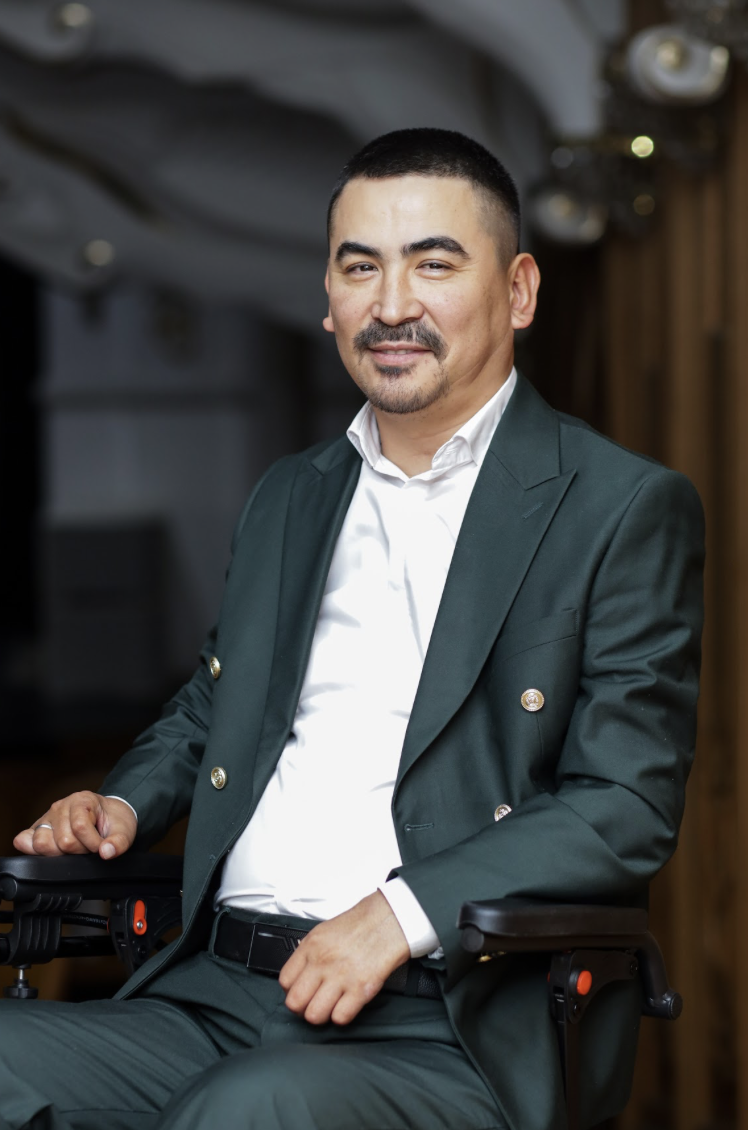
Arnur Iskakov was born in the wide, quiet spaces of Abai district near Semey, a place where the horizon stretches like a promise. His childhood rhythms included school by day and village gatherings by night. But the heart of his earliest fascination was his grandfather’s small rural theater, a simple stage where neighbors transformed into kings and poets the moment a sheet of fabric rose as a curtain. Creativity lived in that family without needing a formal introduction. At school, Arnur was drawn to the stage. He was the student who volunteered for concerts, who sang and danced freely. Still, when it came time to choose a profession, he followed a different dream: “My dream was to become a therapist, a practicing physician,” he says. Medicine felt respectable, a path of service and stability. Creativity would remain a passion, but not a profession.
For five years he studied diligently, nights filled with textbooks, days filled with jokes and improvised skits that made classmates laugh. He imagined a predictable future in a white coat. But early in his sixth year, everything abruptly changed. An accident left him with a spinal injury and dependent on a wheelchair, “more than ten years now,” he adds quietly. Suddenly, the plan dissolved. In addition to the physical trauma, he faced a harsh shift in society’s gaze, a postSoviet assumption that disability means invisibility, dependence, and staying home on a pension. He felt a clash inside between aqyl (mind) asking what comes next, jurek (heart) craving meaning, and qairat (will) refusing to give up. “This will not define my life,” he told himself. He stepped away from medical school and began reconstructing a future that could still hold purpose. His first professional steps after the injury led him into politics, to “Jas Otan” the youth wing of the “Amanat” (then “Nur-Otan” party. There, he found a way to channel his desire to help others like him. He launched Kederğisiz keleșek (Future Without Barriers), a project still active today. “I created this project,” he says without pride, but with conviction
The work reignited his creative flame. He transitioned from politics to radio, hosting programs at Astana radio, and then to television, followed by filmmaking. He even created a movie about his own transformation, titled Life After… Media became his method of showing that life after trauma is not a dead end, but a different kind of script. The idea of an inclusive theater did not arrive suddenly. It formed gradually from the dust-filled backstage memories of his grandfather’s theater, the advocacy for people with disabilities, and his work in media. The key turning point came in 2018, when he helped organize the first international festival of special theaters in Qazaqstan. Watching performers who were deaf, blind, or in wheelchairs take the stage with power and confidence made something inside him say: “This must exist here not once a year, but every day.” Thus was born “Qanattylar” (Those with Wings). He had already begun planning in 2017, but the festival solidified his resolve. He pushed forward with proposals, negotiations, and perseverance. The Zhasstar Theater welcomed his idea, and Qazaqstan gained its first state-backed inclusive theater, founded and led by a person living with disability.
Today, the theater has around fifty members, more than half of whom are “special people,” as Arnur calls them, actors with different forms of disability who work alongside able-bodied professionals. Their repertoire includes dramatic and autobiographical productions, as well as a children’s performance entirely in sign language. When the lights dim and the curtain rises, Arnur’s belief becomes visible: disability is not a deficit, it is a different way of expressing life. This work, however, demands strength beyond creativity. He handles administration and directing: “I do both,” he says, “but of course the creative side is closer to my heart.” Yet a constant challenge remains: “In Qazaqstan, there are still no specialized programs for special actors or directors.” Rehearsals involve not only teaching theater, but re-teaching belief in oneself. The barriers he faces are not mainly about steps or doors. “The main thing is understanding and attitude,” he emphasizes. Ramps matter, but respect matters more. Too often, he still hears attitudes rooted in Soviet legacies: people with disabilities should “stay home,” be passive recipients of pity.
He deeply rejects this idea. “Inclusion is not about pity, it’s about equality,” he says. He dislikes even the word “disabled.” “We are all people. Everyone should contribute.” He has also observed fragmentation within the disability community, separate organizations for the deaf, the blind, wheelchair users, each operating on islands of struggle. “We have the same problems: housing, education, employment. Why not unite?” His theater is his answer, a collective of wings moving in one direction. But even the wings get tired. “Yes, right now is exactly such a period,” he admitted during the interview, his face revealing fatigue. Burnout forms quietly, through endless paperwork, limited support systems, and the emotional labor of holding others’ hopes. What lifts him? “My wife. She always advises and supports me.” And simple things: music, nature, a sauna, silence. “Sometimes I just need rest.” He draws philosophical guidance from Abai, where mind, heart, and will negotiate balance. “They come to unity,” he says, a unity reflected in his own life: mind that strategizes, heart that cares for “special people’s” dignity, and a will that refuses to surrender.
His values have transformed. “Before, it was important just to earn money,” he reflects. “Now success is having a good wife and a job you really enjoy.” Spiritual calmness has replaced material ambition. He lives more fully now, not despite the wheelchair, but through what he has created from it. Arnur continues to dream. Short-term: a permanent building for the theater. Long-term: a cultural development center for people with special needs, not just theater, but film, music, training, and opportunities for social participation. “If I continue entrepreneurship,” he says, “it will be in the media, something that inspires and has meaning.” He is already shaping a new narrative of entrepreneurship, one rooted in purpose, not profit. Every time a child sees a fairy tale signed on stage, or an adult sees a wheelchair user performing a monologue, the story of disability in Qazaqstan shifts. Well-being for Arnur is not ease. It is equilibrium, waking each day and choosing creation over bitterness. He still confronts discrimination, exhaustion, and a world not designed for wheels. But he carries peace: “to live and enjoy life, no matter what.” When asked whether he would change anything in his past, he answers simply, “No. No regrets.” The accident that disrupted his plans also uncovered a deeper calling: to build spaces where others like him can rise, shine, and be applauded. Through “Qanattylar” ( (Those with Wings), Arnur Iskakov has become a quiet force of social imagination, proving that “special people” do not need pity or permission. They need a stage. And wings.