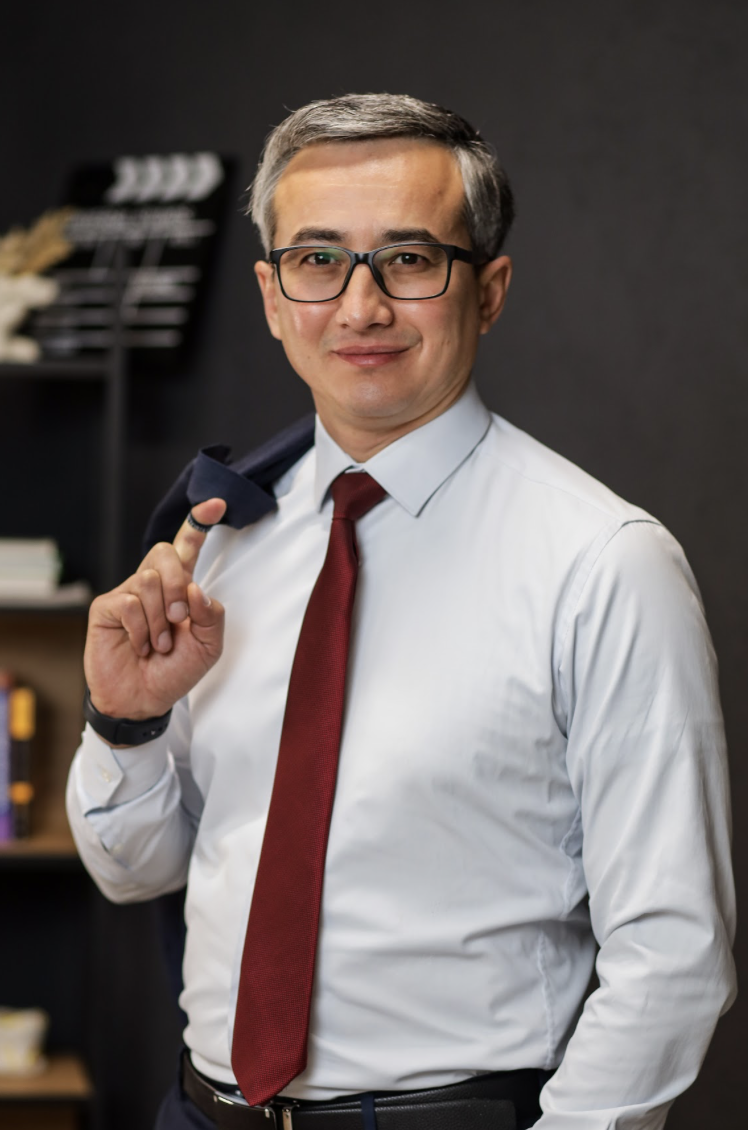
There are people whose lives take shape not through ambition or the pursuit of wealth but through a quiet, persistent calling that refuses to be ignored. For Emin Askerov, that calling began before he even understood it. He grew up listening to his mother’s stories, told late at night after long days working as a district social worker in the early 2000s, when electricity was often cut and salaries went unpaid. She would return home exhausted and tell him about the elderly people she visited, the families she helped, the children whose lives hung on tiny acts of compassion. “My mother shared their pain with me,” he recalls. “I grew up hearing these stories. That’s how it all started.”
These stories planted in him an understanding that service was not a profession; it was a way of being. Years later, when he found himself working in one of the most prestigious institutions in the country, with a good salary, a personal office, a stable routine, he felt none of the satisfaction he imagined success would bring. Instead, he felt something that surprised him: a profound emptiness. “Everything was going so well,” he says, “and that was the problem. There is no middle ground in nature. You either develop or you degrade. I realized I was degrading.” It was in 2014, during this period of internal discomfort, that he first encountered the term “social entrepreneurship.” He remembers the moment vividly. “
I’m a kind person. And I always wanted to do business. But I wanted something that had meaning. When I heard about social entrepreneurship, I thought, ‘Wow… this combines both. This takes my heart.’”
The idea electrified him. Suddenly, the quiet calling he had felt since childhood had a name, a form, a possible path. He walked away from stability and stepped into uncertainty. “Ninety-eight percent of the people around me said I was a fool,” he says. “They told me: you won’t survive, they won’t survive, this isn’t realistic.” But he could not imagine trading more of his life for comfort without purpose. “Life is too short to work a job you don’t like,” he says simply. “I decided to take a chance.”
His first attempt was disastrous. He launched a handicraft workshop based on felt weaving, an area he had no expertise in, and within a year, they had lost 5.5 million tenge. “It was a complete failure,” he admits. “I realized I was a bad businessman. I didn’t have the skills. And my team was suffering because of me.” He calls this period “the first crisis,” and he remembers preparing his farewell speech to his staff multiple times while driving to work. Three times he drove with a rehearsed apology on his lips, ready to close down and send everyone home. Three times he could not do it. “It was too painful,” he says. “People were coming not only for money but for the chance to belong. They had been sitting at home for years. They needed this.”
He decided instead to learn. For three months, he attended business trainings, often for free because, as he jokes, “I must have had the look of a loser.” But those three months transformed him. “I understood that business is like a Rubik’s cube,” he says. “If you don’t know the formulas, you will never solve it.” He learned systems, quality control, sales, the logic of clients and markets. “The most important person in any business is the client,” he says. “Without a client, there is no business. And we had been creating what we wanted, not what anyone else needed.” Armed with new knowledge, he closed the failed workshop and reopened as a sewing and production workshop focused on specific, high-demand services. Slowly, success began to take shape. Today, his enterprise, now known widely in Qazaqstan, employs around 45 people across multiple workshops in Astana and Pavlodar, with services ranging from sewing and printing to wooden toy production and corporate gifting. They serve top hotels, government institutions, and schools. “People think I became successful because I was first,” he says. “But no, I was simply the first to speak loudly about it.”
His workshop became known for something more remarkable than its products: its people. Emin hires individuals who are systematically overlooked, people with physical disabilities, intellectual disabilities, hearing impairments, former prisoners, orphans, single mothers, and others who have lived entire lives in the shadows of stereotype and exclusion. “People ask me whether it is difficult to work with them,” he says. “I always say: it is much easier to work with them than with ‘normal’ people. Their motivation is off the charts. If you’ve been sitting at home for 30 years because no one believes in you, not even your parents, then you give everything to prove you are capable.” He selects not by skill, but by spark. “I look for one thing,” he says. “A sparkle in the eyes. If I see that, they can learn anything.” Some of the most powerful stories in his life come from moments when people defied expectations
One of them is the story of Farhat, a young man who had lost 95% of his vision after a weaving accident. When he arrived at the workshop, he asked Emin only for a chance. “He told me, ‘I’ve been sitting at home for five years. No one will hire me,’” Emin recalls. Emin didn’t think Farhat would last even a week. “Weaving requires perfect vision,” he says. “I didn’t want to refuse him, but I also didn’t give him a stipend. I expected he would leave soon.” Instead, Farhat showed up every day, first to arrive, last to leave. For months, he made no progress. Emin prepared, more than once, to gently let him go. But every time he saw Farhat hunched over the weaving frame, hands trembling but determined, something stopped him. And then, after four months, a miracle: Farhat produced his first perfect basket. “When I saw it,” Emin says, pausing, “I could barely hold back tears.”
The muscle memory had taken over; his hands had learned what his eyes could not see. He went on to become a master weaver, teaching others. Eventually he left, not due to failure, but because he discovered a new calling. He founded his own public foundation teaching blind people how to use smartphones and laptops. When Emin later saw him selected among the 50 best social projects in Qazaqstan, he hugged him with pride. “He became my mentor,” Emin says softly. “Whenever I face something difficult, I remember him. If he could do that without sight, then what excuse do the rest of us have?” Another story is about Ibrahim, a young man with intellectual disability whose family asked Emin simply to give him a place to belong. They never imagined their son would earn a salary. Emin decided to make him the “head of cleaning,” a role that required structure, routine, and responsibility. It took six months of daily reminders before one morning Emin walked into the workshop and found Ibrahim cleaning on his own, without being told. Later, they discovered him confidently using an electric sander, mastering skills no one expected him to. Emin filmed him and sent the video to his family. “They thought he was sanding with sandpaper,” he laughs. “They didn’t imagine he could use a machine.” These stories are not exceptions, they are the core of Emin’s world. “People trust us because they see quality,” he says. “I never hide behind the social aspect. We must compete with traditional businesses. We must deliver excellence.”
He has a rigorous selection and training process, and a mentoring system where experienced workers, often from the same social category, train newcomers. “I never blame a newcomer for mistakes,” he says. “I blame the veteran who trained him. And I do it in front of the newcomer. This creates a sense of responsibility, mentorship. It works incredibly well.” He has built an environment where dignity is restored and people find their “spark,” as he calls it. Over the years, his workshop’s employee turnover rate has remained at 1%. “Every businessman dreams of that,” he says. “Once they find belonging, they never want to leave.” Despite numerous offers, including a recent offer for a Deputy Minister position, he refuses to enter government. “I realized that with today’s bureaucracy, I could drown in paperwork,” he says. “I can do far more for the country from the outside.” He believes social entrepreneurs solve problems the state cannot reach quickly enough. “We free the government from many social burdens,” he says. “That is more valuable than any one official.”
He is now working on building a Central Asian network of social entrepreneurs and pushing for policy reforms, digital systems, and clear implementation guidelines for the laws supporting social entrepreneurship. He dreams of a future in which hiring people with disabilities is not charity, but simply a normal, expected business practice. “A modern society must be inclusive,” he says. “Not ‘helping’ them, but living together as equals.” Through all of this, Emin lives Abai’s philosophy without naming it. His intellect is seen in his systems thinking, his business discipline, and the way he studies international models from the UK, US, Norway, and China. His heart is visible in his empathy, his loyalty to his employees, his refusal to give up on people society has thrown away. His will is reflected in his courage to leave comfort, face repeated failure, and persist until the mission became sustainable. Today, when people ask him how he maintains his energy, he answers with a simple truth:
“The more you give, the more you get. I feel this now.”
He teaches young people, he advises schoolchildren, he mentors new social entrepreneurs, and he continues to give guest lectures on leadership and motivation. He tells children that success requires a mentor, just as Isaac Newton said he stood “on the shoulders of giants.” He encourages them to create innovative social projects connected to their future professions, not clichés. “Don’t walk dogs or visit orphanages just because everyone does it,” he tells them. “Create something meaningful. Something unique.” He also tells them the rule he lives by: “Nothing is impossible.”
Today, the impact of Emin’s work cannot be measured by the number of products his workshop produces or the number of awards he has received. It is measured instead in the quiet revolutions taking place every day among people once dismissed as incapable: the blind young man who became a master and then a founder; the young man with intellectual disability who mastered machinery and now keeps the workshop spotless; the former prisoners who earn dignified updates to their future; the workers who save for homes, marriages, and independence. It is measured in the transformation of society’s imagination: showing what is possible when one person believes deeply, stubbornly, relentlessly in human potential.
Emin often says that if he could live his life again, he would choose the same path, even with the failures. “Those mistakes were my training,” he says. “Only the person who has made the most mistakes can become an expert.” He speaks often about his mission, but when he summarizes it, it always sounds the same, simple and sincere: “We don’t need to help them. We just need to believe in them.” And in believing, he has built a life that embodies the essence of the Tolyq Adam: a person whose intellect, heart, and will are aligned toward goodness. A life where the soul finds peace in service. A life where rising means lifting others. A life where ordinary people become extraordinary. A life where, truly, nothing is impossible.