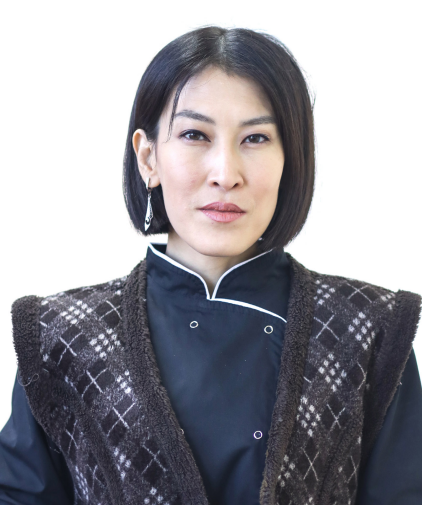
From the first moment she learned to see the world, the world was already blurry. Zhazira Tolegenova was born with a congenital visual impairment, inherited quietly from her father, who also lives with low vision. She says it so simply: “I have visual impairment since childhood.” But behind that sentence is a 26-year journey of adjusting to what she cannot see, and learning that what she can see is enough to shape a full life.
She grew up in Atyrau, in a family where disability was not spoken of as tragedy, but simply as a fact of life. Her father, visually impaired, worked and lived on his own terms. That example planted something powerful in her: a belief that “I feel like everyone else.” She met the man from Karagandy, married him, moved there with him and became a mother of two children. Despite the distance of 3000 km, love made this journey easy. She laughs when asked whether she prefers Qazaq or Russian for the interview, switching comfortably between languages. Identity, for her, has never been one-dimensional.
She remembers trying on many dreams, like any teenager, but one thing was always constant: entrepreneurship. “Everything I notice, I try to turn it into cash,” she says with a half-joking confidence. Where other children saw ordinary things, she saw possibility. Where others waited for allowance, she created opportunity. “The business mindset always worked automatically,” she says, not out of greed, but out of an instinct for self-direction.
In 2020, that instinct became a necessity. She was pregnant with her second child. Her husband had fallen seriously ill, “incapacitated for two years,” unable to work or bring income. They had loans, a family to support, and no salary coming in. “Something had to be done,” she recalls. And so, while the world was shutting down during COVID, she and her husband were stepping out
They registered their company, their sole proprietorship, and bought a freezer and cotton candy machine with their own limited savings. They partnered with a local ice cream factory and began selling ball ice cream from a small stand in their neighborhood. “We hired salespeople, and we stood there too,” she says. It was three months of long days, cold hands, counting coins, but they earned back every tenge and even made a small profit. More importantly, they learned something essential: they could build something together.
It gave them courage. They sold their apartment, partnered with a family friend, and opened a small doner and fastfood business, a kiosk with seating. Her husband led operations with his friend; she handled advertising and Instagram. But something felt wrong. “I couldn’t show my power,” she says gently. Surrounded by men in that business, she felt her ideas, skills, and voice didn’t fully land. Still, she stayed, learned, and waited.
After a year, she and her husband decided to step out on their own. They took their share and opened a pizzaburger-hot dog kiosk, a tiny place, but theirs. They knew nothing about kitchens, so they knew nothing about cooking, but their goal and desire were paramount.
Her husband, Aidar, became the heart of the kitchen: he personally mastered every recipe, honing the technology to a high standard. Each pizza was prepared with love, and each burger patty was handcrafted according to his own recipe. Zhazira handled the suppliers, managed Instagram, and took and processed orders. It was a risky move, but they decided to do it because they needed to survive. And it was this journey that brought them together: they became a true team.
Then burnout came, the kind that creeps in slowly. The kiosk stood in one neighborhood for two years, the days felt repetitive, and their dreams began to feel small. “We felt we were standing in one place,” she says. They wanted to scale, to reach the city, to feel alive again.
Zhazira kept thinking about how else she could complement their work: what was relevant to the neighborhood, what were people truly missing? And one day, she noticed the obvious: there was no takeout coffee where they lived. Nothing that would provide a small, urban atmosphere, the comfort of being “on the go,” and the feeling that life was moving.
She wanted to bring this tiny piece of the city to her neighborhood - the aroma of fresh coffee and a moment of joy for every passerby. Her husband immediately supported her idea
They bought a takeaway coffee kiosk, fully equipped, and signed an official contract with the national post office to place it inside one of their branches. On the first day of work, the police arrived. The land was government-owned. The permission was invalid. For six months she went from one office to another, proving paperwork, pleading for the right to simply work. “I’m not asking for money,” she remembers saying. “Just give us a chance to work.”
She showed them her disability certificate, she explained her husband wasn’t working, she showed rent receipts, she brought a lawyer from a disability rights organization, but in the end, they refused. “We lost hope,” she says quietly. They sold the coffee kiosk. They sold the doner kiosk. They started again from zero. That experience hardened something inside her, but it also clarified her path. It proved to her that she does not depend on the state to give her strength, her strength lives inside her.
And almost immediately, the next idea arrived. Qurt. A taste of childhood. A taste of roots. A taste of the steppe.
Being from Atyrau, she grew up with qurt as more than food, it was heritage. But in Karaganda, she noticed something: qurt wasn’t being celebrated. It was sold as if it were ordinary, packed loosely, handed in plastic bags, when in reality, it was a piece of national identity. Qurt that travels through centuries of nomadic history deserves respect. It deserves packaging that communicates pride.
“We have more than 10 types,” she explains. “Smoked, fruity, different shapes, not just the round salty one everyone knows.” Their innovation wasn’t only in flavor, but in story: qurt packaged in branded boxes, presented as a Qazaq national treasure, a gift for travelers leaving the country. In two years, they opened two branches inside major shopping centers.
Customers grew. Demand grew. Retail orders came. And then wholesale, even chain stores approached. But one thing bothered her: they were still reselling. To ensure quality, they wanted to produce it themselves. Despite their small capital, they and their husband rented a space for a workshop and purchased the most necessary equipment.
So she applied, again, for grants. Twice she wrote her own business plan. Twice she was rejected. She laughs softly: “I’m no documentation expert.” On her third attempt, she paid a specialist to write the business plan properly, and she won
One and a half million tenge from the akim of Karaganda, enough to start a small manufacturing room, do renovations, buy equipment, begin certifications, and call themselves producers. Now they produce seven types of qurt under their own brand, with the documents, the barcodes, the labels, the legitimacy that opens supermarket doors. “This,” she says, “is a big step for us.” It’s a credit to our entire family. Aidar is my partner in life and work, my father-inlaw always supports and helps, and our children inspire us every day to move forward. Without them, none of this would be possible.” Now they’re not just sellers—they’re manufacturers. And they proudly proclaim their product: Made in Karaganda!
But every step has a cost. Her disability has never been a barrier in her mind. “I have never once felt anything wrong with me,” she says plainly. Only one eye sees very partially; the other is almost blind. Her lenses correct what can be corrected, and what cannot, she adapts to. Sometimes she literally cannot see the details others take for granted, and yet she sees opportunities they overlook. She carries heavy boxes of qurt even though doctors say she should not lift more than three kilograms. “In the beginning… I couldn’t stop myself,” she admits. Her enthusiasm pulled her forward, but her body eventually demanded rest. In 2023 she learned, painfully, the cost of overextending herself.
She also learned that entrepreneurship means weathering moments when everything feels like failure. Some barriers she never asked to be removed. She refuses to skip medical lines meant for wheelchair users. “It is not necessary in my case,” she says. It is an internal standard, she does not want special rules. She wants the same opportunities, the chance to run. But there are gaps in the system she now sees clearly. Grants mention entrepreneurs with disabilities as priority, but “It’s not always applied.” She believes funding should truly prioritize those who face more risks. And she wants a community, “Because I don’t know any disabled entrepreneurs,” she says. “I think it is a feat to succeed with a disability. I’d be interested to meet people like that.”
Her advice to others:
“don’t underestimate yourself … Believe in yourself first …We are all the same.”
She speaks with pride about the TalpynUp program, free entrepreneurship training for women. “I am always on the lookout, always learning,” she says. She never stops improving her skills, from marketing to financial literacy to mastering documentation. She studies, she adapts, she grows, and proves that economic participation is a form of empowerment. Her children already understand what business is. They unwrap packages of qurt at home and call it “our product.” They show pride before they learn the word. Entrepreneurship becomes not only a livelihood, but a legacy.
From qurt, she dreams bigger. The next goal is franchising, the opportunity to bring the product to every corner of the country. She wants their brand to become recognizable throughout Kazakhstan, a true symbol of quality and tradition—a Made in Kazakhstan brand. Expanding into all Qazaq national foods: tary, talkan, zhent, kymyz, sour cream, a whole ecosystem of heritage. She wants Qazaq youth to gift their culture, not lose it.
“Boys buy qurt to give as love gifts to girls,” she laughs. “Instead of chocolates.” Qurt becomes romance. Qurt becomes cool. Qurt becomes a statement: I know who I am.
Entrepreneurship has changed her deeply. “ I became more confident, I felt like I had found myself and could be truly useful” she says. “My circle changed. I lead meetings. I am invited to master classes. I am recognized in Karaganda.” Being seen as a businesswoman, not as someone with a disability, fills her with a sense of dignity and freedom. She knows this visibility matters for others watching quietly.
But she is honest: business takes time from family. She tries to compensate on weekends, with presence and laughter. Her children grow up seeing their parents build something real with their hands, something heavy, something traditional, something theirs. Recently, a new curiosity awakened in her. She learned, at age 32, that people with visual impairments can participate in the Paralympics. “How did I not know?” she asks, bewildered. As a child, she stretched at home, pushed her body, dreamed quietly. She assumed sports were not for “people like her.” No one told her otherwise.
She found a free adaptive sports school in Karaganda. She tried athletics and swimming for a month until the winter logistics made it difficult. She applied for a disability taxi for the first time, and learned she wasn’t eligible because she is Group 2. Still, she didn’t give up. This year she shifted into yoga, where her flexibility shines. Sports will remain part of her path now
She insists: disability information, resources, pathways, must be communicated better. Especially for those who are not active on social media, who do not know how to search.
“Not everyone is like me…many do not try, because they don’t know what’s possible.”
And yet she continues seeking, and creating possibilities. Her greatest joy in business? “Giving something useful to society … Giving people jobs. Making the world a kinder place.”
There is no grand heroism in her tone, just quiet purpose. She never wanted to be someone who only receives. She wants to stand, contribute, and bring honor to the work of her hands. At the end of the interview, she says something that reveals the true core of her story: “Success is when you are satisfied with yourself, when your business grows with you and at the same time you create something valuable for others..”
She has lived her life refusing to see disability as a deficit. She has built a family business that honors national identity. She has insisted on self-determination through hardship. Each choice, bold, practical, loving, reflects a harmony of mind, heart, and will. She does not wait for someone to grant her dignity, she earns it, shapes it, brands it, and sells it in a box of qurt to passersby who may not know her name, but are nourished by her courage.
Her vision is blurry. Her future is not.