In her relationship with others, she also lives Abai’s moral demand. She never shames those who depend on her; she shoulders difficulties without bitterness; she blushes not for herself but for systems that neglect people like her son. The pain she feels when she watches him suffer, unable to help, reflects the empathy Abai describes, the capacity to feel ashamed for the failures of society, for the ways others fall short of dignity, for the suffering of those who deserve better. Her life is a quiet rebuke to the “shamelessness” Abai condemns, the attitude of those who say, “Yes, I have behaved badly, but so have others,” or “If they can do it, why can’t I?” Galina never thinks like this. Her moral compass faces inward. When she speaks of difficulty, she responds with patience. When she speaks of success, she responds with humility. When she speaks of dreams, she prays that they align with what is right.
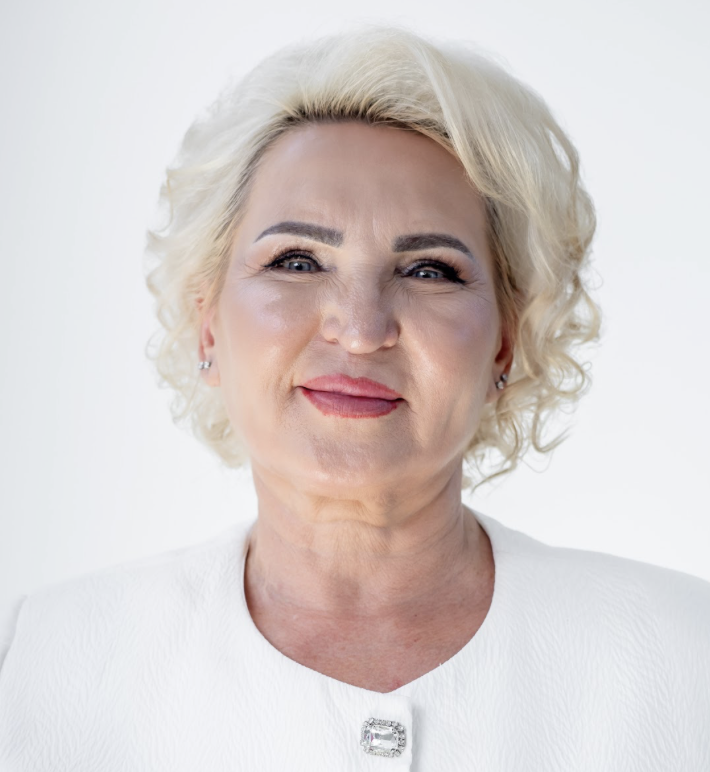
Galina Kudinova has lived many lifetimes within one. When she introduces herself, she does it with a modest smile, as if recounting an ordinary life: a woman from Shymkent, a mother of four, an entrepreneur, a second-group disabled person, and a caregiver to her adult son with cerebral palsy. Yet each piece of that introduction carries a story of loss, faith, unbroken resolve, and an ethic of care that has shaped her into a woman whose quiet persistence has built not just a business but a community.
Born and raised in Russia, Irkutsk region, Kak-Uchei village, she married young and worked at a tire factory through her youth. Those were stable years, predictable shifts, steady income, a structured life that seemed to promise more of the same. She and her husband built a household through hard, honest work raising animals, tending to land, feeding a growing family. Their life was modest, but it was theirs, and it held a rhythm familiar to post-Soviet families trying to rebuild after the turbulence of the 1990s But in 2000, everything collapsed at once. Her daughter died at sixteen, an unbearable loss no mother should ever have to endure. On the same day, her husband broke his leg, immobilizing the family’s only reliable provider. And just two months earlier, their youngest son, Vlad, had been born with cerebral palsy. In a single season, Galina found herself holding her entire household upright while her own heart was breaking, her husband unable to work, her baby needing constant care, and her remaining children looking to her for stability
She remembers having no money even for bread. She collected bottles to buy food. She prayed and fasted until she weighed only 42 kilograms, begging the Almighty for a way to keep the children alive. “People say difficulties are punishment,” she reflects. “But really, they are love. They make a person stronger.”
One dawn, she awoke from a dream that would change everything: “Make kvass.” She felt goosebumps. She had never imagined herself making kvass; she had no recipe, no training, just desperation and something like a whisper of guidance. She went to an elderly neighbor to ask how kvass was made. The woman told her:
water, yeast, bread. That was all. Galina began boiling and experimenting at night while the children slept. Some batches were sour, some made people laugh because they were slightly intoxicating, but she kept refining the recipe day after day. Within a month, she produced something she could sell. With a baby in one arm and bottles in a stroller, she carried kvass to small cafeterias and market stalls. She worked through the night, pouring and capping bottles by hand, then delivering them at dawn before her husband’s shift started. “When you do something with love,” she says, “the difficulties don’t feel heavy.” It was not kvass alone she was producing, it was survival.
She earned three thousand rubles in a single day once. She remembers the wonder of going to the market and buying meat and cookies for the children. That feeling of feeding her family with her own labor, clean, honest, and immediate, became her first taste of entrepreneurial dignity. Her husband initially doubted the idea. “Kvass? Everyone sells kvass in barrels,” he told her. But she insisted: “They can sell theirs. We will make ours.” That stubborn certainty, that fusion of will and instinct, carried her through those early years. As her business grew, she reinvested every tenge into improving production. She first hired a girl to help, then another. She organized delivery points. She built a workshop with a loan and repaid it in a year. She still remembers the satisfaction of expanding to a one-ton capacity. Every achievement was won with sweat, prayer, and the unbending resolve to keep going because she had no other choice. Vlad needed treatment, expensive treatment. Armenian doctors, courses costing a thousand dollars, herbs and injections, travel and rehabilitation. She and her husband withdrew their pension savings, begged sponsors, and received unexpected help from a Baptist church in America. They believed every promise that he might walk, even when those promises proved false. “We tried everything,” she says. “He is still with full intellect, he understands everything, he wants to work.”
Through all this, she never paused to take care of herself. Her own disability came later, in 2014, when she fell down a high staircase at home and broke her thoracic spine. She spent almost a year bedridden. Her husband and sons cared for her, lifting her, feeding her, helping her move. With rods in her back, she eventually learned to walk again. She cannot lift heavy things now, but she refuses to see herself as limited. “My disability does not affect me,” she insists. She did not tell anyone for years, she felt it was unnecessary information, something that might make people see her differently. She returned to work, managing the production process, overseeing quality, ensuring every bottle met her standards. Her eldest son, watching her strain, convinced her to automate the production line. With his help, she worked with suppliers from China to install machinery. Today, her kvass workshop runs with a small team, a semi-automated line, and twenty-one years of accumulated expertise. She speaks of it with pride, not as a businesswoman boasting, but as a mother who built something that has kept her family alive.
Her identity as a caregiver intertwines with her identity as an entrepreneur. Vlad, now thirty, with sharp intellect but a body that refuses to obey him, is her constant companion. She moves him from bed to wheelchair and back, cleans him, feeds him, sits him at the table with small online tasks while she works. On days when he has severe neurological episodes, she wants to cry from helplessness. Yet she still dreams for him: independence, work, dignity. He now has mentors, small assignments, and a first taste of entrepreneurship. “He does it with desire,” she says. “He wants to be independent.”
Her husband, aging and unwell, can no longer play the role he once did. “If you go, how will I manage here?” he asks. So she limits her travel, though she longs sometimes to rest. She cannot remember her last vacation. Even at the dacha, she is caring, organizing, ensuring everyone around her is fed and comfortable. “I’ve forgotten what rest is,” she admits gently. Yet her heart remains open. She sponsors celebrations for children with disabilities, coordinates volunteers, and runs a club called “World Without Borders,” where over forty people with disabilities gather for community and joy. Two couples have already met and married through the club. She organizes New Year events, finds sponsors, and brings joy to adults who “behave like children” but whose happiness lights up a room. These acts of giving sustain her. “When there is no communication, there is no life,” she says The community fills her with strength.
Her views on Qazaqstan’s disability policies are sharp and formed by lived pain. “There is almost no free medicine,” she says. “Doctors don’t visit. Ramps are made so poorly that a healthy person can barely climb them.” She remembers carrying her grown son to the polyclinic herself. She wants society to see, not abstractly but concretely, how invisible people with disabilities can become in health systems, social services, and urban design. “More attention,” she repeats. “We need more attention.” Through all this, she continues expanding her business. Demand grows every year. Clients recognize her kvass as natural, clean, and good for health. She will never compromise her recipe, never add chemicals, never chase profit at the expense of quality. “I don’t want to praise myself,” she says. “Let people praise the kvass themselves.” She refuses shortcuts. She refuses easy profit. Her work is an expression of conscience, of Abai’s insistence that a full human being must unite reason, heart, and will. She lives this truth not through grand speeches but through quiet, consistent deeds.
Her dreams remain large. She wants to expand her workshop and reach the global market. She wants her workspace close to her home so she can care for Vlad. She wants to scale, grow, improve, innovate. And she wants to teach young people, not in formal mentorship programs, but in the same organic way she does everything: by opening her doors, sharing her experience, and encouraging them to dream boldly.
“Don’t overthink, Just go. Everything starts in the mind. If you believe, want, and act, God gives the opportunity.”
When asked whether she considers herself successful, she hesitates only for a moment, then answers: “Yes, of course.” Not because she measures her life by money or status, but because she has held her family together through tragedies that would shatter most people. Because she built a business from nothing. Because she raised children while caring for a son with disabilities. Because she supports a community, nurtures others, and refuses to let hardship harden her spirit. Because she built her life around love, for her children, her work, her neighbors, her employees, and even strangers who taste her kvass on a hot Shymkent afternoon.
She ends her interview the way she runs her life, without drama, without selfcongratulation, simply and sincerely. “I love my family. I love my work. I love all of them.” And in that simple statement lives the essence of Abai’s complete person: a harmony of intellect, compassion, and will forged through suffering, sustained by faith, and carried forward by love. Galina’s life may seem ordinary to her, but to those who listen, it reveals the extraordinary strength of a woman who rebuilt her world with her own hands, and who continues, every day, to create spaces of dignity, inclusion, and hope in Qazaqstan.