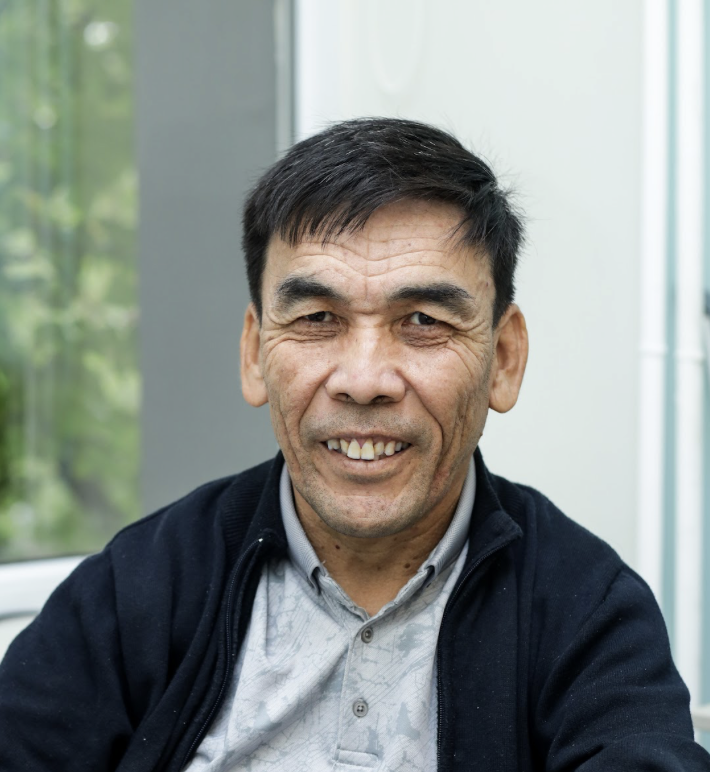
From the beginning, Ulan Inkarbekov was raised to believe that limitation was never a part of his name. He was born as a healthy baby and growing like any other child in a Soviet apartment courtyard. But a sudden illness when he was only six months old, rubella that spread across his tiny body, changed the course of his life. Doctors suspected meningitis and performed a spinal puncture. It was a time of rough procedures and limited technology. The damage to his spinal cord and nervous system led to cerebral palsy. His left side would never function like his right. His speech would be altered. His childhood would unfold with crutches and wheelchairs instead of free-running feet.
But Ulan does not perceive that moment as a tragedy, because his parents never allowed him to experience himself as “less.”
“Since childhood, my parents and relatives never allowed me to feel like a person with a disability…Even today, when I look in the mirror, I don’t feel disabled.”
In his memory, he was simply a boy dreaming of roads stretching across continents, a boy who wanted to become a truck driver, seeing the world through movement. Or an architect, designing cities that rose from imagination to skyline. Those dreams were not childish fantasies, they were early expressions of inner will (qairat), an insistence on possibility.
School, however, reflected the Soviet view of disability, invisibility, sheltered pathways, limited expectations. Teachers removed him from classes they deemed pointless “for someone like him.” Drafting, music, foreign languages, struck from his education. “They said my hands were crooked,” he recalls. “Why teach him English? Where would he ever go?” It was a quiet but cruel erasure of identity, the state deciding dreams on behalf of a child. Yet those very denials planted a stubborn fire in him, “I will prove them wrong.”
Ulan’s parents spent years traveling the Soviet landscape searching for treatment, from Almaty to Moscow, from hospitals to miracle healers. “My mother exhausted herself,” he remembers. A neurologist in Moscow finally told her gently, “You must understand … your son will remain in this condition for life.” It was not a sentence, it was the moment his mother shifted from seeking a cure to building a future.
At home, Ulan learned that dignity did not depend on legs. He played, fought, studied, argued, like every other child. He learned to walk with crutches, and when he fell, he stood back up. Every step was an act of courage of the jurek (heart). After the collapse of the Soviet Union, Qazaqstan stood on uncertain ground, a country changing faster than its people could comprehend. Ulan was 16 and wanted not just survival but independence. He began working from home, doing piecework assembly, envelopes, light switches, anything that allowed him to contribute. “That’s how I started working,” he says. “I wanted not only financial independence, but socialization.” Money was dignity. Work was identity.
The chaos of the 1990s pushed many into business, and Ulan saw opportunity where others saw disorder. He founded his first company, INKAR, in the grain industry. He helped sell grain and provided agricultural supplies. It was ambitious, but ambition was his native language. Later came a printing house producing cardboard packaging at a moment when Qazaqstan relied entirely on imports. They secured a contract with a tea company, a historic shift. Competition emerged quickly, so Ulan proposed a bold strategy: instead of cash payments, they would receive tea. He turned that tea into a brand: EDA, packaged by workers with disabilities. He built not only businesses, but systems of inclusion before such language even existed here. He created a workshop employing 45 people with disabilities, scales, sealing irons, human skill. At a major competition, their tea beat large corporate brands. For a moment, the future seemed bright and unstoppable.
But tea is a business that requires constant stock and advertising. Supply chains wavered. Borders changed. Partners withdrew. Twice the project had to close. Selling the equipment and releasing employees was one of the hardest days of his career. “You must never let anyone down,” he once promised himself, after a bank chairman granted him his first major loan with trust alone as collateral. That sentence became a core of his aqyl (mind), a principle shaping everything he builds.
Yet even in loss, Ulan does not dwell in regret. “Stress lasts five minutes for me,” he laughs. “Every problem has a solution. If you see a concrete wall, you can always go around it.” This refusal to collapse, this philosophical steadiness, is what Abai would call the unity of aqyl (mind), jurek (heart), qairat (will) becoming whole through struggle. Business doors were not easy to push open. “Partners look at you and think: what can someone with crutches do?” he says. Banks decline loans without ever stating the real reason. Building a bus company, developing routes, all stalled when outdated vehicles needed financing for renewal. Discrimination rarely speaks, but it acts.
“They say only ‘the commission refused.’ They never say why.” Ulan understands the duality of disability in Qazaqstan: obstacles and unexpected openings. Some officials help because they feel responsibility. Some because they have relatives with disabilities. Others simply out of sympathy. But he has never accepted pity as currency. He enters meetings with equal footing. “If you sat Donald Trump in front of me,” he says with a smile, “I would talk to him as an equal.” His entrepreneurial spirit eventually intersected with public advocacy. Leaders in the disability community recognized his strategic mind. His business skills translated into structural change. He became deputy in the district organization, then deputy in the city organization, and in 2022, he was elected Chairman of the Almaty City Society of People with Disabilities, overseeing support for 3,000 members across eight districts. He also leads the Qazaq Union of Organizations of People with Disabilities, with branches nationwide. His influence is international, Vice President in a global disability organization headquartered in Kyiv, representing Qazaqstan at seminars from Berlin to Rome
His work helped introduce InvaTaxi, personal assistant services, and employment practices that are now national standards. He helped open metaphorical doors, so others could enter countries of possibility. Still, he refuses to rest. “I get excited by ideas,” he says. “Once a business is running, I lose interest … I need the process of creating something new.” Creation is his oxygen. Even his dreams from childhood eventually found their form. He has now traveled to 35 countries. He never became an architect, but he approves accessibility designs shaping the city. “I believe I became one … just in another way.” This is identity reinvention at its most profound: the essence of the dream survives even when its shape changes. Qazaqstan’s past shaped him, but he fights so its future will not resemble its past
“In the Soviet Union, they locked us at home … There were no people with disabilities, we were made invisible.” That invisibility has slowly lifted, but remnants remain: stares on the street, hesitation to dine in a café run by staff with disabilities, parents pulling children away from wheelchairs and wiping their hands in fear. He sees these moments not as insults, but indicators of how much work remains. With each advocacy victory, a properly built ramp, a new legal protection, he feels moral fulfillment. He goes from one battle to the next within minutes. His work reshapes not only infrastructure, but hearts.
Entrepreneurship and activism are one path for him, the path of Tolyq Adam. He builds with intellect: master’s degree at 50, constant learning, strategic innovation. He leads with heart: offering free transportation to visitors with disabilities from other regions because “one wheelchair user is every wheelchair user’s responsibility.” And he rises with willpower: founding companies even when capital was scarce and expectations were lower than the ground he walked on. He dreams bigger now, and dreams for others. One major project underway will manufacture adult diapers in Qazaqstan, employing more than 25 workers with disabilities and keeping profits inside the country. The second: an eco-friendly electric taxi fleet employing 70 more. He imagines small production workshops and even inclusive tourism, buses to China where people with disabilities can shop freely, experience mobility, feel the world expanding.
He takes weekends to be with his children, and now a grandson, because dignity is incomplete without love. He teaches his daughter and son to see accessibility not as accommodation, but as normalcy. They invite him to places assuming access exists, because for them, inclusion is not a political stance, but a fact of family. And now, his dreams stretch further: “My ambition is to finish my career as Minister of Social Welfare,” he says calmly. This is not ego, it is the belief that those who understand struggle from within should write the laws that shape solutions.
He has advice for others with disabilities: “You must start with your own mind. Remove the thought that you are worse than others.” If one cannot enter a bus, he does not see a world that owes assistance, he sees a system that must be changed and insists on being part of that change. He teaches rights-claiming as active practice: take photos, collect receipts, go to court, and change the country case by case. He asks Qazaqstan for one thing: to remember that disability is not a distant issue.
“No one is immune … Accidents and illnesses can happen to anyone. You may one day need access to the buildings you never thought about.”
Ulan believes in collective transformation, not through pity, but through participation. “Everything is in our hands,” he says. “We must prove we exist. Show we are capable. And then society will see us differently.” His life is a refutation of invisibility. A 16-year-old boy assembling envelopes became a national leader shaping policy. A child denied drafting lessons became an architect of accessibility. A man told he would remain dependent on built enterprises that provided independence to hundreds. His story reminds us: A person is never defined by what was taken from them, but by what they insist on building anyway. Ulan Inkarbekov lives not as an object of care, but as an author of change. And through him, Qazaqstan learns to become more whole.