Philipp Schroeder presented at FU Berlin on 22–23 July 2025, delivering a keynote lecture on “Theorizing Entrepreneurship in Central Asia” at the Workshop on Russian and East European Politics.
On July 22, 2025, Indira Alibayeva presented “Crafting Identity and Nationhood: The Multifaceted Role of Artisans in Uzbekistan’s Contemporary Development” at the ICCEES XI World Congress at UCL, London.
Indira also spoke on the Oy-detox podcast about the importance of social sciences, the study of entrepreneurs, and how anthropology can help understand society. She explained the distinction between anthropology and sociology, discussed the value of social research for society, addressed stereotypes (such as the perception that Uzbeks are naturally inclined toward trade), and reflected on the purpose of academic research in Kazakhstan. She further highlighted the importance of studying cultural context, the ability of individuals to conduct meaningful research, and how scholars use social media to share insights.
Start of Fieldwork in Almaty, Astana, and Tashkent
Philipp Schroeder, Indira Alibayeva, and Kholida Khaldarova have begun conducting research for the project. Currently, the team is conducting online interviews with green entrepreneurs from Uzbekistan. Indira Alibayeva conducted fieldwork in Almaty from June 24 to July 2, 2025, visiting workplaces of green entrepreneurs and carrying out structured and semi-structured interviews.
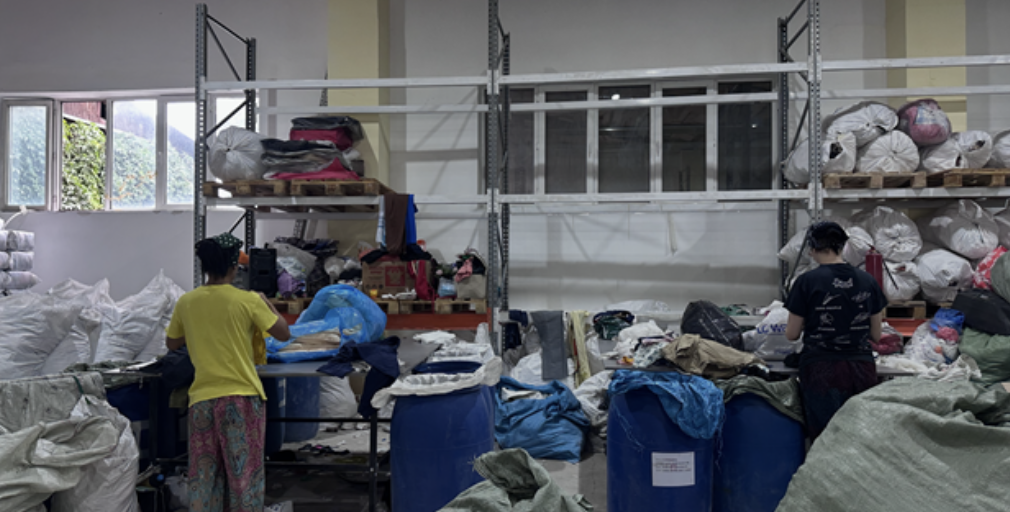
Photo 1. Employees of the textile recycling factory sorting out the clothes into categories. Almaty, June 26, 2025. Photo by Indira Alibayeva
Initial Thoughts from Indira After the First Phase of Fieldwork
Preliminary analysis suggests that green entrepreneurs are primarily motivated by intrinsic and ecological concerns rather than profit maximization. Many began their ventures in response to visible environmental problems, particularly urban plastic waste, and their work often reflects a personal desire to contribute to ecological improvement.
Interestingly, international donors or environmental funding agencies play a secondary role; many entrepreneurs discover external support only after initiating their ventures.
From a temporal perspective, most green enterprises were established within the last five years, with noticeable growth in the past two to three years (as of 2025). These ventures often function as secondary or side activities rather than primary income sources, and many entrepreneurs view their work as civic engagement or a moral stance toward environmental sustainability.
The data also highlight differences between entrepreneurial sectors: while IT entrepreneurs often operate with fast-paced goals and immediate outcomes, green entrepreneurship is future-oriented, measuring impact through long-term ecological and social change. This temporal distinction influences both business priorities and self-identification, with many individuals blurring the line between green entrepreneur and eco-activist.
Green entrepreneurship in this context also carries an educational or “eco-enlightenment” function. Entrepreneurs frequently incorporate elements of recycling, upcycling, and environmental awareness into their business models, aiming to engage and influence the wider public through their practices.
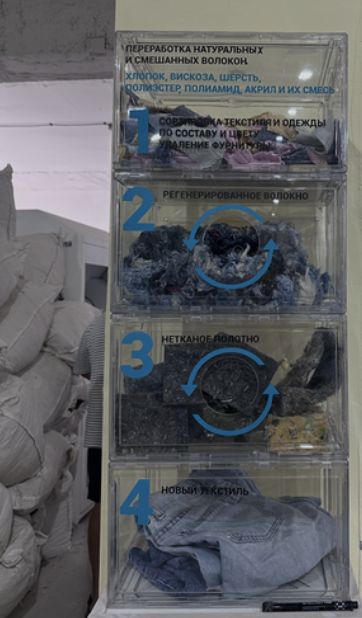
Photo 2. Inside an Almaty textile-recycling workshop: a four-step display shows the circular process—sorting used clothes, regeneratin, fibers, forming non-woven fabric, and producing new textiles—capturing local green entrepreneurship in action. Photo by Indira Alibayeva.

Photo 3. Indira Alibayeva at the Oy-detox podcast.