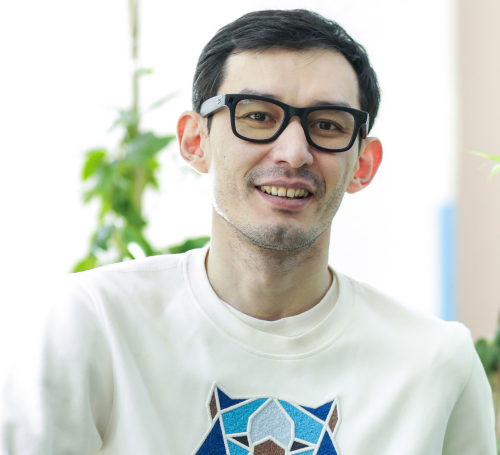
He grew up in the South, in Shymkent, where neighbors still greet each other at gates and the line between kin and community is thin. Erkebulan Rustemov remembers that the elders valued modesty, the gentle habit of treating people as people, regardless of status. “Humanity should come first,” he says now, echoing a lesson he learned long before he could name it. He carried that quiet code into adulthood without fanfare, studying, working, living fast the way young men do, not yet imagining that one day he would have to relearn everything from sitting to eating. In 2020, when the world paused for a pandemic, his life stopped altogether.
An injury left him in critical condition, six months in intensive care, and after that, practically bedbound. Rehabilitation centers turned him away; none were ready to accommodate him. “For three years,” he says, “I was at home.”
What a person does in that kind of stillness reveals who they are becoming. The first revelation was pragmatic: you cannot survive on benefits. He began searching for ways to earn with a phone, a mind, and whatever strength he could gather. Online courses had just begun to bloom across Qazaqstan; he enrolled in Arman Yusupov’s “Potok” (flow) programme and spent six months learning and, crucially, practicing, managing social media, keeping a blogger’s profile alive, turning attention into value. A classmate let him cut his teeth on an early e-commerce project; the work went well, and the second revelation followed: when you do good work, word travels on its own legs. He did not yet call it entrepreneurship, but the qairat (will), the will to move, was already underway.
The turning point came like a pair of thunderclaps. First, his body was still adapting; the vestibular system wouldn’t cooperate, and rehab was fragile. Then his father was diagnosed with late-stage cancer. “It was just my mother and me,” he says. They were renting a small place in Astana without many relatives nearby. The question — how will we live? — carried both money and meaning. “I started taking different courses, acting in videos as a model, doing everything I could.” He worked on his personal brand not as vanity but as survival, first doing things for social reasons, later learning to monetize his time because time is health and health is life. “There’s nothing personal, just business,” he says with a wry smile, meaning that dignity requires fair exchange: I work, you pay. You don’t owe me, and I don’t owe you.
A practical miracle arrived in 2022 when he bought a German Otto Bock wheelchair, 1,800,000 tenge, a fortune, and the company offered him an internship in return. First he worked remotely, then came in twice a week, and after a threemonth probation, full time. “They have a Western attitude,” he says with gratitude. “It doesn’t matter how many hours I sit in the office, the result matters. I can complete a monthly plan in a week and rest the rest of the time.” That simple, outcome-based respect for aqyl (mind) and qairat (will) became a lifeline. In parallel, he declined full-time social-security placements that paid 80–100k tenge for a whole day’s presence; the hours-for-pennies logic held no future. He wanted a results economy, not a chair economy.
Alongside paid work, he opened another channel of service and self-respect: his Instagram blog. He posted, very plainly, the information he wished someone had handed him, how to apply for disability status without endless circles, how to get discounted train and air tickets, how to access theaters and cinemas for free. He wrote about etiquette, too: “Our society doesn’t yet know how to interact with people with disabilities,” he says. Some push a wheelchair without asking; others hover and avoid eye contact. He began giving talks and running seminars. The message was not condemnation; it was education rooted in dignity. “We’re the same people, and our heads are working. We don’t bite in the street.We’re not contagious.” When spring softened the city, he helped launch forums in malls, asserting on presence as pedagogy. The barriers themselves are often banal and therefore exhausting.
“Ramps set at the angle of a roof. No elevators to a meeting room. Doors too narrow by a finger’s width.”
He has learned to ask for help. “Even healthy people do,” he says, trying to dismantle the shame that clings to assistance in post-Soviet culture. The deeper barrier sits inside minds trained to see disability as deficit. Some people with acquired injuries hide; others cannot yet accept the change. He has seen despair hover like a shadow, “there have been cases when people wanted to commit suicide,” he says quietly. So he uses his voice without theatrics. His advice is straightforward: don’t be afraid of people’s opinions, because people will always talk; fear only living in fear. Try an idea, test it, and if it fails, move; qozgalys bul omir. (movement is life).
Work brought structure, but resilience required a different architecture, one that wove heart and mind with a discipline of spirit. Music steadies him. He is self-taught on the piano, the grandson of a composer, and he keeps melodies running, during content planning, during emails, even between meetings. Books helped, too; he clung to lines from Joe Dispenza, Your Own Placebo, The Subconscious Can Do Anything, copying passages by hand, practicing the mental drills they proposed. And there is prayer. “The Qur’an helps,” he says simply. On heavy nights he reads suras before sleep. He is not a fanatic. He is grateful. Gratitude is its own practice of wholeness.
That wholeness shows up in work habits as well. He has learned to delegate, building a small team of hungry, talented teenagers, mobile photographers, copywriters, bright 16-to 20-year-olds who know the pulse of platforms. He takes the strategy himself, sits with clients to clarify average checks and monthly goals, writes content plans, and then hands tasks to his team. The feedback loop keeps his heart awake: audio messages from customers who can suddenly move freely because a prosthesis fits, a video from a client whose properly chosen wheelchair restored the rhythm of errands. “That’s the best thrill,” he says. Online followers leave comments that tug him through long days. Sometimes he burns out anyway. “We are a generation that hasn’t learned to rest,” he admits. When he catches himself fraying, he drives to Borovoe, listens to the wind, and comes back.
The aqyl-jurek-qairat (mind-heart-will) balance also reshaped his sense of mission. In the beginning, he wanted to cover rent and groceries. Three years later, his horizon has widened: he wants to build a rehabilitation center that treats the body and the mind together. “Physical recovery is hard,” he says, “but mental recovery is harder. You can build muscle; if your mind doesn’t heal, you can’t live fully.” The center he imagines will help families, too - parents and spouses who carry invisible burdens. “When one person becomes disabled, the whole family suffers,” he doesn’t say it as a complaint. He says it is like a design requirement.
If there is a philosophy in all of this, it is spare and Qazaq and very Abai. He believes in learning, in steady work, in treating people with respect, in not confusing office hours with results. He believes that status tempts people to forget who they grew up with, and he refuses that amnesia. “Don’t forget your people,” he says. He’s seen how sudden wealth or public praise can lift a person out of their circle and into loneliness. He declines that path, not as moral performance, but as a habit of jurek (heart): humanity first, always. He teaches his friends in the Para-sport community to value their time and reputation: interviews and filming are work; monetize them. Dignity is not charity; it is fair exchange
There are still days when the old world shows its teeth. A grand building without an accessible entrance. A meeting where the only open path is asking strangers for a lift. A public contract that values presence over contribution. On those days, he leans on a sentence that is both shield and invitation to proportion: “If a problem can be solved with money, it’s not a problem; if it can’t be solved, it’s experience.” The line lets him keep moving. It also keeps him generous with himself, forgiving the body’s limits without resenting the work of adaptation. “I haven’t learned to rest yet,” he admits with a laugh. “I will try.”
In a post-Soviet city still learning new etiquette, he has become a modest architect of culture change. He explains how to talk to a wheelchair user: ask first, never push without consent. He models what genuine inclusion looks like: give a person a job, not a pitying glance. He insists that fear and shame are bad teachers. In his words you can hear Abai’s insistence that the Tolyq Adam grows where intellect, compassion, and will are held together by everyday deeds. He isn’t preaching a framework; he is living it. He studies, delegates, prays, plays piano, answers DMs, speaks at forums, trains with the Paralympic team, rolls into rooms that don’t yet expect him, and, day after different day, chooses movement.
His impact spreads in rings: a client who can cross a street without pain; a teenager on his team who discovers she is good at copy and better at courage; a follower who learns how to claim a travel discount and then takes her mother to the sea; a family that sees their son’s new routine as possibility rather than punishment. He will tell you that he’s only beginning to understand why this trial was given to him. He will also tell you, with that same plainness from Shymkent, that gratitude is not a feeling but a practice: you keep showing up, and the meaning shows up, too.
“Don’t be afraid,” he says when asked for advice. “People will always talk. Fear only living your life in fear.”
Try, test, change. Ask for help. Keep learning. In that sequence you can feel a life bending toward wholeness. Erkebulan’s narrative is not the heroic arc of a man who conquered his body. It is the quieter, more demanding work of a man who integrates aqyl (mind), jurek (heart) and qairat (will) until the person you meet is not an injury, not a social unit, not a case, just a human being, building a future that includes everyone he can reach. Movement is life, and he is moving