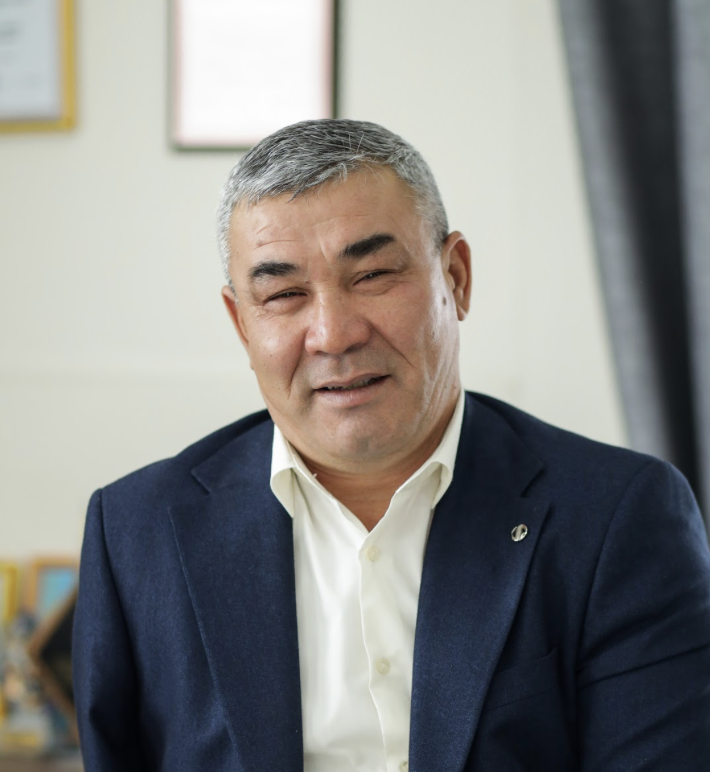
Abai also asks: “What can you talk about with a man who does not know the value of words?” Sanash knows the value of words deeply, the hurtful ones that once stripped him of dignity, and the encouraging ones that gave him strength to build a future. That is why he speaks gently but firmly now, using his words to raise others, respecting every worker, uplifting every soul that joins his organization.
His life shows that becoming a Tolyq Adam, a complete human, is not a gift, but a lifelong education. Through trial and observation, through pain and purpose, through listening and responding with courage, he has become an example of Abai’s teaching: a man who continues to grow, and in doing so, helps others grow too.
Sanash Yechshanov grew up in an aul (village) where life was simple and everyone knew each other by name. In the village, boys spent their days riding horses, running across fields, and helping their families with whatever work needed doing. When he was seven, one of those ordinary days changed the course of his life. He fell from a horse and broke his wrist. It seemed minor at first, the kind of injury village children often shrugged off. But a medical mistake led to gangrene, and his arm had to be amputated.
The adults around him were devastated. His mother cried at night, whispering, “What will happen to you?” Yet the boy himself refused to treat it as a tragedy. He learned to do things differently, not less. Over time, the stump became part of his body’s map, not a mark of shame. His wife now jokes, “I can’t even imagine you with two arms,” and Sanash laughs, telling people, “It’s nothing terrible.” From early on, he began to practice the quiet harmony of mind, heart and will: thinking pragmatically about his limits, refusing self-pity, and pushing himself to move forward.
In the village everyone knew him, so no one treated him as “the disabled one.” He helped his father support the family, traded whatever they could buy and sell, and learned to hustle in the informal markets of the 1990s. They sold milk and sour cream, repaired old cars and resold them, carried bags from city to aul and back again. He wasn’t “a person with disability” then; he was simply Sanash, a hardworking son and husband who did what needed to be done.
The real shock came much later, when he and his wife decided to leave that rough but familiar life and move to Rudny. They wanted what his wife called a “normal life”: stable work, mornings at the office, evenings at home with their children. She quickly found a job in a store through recommendations. Sanash began visiting factory gates and offices, offering himself for any position – “even as a night guard.” At first the conversations went smoothly. He would talk, people nodded, everything seemed fine. Then they noticed his missing arm. Faces changed. Doors closed.
“For almost eight months,” he remembers, “I went around to different organizations, 168 169 | Abai’s Word Nineteen: On Learning Through Life | Abai’s Word Nineteen: On Learning Through Life but no one would hire me.” That was the first time he truly felt disabled. “I had been without an arm for seven years already, but only in Rudny I understood: this is what it means to be disabled in people’s eyes.” He discovered that in the post-Soviet city, where people didn’t know his history, his missing arm suddenly spoke louder than his character, skills, or experience.
One episode cut deeply. He put on his prosthesis and took a security job at a mill with a bathhouse. For two months he worked diligently. When the head of security found out he had no hand, he was immediately fired. “I was shocked,” he says. “I thought, how can this be? I am the same person. If someone attacks, even with two hands you are not guaranteed to do anything.” In that dismissal, he felt how a whole system quietly decided he was “less than,” no matter what he could actually do. With a small disability pension and his wife’s salary, they survived. But the experience left a scar. It also sowed the seed of his future mission: to ensure that other people with disabilities would not be pushed to the sidelines in the same way. Searching for some foothold, he went to the Rudnyi City Association of People with Disabilities. The organization was in a dilapidated former kindergarten building, surviving on random donations. The chairman, Viktor Pavlovich Kasatkin, welcomed him: “We have nothing – only this building. But if you want to help, you are welcome.”
Looking around at the empty rooms, Sanash’s aqyl (mind) kicked in. “We can’t just keep begging,” he said. “Let’s rent out some rooms. At least we’ll have some income.” They started slowly, one room at a time. The association took its first tentative steps away from charity and toward selfreliance. When Viktor Pavlovich suffered a heart attack and could no longer work, he insisted: “Only my successor will lead this organization,” and chose Sanash as the new chair. It was a turning point. The building had no equipment, not even a single computer. Determined not to return to a life of begging, he went to a businessman who sold computers and asked for help. The man replied coldly: “You disabled people are always begging. I’m tired of it.
That sentence struck him “to the very core.” Walking out of the shop, he made an inner vow: “This is the first and last time I will ever ask for something as a leader.” His jurek (heart) burned with hurt, but his qairat (will) transformed that hurt into resolve. Around that time, government procurement had just begun. Seeing a path, he scraped together money from his pension, borrowed what he could, and travelled to Almaty and Taraz to study tenders and social procurement. He sat in seminars, took notes with one hand, and passed certification exams. Eventually the association won its first tiny tender: reupholstering thirty chairs. They had no machinery, no tools, just willpower and a friend named Yerlan. “We spent the whole night figuring it out,” he recalls. “And we did it … by any means possible.” The profit was thirty-seven thousand tenge. It felt immense, not because of the amount but because it was, as he says, “honest money, earned by our own hands.” In that small success, the association shifted from passive recipients of pity to active producers of value. It was the beginning of an entrepreneurial journey that would reshape not only his identity, but the lives of dozens of others.
From that first tender, the projects multiplied. Sanash saw that the biggest barrier for people with disabilities was not only society’s prejudice but the lack of meaningful, accessible work. “How can they earn?” he asked himself. “Heavy physical labor is impossible for many, and not everyone can provide professional services.” So he designed businesses where tasks could be tailored to different abilities. With a 3-million-tenge grant from Samruk-Kazyna Trust, he launched a social auto service: ordinary drivers could rent a warm box with a lift and tools to work on their own cars for a small fee. Administrative jobs – greeting clients, registering time, calculating payments – were done by people with disabilities. No one had to lift heavy things; they managed the workflow using aqyl (mind) and communication. The project was so popular that they soon had queues and reservations, and expanded to six lifts.
Next came a laundry funded by the First President’s Fund, employing women with disabilities to wash linens for dormitories and private clients. Another grant allowed them to buy furniture-making equipment. Although bureaucracy later stalled that line due to certification requirements, it remained a proof of concept: they could build production, not just consume aid. He applied to the German embassy and obtained support to equip a hair salon. Even when they struggled to find hairdressers with disabilities, the equipment stayed ready. It was part of his broader vision that people with disabilities should look and feel dignified.
“I invited specialists… paid them myself to show our girls how to care for their hair, how to look beautiful. I wanted them not to look like ‘disabled people,’ but like confident women.”
He knew that identity reconstruction often begins with small, visible signs: neat hair, manicured nails, a straight back. A cafeteria followed, created from their own funds in a building they now maintained themselves. Six women work there, serving around a hundred people a day, many from a nearby police department. The association also runs tenders for city maintenance: mowing grass, cleaning playgrounds, snow removal, welding and repair work. They opened a small taxi service where wheelchair users work as dispatchers. “Before, healthy girls were dispatchers, and there were constant conflicts when cars were late,” he smiles. “Now wheelchair users themselves manage the calls – they understand each other, and everything goes smoothly.”
From four staff members in a crumbling building, the association has grown to around forty-seven employees, about eighty percent of whom are people with disabilities. No one earns less than two hundred thousand tenge; drivers can earn up to three hundred fifty thousand or more. For fifteen years, Sanash has reinvested every tenge back into expanding opportunities, consciously choosing growth over personal comfort. This is his understanding of social entrepreneurship: not living from social order to social order, but building self-sustaining ventures where income circulates back into jobs and dignity
The work comes with stress. He jokes that January and February are his “depressive months,” when he lies awake wondering whether they will win tenders and keep all the jobs. The constant responsibility has cost him his teeth, “all eaten by nerves,” he says, and he often goes to bed thinking about heating bills and electricity for their two-story building. Yet his well-being rests on three pillars: his loving wife of almost thirty-seven years, his children and four grandchildren, and the sense of purpose he feels when someone walks into his office asking for work and walks out employed. His wife is his steady jurek (heart). She believed in him when no one else did. She travels with him to sanatoriums, keeps the home warm, and celebrates each small victory. She also supported him when a new calling appeared: Paralympic shooting. What began as a spontaneous try at a championship, he unexpectedly took third place, grew into serious training. Now he is a member of Qazaqstan’s national team, has travelled to seven countries competing, and is aiming for the 2028 Paralympics in Los-Angeles. Shooting meets his inner need for discipline and focus. It is another field where he refuses to let his body define his limits.
Despite his achievements, entrepreneur, deputy of the local maslikhat, national, he still feels the weight of societal attitudes. At the beach or swimming pool, he notices people staring at his missing arm “like I am an exhibit in a zoo.” Abroad, in European pools, he saw people with and without disabilities swim together without anyone looking twice. “Our problem is not the body,” he says, “it is the mindset.” That is why he speaks often about the need for education and visibility. For years he organized visits to schools with a group of people with severe disabilities. They sat in front of teenagers; some lacked arms, some legs, some fingers. They told the students: “We are trying, we are living, we want to work and be useful. And you, why are you giving up on life?” The children cried. In a society shaken by news of youth suicides, he hoped that at least one child would reconsider, would see life differently through the presence of these resilient adults.
Inside his own organization, he fights against dependency. When people come asking for flour, potatoes or cash because “before they gave us,” he answers: “Come and work.” He knows poverty and hunger; he once himself distributed donated sacks of food. But he believes that constant handouts kill initiative and teach children that survival comes from pleading, not effort. “How much do you really need?” he asks. “Even ten sacks won’t be enough. Better learn to earn.” And yet he remains generous. Each year his accountant shows that he has given away one or two million tenge in help, small amounts here and there, groceries delivered personally to families who truly struggle. He prefers to bring food rather than hand over cash that might be spent on alcohol. His compassion is firm, not indulgent.
In his dreams, there is one project that keeps returning: a dedicated sports hall for people with disabilities. For fifteen years, they have played sitting volleyball every Sunday at ten in the morning in a college gym, scheduled at a time when no one else is around. Men with prosthetic legs and arms drag themselves across the floor, laughing, shouting, feeling alive. When students occasionally walk in, they often freeze in shock. “We say we want inclusion,” he reflects, “but we hide in basements and borrowed gyms.” A hall of their own would be both a business, creating 10–15 new jobs for trainers and staff, and a symbolic home where bodies with disabilities are not hidden but normalized. Looking back, he knows his life has been shaped by the interplay of mind, heart and will. Mind helped him read tenders, design projects, and navigate bureaucracy even when officials “speak a different language.” Heart guided his insistence on respect, on never humiliating anyone, on creating spaces where a woman with epilepsy can reduce her seizures simply because she feels needed and calm. Will carried him through the humiliation of being told “you disabled people are always begging,” through sleepless nights over heating bills, through international competitions where a license for Paris slipped just out of reach
Asked if he is a happy man, he answers without hesitation: “Honestly, I am a very happy person.” Happiness for him is not the absence of pain or barriers but the presence of family, meaningful work, and the ability to say yes or no with integrity. “When as a father your word has weight, when you see your family walking the right path, that is the greatest treasure.” His measure of success is simple: creating jobs where people with disabilities earn real salaries, regain confidence, and start doing their eyelashes and hair not for others’ approval but because they feel worthy. Through his journey, the old Soviet idea of disability as deficit is quietly dismantled. In Rudnyi today, a network of services, e.g., auto lifts, laundry, cafeteria, taxi dispatch, testifies that people with disabilities are not objects of charity but subjects of economic and moral life. Young employees arrive withdrawn and leave transformed. Children in schools see men and women without limbs who still laugh, work, and love. Officials who once saw “beggars” now see a partner pushing for better policies.
Sanash’s life does not erase pain or injustice, but it rearranges them into a different pattern. Instead of being the man no one would hire “even as a guard,” he has become someone who can look at a person who walks into his office and say, with a quiet sense of fulfillment, “If you want to work … I will find something for you.” In that simple promise lies the deeper inclusion he has spent his life building: a Qazaqstan where worth is not measured by limbs, but by the work of the heart, the clarity of the mind, and the stubborn, steady courage of the will.