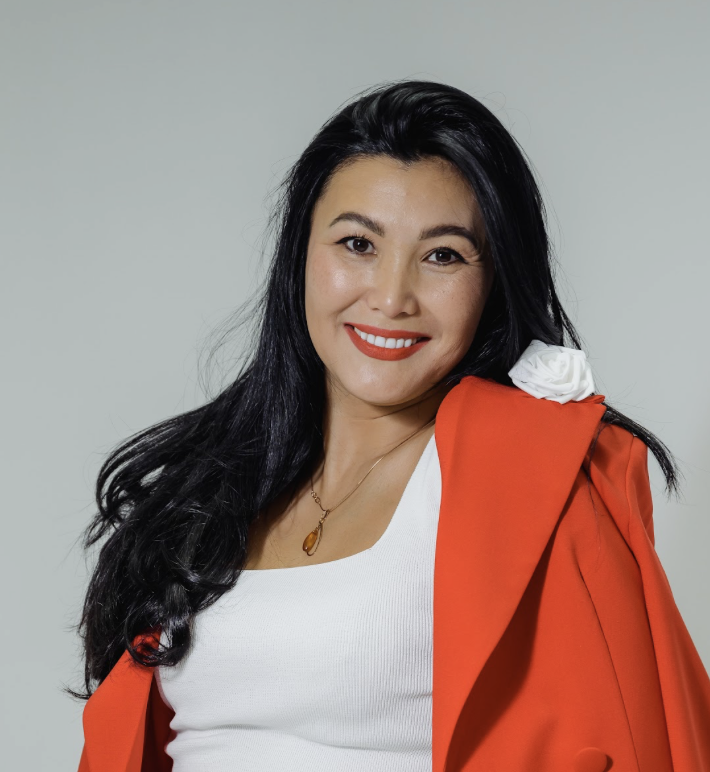
Moreover, Abai distinguishes between aspirations rooted in ego (wealth, status, reputation) and those rooted in humanity. Saida exemplifies the latter: her aspiration matures into service, compassion, and the desire to uplift others. When she stands before newly amputated teenagers and their parents with the message, “You cannot grow a new arm or leg. But you can grow a new life,” she embodies Abai’s call to aspire toward what elevates the human spirit. Her dreams, building a stable home, raising her sons, supporting families, and creating an inclusive rehabilitation space, echo Abai’s belief that true aspiration is measured not by what one gains, but by the goodness one cultivates within and around oneself. In this way, Saida’s entire life becomes a living interpretation of Word 44: aspiration as moral striving, inner clarity, and the quiet courage to grow a meaningful life.
Saida Kenessarina’s life began with a shock that struck her family long before she could speak, but its echoes would one day shape her into a woman of rare strength, luminous resilience, and a deep sense of purpose. She was only four when a sudden fever took hold of her small body, sending her into the ICU where her parents, young, frightened, and unprepared, were not allowed to see her for nearly two weeks. By the time her mother finally caught sight of her again, Saida was barely alive. Her arm and leg had wasted away. Her skin was marked with dark patches where medications had scorched her fragile body. Doctors from different cities arrived, convening medical boards, searching for answers they could not find. In the end, they could not save her limbs. “Praise be to Allah, I survived,” Saida says today, with a clarity that contains both memory and grace.
Her parents were young, her mother only twenty-seven, and unprepared for the future that suddenly appeared before them. Yet they did not crumble. Saida’s survival became a task of love, persistence, and quiet courage for her parents, who would raise her not as a fragile child but as someone who must learn to stand in the world with dignity. “They didn’t focus on my deficiencies,” she says. “They raised me to be independent.” That choice, made in the chaos of hospitals and uncertainty, would later become the foundation of Saida’s own resilience.
When she was five, they traveled to Leningrad to make her first prosthetics. She remembers entering the giant building, rising in the elevator, and seeing for the first time many children like her, some without arms, some without legs, some without both. And they were joyful. Laughing. Moving through hallways in wheelchairs. “I remember thinking, ‘Thank God I at least have one arm and one leg.’” Out of that moment emerged the first seed of gratitude that would later mature into what Abai calls the heart’s moral clarity. Even as a child, Saida sensed that since Allah left her this life, she must live it fully.
Back home, life unfolded with both tenderness and pain. In kindergarten, some parents whispered that she might “irritate” their children. But her mother, stubborn, fierce, guided by a mother’s heart, refused to let anyone shame her daughter. She brought Saida to school herself and made sure teachers protected her. Saida grew up in a regular school, with regular children, doing her best to blend in. She hid her prosthetics behind long sleeves and skirts, dreaming only of walking without limping. “I practiced walking from the entrance to the trash bin like a model,” she remembers, laughing softly. “Trying to show everything was fine.”
Her teenage years brought new challenges. When other girls started wearing heels, she cried because her prosthetic foot was flat. She longed for summer T-shirts and swimming, but the thought of exposing her prosthetics filled her with dread. These were the private wounds, hidden beneath fabric, behind smiles, that shaped her adolescence. “I cried into my pillow,” she says. “I had to be strong; I couldn’t show weakness.” Then, as if in answer to her prayers, a prosthetics center in Almaty invited her to test new technology that allowed heels. She remembers standing, walking, and feeling, for the first time, the thrill of looking like every other girl her age. There were only two or three girls in all of Qazaqstan with prosthetics that allowed heels, and she was one of them. Her world brightened.
As she grew older, another shift happened, not in her body, but in her heart. When her younger sister was born, ten years her junior, Saida found herself carrying her tiny sibling to dance classes, caring for her on her own, shielding her from difficulty. “Let her have an easy life,” she prayed. “It’s okay that this happened to me.” This love for her sister softened her struggle. Gratitude replaced bitterness. Acceptance replaced pain. University followed, English translation, chosen because it allowed work despite her disability. She traveled alone for prosthetics since age sixteen, so independence was familiar. After graduation, she worked in Aksai, far from home. Her parents worried, but Saida managed everything: cooking, washing, daily routines, all with one hand and one leg. Life demanded creativity, and she met it with quiet determination
Marriage came, then motherhood at twenty-four. Her first son changed her entirely. “I stopped thinking about myself and focused on my child.” With one arm, she fed him, dressed him, soothed him. Her parents helped, especially with bathing. But Saida insisted on doing everything she could herself. Motherhood strengthened her sense of purpose. Her second son was born under far more difficult circumstances, in London, where she lived alone, waiting for visa documents. She had no family around her and cried many nights from exhaustion. But neighbors helped, and she pushed through. “Praise be to Allah,” she says. “I got through it.” She balanced classes, newborn care, commuting, and uncertainty with an inner steadiness that astonished everyone around her
Yet life brought more trials. She eventually separated from her husband and raised both sons alone. Employment became essential. She worked in auditing, engineering, quality control. She tried entrepreneurship once, opening an Individual Entrepreneurship (IE), but unstable income pushed her back into traditional employment. Still, the entrepreneurial spark never left her. Her long-term dream is to open an inclusive rehabilitation center, one where people with disabilities, the elderly, and children can interact naturally. “So people know that among ordinary life, there are people like me.” But Saida’s most remarkable journey was internal: the path to self-acceptance. For years she could not show herself without prosthetics online. She covered up for the comfort of others, feeling responsible not to “disturb” them. Only three years ago did she reach what she calls “100% acceptance.” On hot days now, she sometimes goes out without a prosthetic. “If I’m comfortable, that’s enough,” she says. “Why hide?”
Her Instagram blog, running for nearly a decade, became a window into her life. What began as random posts slowly turned into a source of motivation for people across Qazaqstan and even abroad. “People said I was strong, had will. At the time, I didn’t realize it. Only when I fully accepted myself did I understand.” She visits people in hospitals, especially those newly amputated. Recently, she met a 10th-grade girl who had lost her leg in a train accident. Saida came not only for the girl, but for the girl’s mother, knowing too well that parents also carry a grief they cannot speak. Saida showed them her own amputated arm and leg, stood before them not as a symbol of tragedy but as proof that life not only continues, it can shine
She tells them, “You cannot grow a new arm or leg. But you can grow a new life.” Acceptance, she believes, is the turning point between despair and renewal. Her coaching is informal, born from lived experience rather than certification. People come to her one by one, through her blog, through word of mouth, through quiet requests for help. She listens, advises, shares her story. She helps them unlock their own inner will, which Abai says allows a person to move from mere survival toward moral wholeness. Motherhood continues to give her strength. Her younger son once said in an English class interview that his best friend is his mother. When the teacher shared the video, Saida cried. “We talk about everything,” she says. “I let them make their own choices.” She believes that children learn not from lectures but from watching how their parents live. And Saida lives with joy. “Waking up makes me happy. The sky, clouds, rain, coffee, everything.”
Of course, there are fears. Financial uncertainty. Occasional discomfort with her prosthetics. Moments of sadness.
“I used to think a motivator must always be strong … Now I know I’m human. I allow myself to cry. Then I move on.”
She has done extraordinary things, parachuting, climbing part of Mount Elbrus, learning to swim despite missing limbs, traveling alone across countries, driving with one hand. But she considers her greatest achievement something small: the ability to walk outside in a T-shirt, prosthetics visible, without fear. Looking back, she says she wishes she had learned financial literacy earlier. Looking forward, she hopes for her own home, a stable future for her sons, a loving marriage when Allah wills, and her rehabilitation center. When asked what she wants to tell others with disabilities who dream of starting a business, she answers simply: “Move forward. Don’t look back. If you have the desire, make it real.”
At the heart of Saida’s journey is a profound embodiment of Abai’s Tolyq Adam: the harmony of mind,heart, and will. She moves through life with reason guiding her, compassion extending from her, and willpower carrying her through every trial. She is a woman shaped not by what she lost, but by what she built, courage, self-respect, gratitude, purpose. And through her story, she offers Qazaqstan not just an example of resilience, but a vision of inclusion rooted in humanity, dignity, and love.