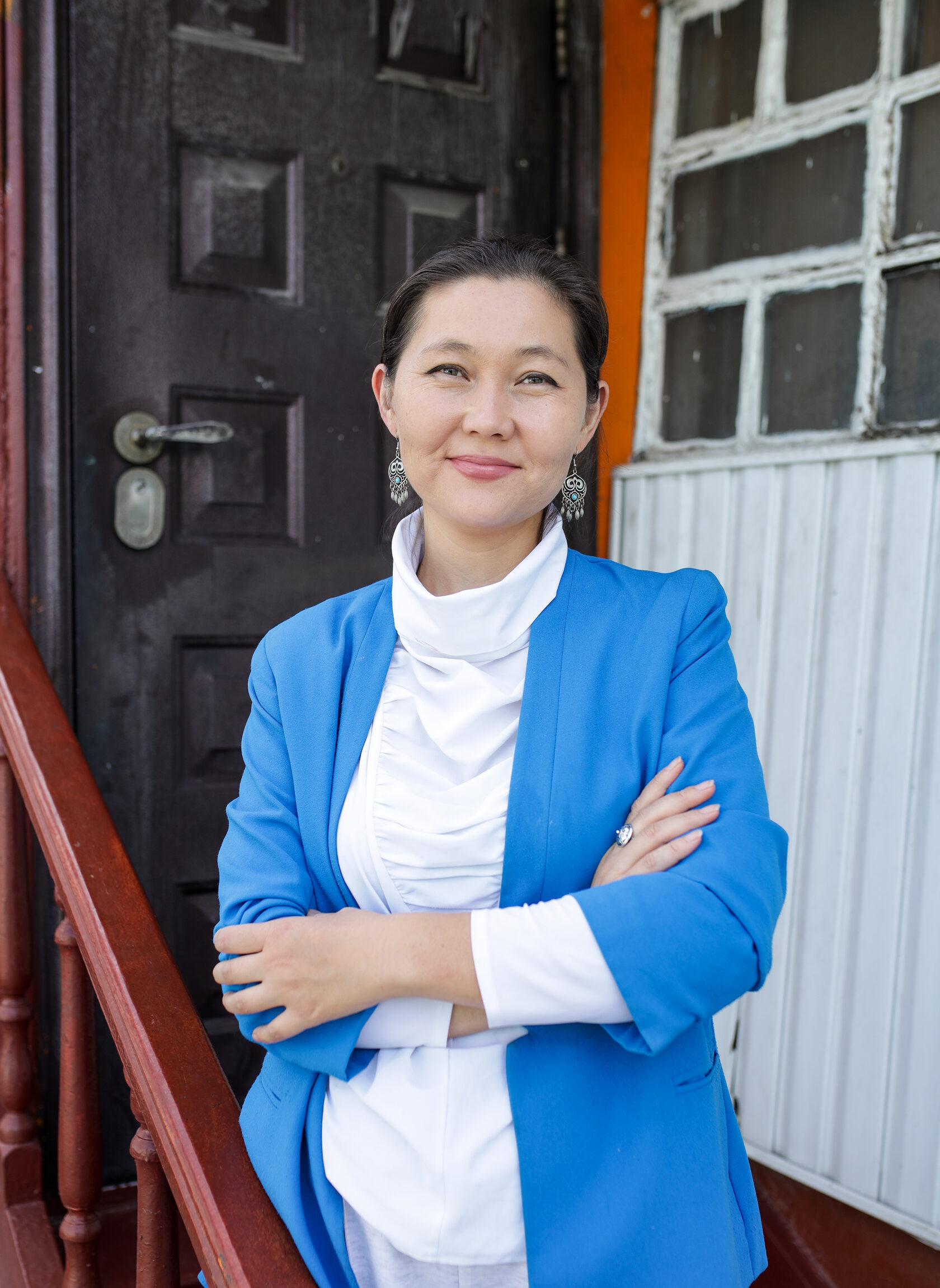
There are stories that begin with thunder, and there are stories that begin with silence. Anara Abzhanova’s life opened in the quietest register of all, the fragile breath of a child born seven months into pregnancy, so small her mother feared even the wind might harm her. She grew up in a modest home in old Almaty, raised by a single mother who had once been a physics teacher. Despite financial limitation, their home carried warmth, affection, and something far more rare, the belief that a child must grow freely. “My mother gave me complete freedom,” Anara recalls, and that freedom became the language through which she learned to understand the world. By the age of two or three, she lost her hearing entirely. The silence that entered her life could have become a wall, a border that marked her as separate. Instead, it became the threshold of a different kind of perception.
“When hearing becomes impossible, you begin to feel the world differently, with your heart, your eyes, and your soul.”
Where sound ended, sensitivity began. She learned to read the flicker of light, the tremor of emotion on someone’s face, the rhythm of nature. Her world was not diminished; it simply reordered itself. There is a line in Qazaq jurekpen koru (to see with the heart), and Anara embodied it long before she had the words for it. Her childhood flowed between two landscapes: the old streets of Almaty and the vast, unbroken Qazaq steppe. She calls herself a “steppe girl,” a child who knew the feel of the earth beneath her feet and the taste of dusty summer wind. In the village, she played with other children, wandered fields, and lived in a way that felt boundless. But life also showed her its fragility early. She once fell into a water reservoir and nearly drowned. Someone pulled her out just in time. She remembers this moment as her “second birthday,” a reminder that life holds you even when you slip, that fate sometimes chooses to return you gently to the world you almost left. At fifteen, her mother, the center of her universe, fell gravely ill. She lost her speech and underwent complex surgeries. For a year, their small house filled with silence of a different kind: fear, helplessness, and the unknown. Anara remembers climbing to the attic at night, sitting beneath a small window where she could see the moon. She would draw in the dim light, whispering her hopes into the night sky. “I looked at the stars and asked the moon to give my mother her health back.” Her mother eventually recovered, not gradually, but like a sudden mercy. It strengthened Anara’s belief that unseen forces move quietly in our lives, supporting us in ways we never fully understand.
The foundations of her artistic life were laid in 1998 when her mother enrolled her in a small art studio for deaf children. There she met Alexey Utkin, the teacher who would shape her artistic identity. “His school became the foundation of my professional growth,” she explains. Under his guidance, she learned not only technique but also discipline, visual language, and confidence in her gift. She painted her first serious work at twelve, and someone immediately tried to buy it, an astonishing moment for a shy girl who rarely believed she could be seen. “For the first time, I felt that I could be the master of my own destiny.”
That realization became a seed of the willpower that Abai describes as essential to the Tolyq Adam. Her teenage years were marked by achievement. She won the Grand Prix at the “ZhuldizAi” festival and later at the international “Shabyt” competition. Encouraged by her success, she entered the Zhurgenov College of Arts, then earned both bachelor’s and master’s degrees at the Qazaq National Academy of Arts. Eventually she returned as a teacher, guiding young artists through the same corridors where she once stood uncertain and hopeful. Over time, she developed a personal style she calls romantic realism, a way of painting that blends memory, emotion, and poetic vision.
“My main genre is nature, flowers, and the city… to see beauty in simple things, and to express it the way you feel it in your heart.”
Flowers, blossoms, spring light, Sievers apple trees, winter streets, everything she painted carried softness and emotional clarity, as though each canvas held a memory breathing beneath it. Among her works, none is more defining than her series Shades of White. It was born from a childhood moment she carries like a sacred photograph. She was studying at an internat for children with hearing impairments. One evening, her mother had promised to bring her a cake. Hours passed. The teachers told her to go to bed. Snow fell in soft, glowing flakes outside the window. She remained there, waiting, and then she saw her mother, exhausted, holding two bags of sweets and the promised cake. Anara says, “Snow was falling quietly in soft flakes… and then I saw my mom: she was holding two bags of treats and the promised cake.” The moment marked her deeply. Snow became more than weather; it became memory, devotion, and love. “‘Shades of White’ is about memory, warmth, care, and light,” she explains. Through it, she paints her mother’s love again and again, refusing to let that tenderness fade.
Her art slowly evolved into a livelihood. In 2018, she formally registered her art business. She has sold more than 300 original pieces, but she also began to understand that sustainability requires diversification. “Art can bring not only onetime income… but also passive income.” With clear reasoning, she enrolled in art marketing courses, studied portfolio strategy, and began building collections meant for licensing: notebooks, stationery, packaging designs. She wasn’t abandoning art; she was expanding its reach, ensuring it could support her family while remaining true to her heart. Family, for Anara, is a universe of its own. She is a mother of three daughters, Alua, Amina, and the youngest. She speaks of them with a tenderness that softens her voice. “All three are my wings, my source of inspiration, strength, and meaning.” Her husband, Timur, a sign language interpreter, is both partner and anchor. Their meeting, she believes, was destined. “Sometimes I feel that our meeting was destined from above.” Even though her entrepreneurial ambitions are not always fully understood by her family, she draws strength simply from their presence. “It gives me the strength to keep moving forward.”
Her values, kindness, love, honesty, and respect, come from her mother. “Love is the main value my mother taught me.” Through these principles, she anchors her work in something deeper than recognition or income. Yet like every entrepreneur, she faced real challenges. She struggled with financial literacy, with building a stable team, with navigating the demands of social media. “Social media requires a lot of time and attention.” She also once secured a major grant, more than 700,000 tenge, but had to pause the project due to the pandemic. These disruptions tested her, but each struggle contributed to the reconstruction of her identity as an entrepreneur. “My true victory is within myself,” she says, and this statement reflects the inner evolution Abai describes: the merging of reason, heart, and will into a full, resilient self. Her mission is clear and steady. “Through my paintings, I give the viewer emotions and a part of my soul.” She believes art can heal, communicate, and console. It is, for her, a universal language: “Art for me is a way to speak without words.” Her silence is not emptiness; it is eloquence in another form. Her resilience is not noisy triumph but quiet, continuous courage. What emerges from Anara’s journey is the portrait of a woman who turned silence into artistry, fragility into strength, and memory into purpose. Her life is shaped by a heart attentive to beauty, and the will to keep moving despite obstacles. It is shaped by the clarity to expand her art into a sustainable business, and the wisdom to anchor her purpose in meaning rather than ambition
Through her work, she contributes something invaluable to Qazaqstan’s cultural landscape: a reminder that art carries its own form of inclusion, its own way of widening the world. Her canvases offer solace, reflection, and emotional truth. And her entrepreneurship challenges the narrow post-Soviet assumptions about disability. Instead of hiding her difference, she turns it into a source of sensitivity, creativity, and depth. In the end, Anara’s narrative is a testament to a life lived fully, where hardship did not dim her spirit but sharpened her vision. She has created a world where silence becomes luminous, where beauty is a form of resilience, and where every stroke of paint is an act of hope. Her journey shows us that the human soul, when guided by heart, mind, and will, can transform even the quietest life into something extraordinary.