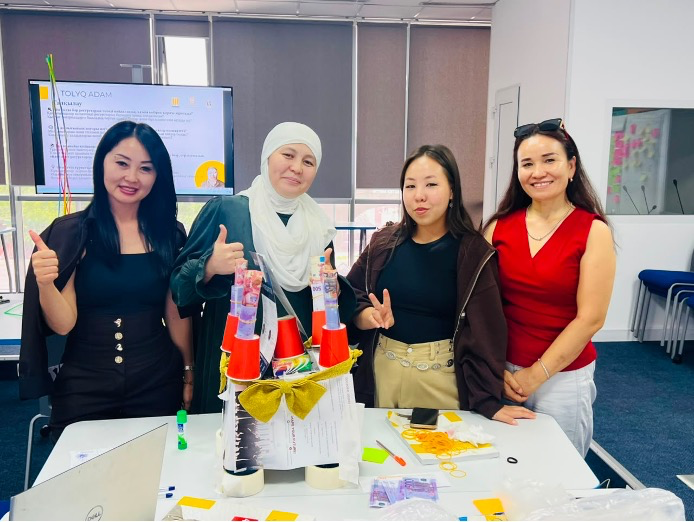
The sixth stream of the Tolyq Adam master training programme, held in Almaty, was delivered entirely in Kazakh — the first time the full programme has been conducted in the language since it began. The shift, programme organisers observed, was not cosmetic. Participants noted that concepts such as aqyl, qairat, and jurek landed differently when spoken in the language in which they were first formed — closer to their original register, harder to mistake for imported management jargon.
Among the thirty-one entrepreneurs in the Almaty stream were several holding qandas status — ethnic Kazakhs returned to Qazaqstan after generations abroad. Their presence, organisers noted, turned the room’s conversation about national values in modern entrepreneurship from a theme into a lived fact. Participants with no obvious reason to cross paths — a qandas returnee and an Almaty-born business owner, a psychologist and a brand strategist — left having built new professional connections, several of which were still active weeks later.
Psychologist Aliya Sharipova, one of the participants, described understanding for the first time how Abai’s concept of the whole person and the principles of ESG are closely tied. She left the training already planning to fold the programme’s themes — national values, personal development, social responsibility — into her own psychological practice, extending the programme’s reach into a professional space it had never intended to enter. NURCE now carries the Kazakh-language template forward into whichever region and language asks for it next.
The participation of entrepreneurs with Qandas status added another meaningful dimension to the training. Their stories and entrepreneurial experiences became part of a broader dialogue about reconnecting with historical and cultural roots, preserving national values, and building modern businesses while drawing on one’s identity and cultural heritage.
Personal reflection was also an important part of the program. Participants had an opportunity to step away from their usual work routines and look at their businesses from a different perspective: to identify the values underlying their work, consider what kind of leaders they want to become, and reflect on the impact their businesses have on people and society.
Key Results:
• First-ever full delivery of the program in the Kazakh language;
• Deeper engagement with Abai’s philosophical heritage through the native language and national cultural context;
• Participation of entrepreneurs with Qandas status, broadening the dialogue around national identity, values, and the role of entrepreneurship in social development;
• Increased attention to social responsibility, ethical leadership, and the social value of business;
• Development of strategic thinking, decision-making, and teamwork skills;
• Creation of a space for experience sharing among entrepreneurs with diverse personal and professional backgrounds;
• Formation of new professional connections within the entrepreneurial community;
• Confirmation of the relevance and demand for the program in Kazakh;
• Creation of a foundation for further development and scaling of the Kazakh-language version of the program across other regions of Kazakhstan.