
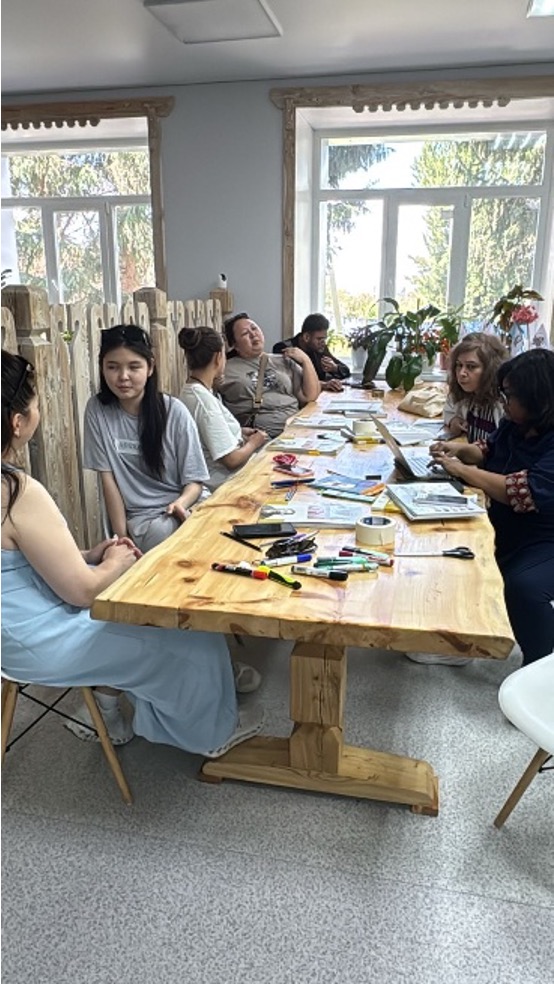
East Kazakhstan Region / Katon-Karagai Village - 15–18 June 2026
Venue:
House of Culture, 80 Abai Street, Katon-Karagai Village, East Kazakhstan Region
Participants:
10
Date:
18.07.2026
About the Event:
Katon-Karagai: Entrepreneurship, Tourism, and Responsible Development of the Region
The Katon-Karagai cohort was particularly distinctive due to its regional context and participant profile. The training brought together 10 entrepreneurs, many of whom develop businesses in tourism and hospitality.
For Katon-Karagai, sustainable entrepreneurship is especially important. The region has unique natural and cultural potential and is attracting an increasing number of travelers. For tourism entrepreneurs, it was particularly relevant to understand that business activity can be closely connected with caring for the territory where they live and work. Tourism here is not only about providing services and generating profit, but also about promoting the region, preserving its unique character, creating jobs, and generating new opportunities for local communities.
Abai’s philosophy helped participants rethink their own role in the development of the region. Ideas of responsibility, mindfulness, respect for people, and care for the environment acquired practical meaning in the context of local entrepreneurship.
It was particularly valuable that the training took place directly in Katon-Karagai. Participants were able to discuss the knowledge and tools they gained while immediately relating them to the real conditions of doing business in the region - the seasonality of tourism, infrastructure development, attracting visitors, preserving natural resources, and the need to build sustainable business models.
The Katon-Karagai cohort demonstrated how differently Abai’s ideas can be interpreted depending on the regional context. Here, the “Tolyk Adam” philosophy naturally connected with themes of responsibility for one’s homeland, care for nature, respect for cultural heritage, and the desire to build businesses that benefit not only entrepreneurs, but the region as a whole.
For participants, the training was an opportunity not only to gain new knowledge and tools for business development, but also to view their activities more broadly - as part of the shared future of Katon-Karagai and East Kazakhstan.
Key Results:
• High interest in sustainable and responsible entrepreneurship in the context of regional development;
• Particular relevance of the program for entrepreneurs working in tourism and hospitality;
• Greater understanding of the importance of preserving Katon-Karagai’s natural and cultural heritage as a foundation for the long-term development of tourism;
• Application of Abai’s philosophy and the “Tolyk Adam” concept to real challenges facing regional businesses;
• Development of strategic thinking and a stronger understanding of the importance of long-term approaches to business development.
Feedback of Participants:
Dina Taubakulova: “The training was very interesting, productive, and delivered in an easy and engaging format. It had an entirely positive impact on me. The most valuable things I gained were new knowledge, practical experience, and the understanding that a business can be built on Abai’s philosophy. This was a real discovery for me: entrepreneurship can be based not only on the pursuit of profit, but also on values, responsibility, and a long-term vision.
If a business is developed with Abai’s philosophy in mind, considering not only today but also the future, it has every chance of becoming sustainable and successful. The environmental part of the training made a particularly strong impression on me. For the first time, I thought about the ecological footprint each person leaves behind. We calculated our ecological footprint, explored how much plastic we use in everyday life, learned how to sort waste properly, and how to understand packaging labels.
After the training, I began applying this knowledge in practice. I now sort plastic, pay closer attention to the materials used in packaging, try to choose more environmentally friendly options, and use water more carefully. I have come to better understand that even small daily habits can help preserve natural resources for future generations.”
Gulnur Amankulova: “I really enjoyed the training. It made me look differently not only at business, but also at many situations in life. What stayed with me most was the idea that every choice should be made consciously, considering not only our own benefit but also what positive impact it can have on others. After the training, I became calmer when making decisions and started thinking more often about my actions.
Now I try to plan several steps ahead and avoid rushing to conclusions. Most importantly, the training helped me understand that development begins with the individual. When you change yourself, gradually everything around you begins to change as well.”
Photos of the Event: