
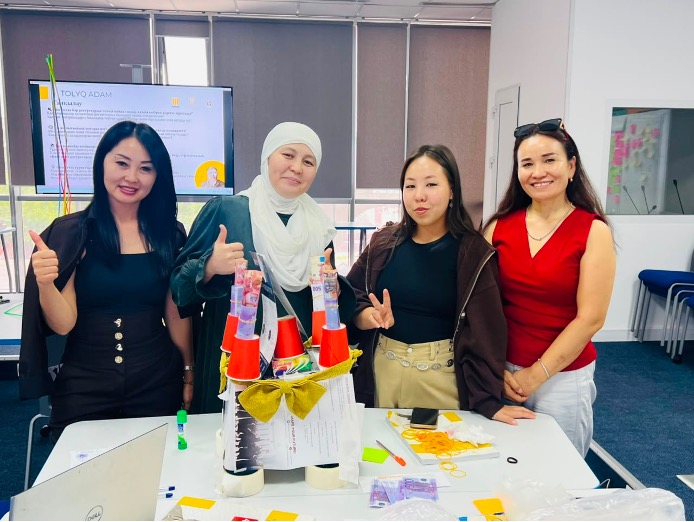
Almaty - 30 June–3 July 2026 (Second Almaty Cohort)
Venue:
NU Executive Office, FORUM Business Centre, 609 Seifullin Avenue, 3rd Floor, Almaty
Participants:
31
Date:
03.07.2026
About the Event:
Almaty: Values-Based Leadership, National Identity, and Entrepreneurship through the Lens of Abai’s Philosophy
The second Almaty cohort was special for several reasons. For the first time since the program was launched, the training was conducted entirely in Kazakh, allowing participants to engage more deeply with Abai’s philosophical heritage through their native language and a familiar cultural context.
The training brought together 31 entrepreneurs representing different business sectors, including entrepreneurs with Qandas status. The diversity of participants created a unique atmosphere of open dialogue, experience sharing, and reflection on how national values and philosophical heritage can find their place in modern entrepreneurship.
For participants, the cohort became an opportunity not simply to study Abai’s philosophy, but to rediscover it through their own entrepreneurial experiences. Conducting the training in Kazakh allowed participants to engage more deeply with Abai’s original concepts and meanings. Concepts such as ақыл (reason), қайрат (will), жүрек (heart), ар (honor/conscience), еңбек (work), and жауапкершілік (responsibility) were explored not only as philosophical categories, but also as practical guidelines for entrepreneurs.
The participation of entrepreneurs with Qandas status added another meaningful dimension to the training. Their stories and entrepreneurial experiences became part of a broader dialogue about reconnecting with historical and cultural roots, preserving national values, and building modern businesses while drawing on one’s identity and cultural heritage.
Personal reflection was also an important part of the program. Participants had an opportunity to step away from their usual work routines and look at their businesses from a different perspective: to identify the values underlying their work, consider what kind of leaders they want to become, and reflect on the impact their businesses have on people and society.
Key Results:
• First-ever full delivery of the program in the Kazakh language;
• Deeper engagement with Abai’s philosophical heritage through the native language and national cultural context;
• Participation of entrepreneurs with Qandas status, broadening the dialogue around national identity, values, and the role of entrepreneurship in social development;
• Increased attention to social responsibility, ethical leadership, and the social value of business;
• Development of strategic thinking, decision-making, and teamwork skills;
• Creation of a space for experience sharing among entrepreneurs with diverse personal and professional backgrounds;
• Formation of new professional connections within the entrepreneurial community;
• Confirmation of the relevance and demand for the program in Kazakh;
• Creation of a foundation for further development and scaling of the Kazakh-language version of the program across other regions of Kazakhstan.
Feedback of Participants:
Dinara Baitorieva: “Participating in the training ‘Entrepreneurship through the Lens of Abai’s Philosophy’ was a valuable experience and left a strong impression on me. The training helped me deeply understand that entrepreneurship is not only about making a profit, but first and foremost about bringing value to society while preserving humanity, honesty, hard work, and responsibility.
I was particularly interested in seeing how the values expressed in Abai’s Words of Edification remain relevant to business today. Previously, I mainly viewed entrepreneurship through management, marketing, or finance. Now I understand that at its foundation are a person’s character, principles, and values.
During the training, I had the opportunity to step back and look at my own business from the outside and think deeply about what kind of entrepreneur I want to be. I realized that the greatest achievement is not simply financial success, but earning people’s trust and contributing to society through honest work.
I sincerely thank all the organizers and trainers for providing such meaningful and values-driven education. This training inspired me to set new goals and gave me a strong impetus to develop my business more consciously and responsibly.”
Photos of the Event: